Artificial intelligence is rapidly transforming the landscape of scientific research, and cosmology is no exception. New research highlights the immense potential of a machine learning technique known as transfer learning to dramatically accelerate and reduce the cost of the search for new physics beyond the standard cosmological model. Published in the prestigious Journal of Cosmology and Astroparticle Physics (JCAP), the study reveals that this innovative approach can slash the computational burden of complex simulations by more than tenfold. However, the investigation also uncovered a surprising and critical caveat: AI, when extensively pretrained, can sometimes become overly reliant on its acquired knowledge, leading it to misinterpret genuinely novel phenomena as mere variations of what it already knows. This phenomenon, termed "negative transfer," poses a significant challenge that researchers must actively address as AI tools become more integrated into fundamental scientific exploration.
The Universe’s Standard Model and Its Enigmas
For decades, the standard cosmological model, often referred to as Lambda-CDM (ΛCDM), has served as the bedrock of modern cosmology. This model posits a universe composed of approximately 5% ordinary matter, 27% mysterious dark matter, and 68% enigmatic dark energy. It has been remarkably successful in explaining a vast array of cosmic observations, from the large-scale structure of galaxies and galaxy clusters to the accelerating expansion of the universe and the subtle temperature fluctuations in the cosmic microwave background (CMB) – the relic radiation from the Big Bang. ΛCDM provides a coherent framework for understanding the universe’s evolution from its infancy to its current state.
Despite its profound successes, ΛCDM is not without its limitations and unresolved mysteries. The fundamental nature of dark matter and dark energy remains unknown, representing two of the most significant puzzles in modern physics. Furthermore, recent high-precision astronomical observations have begun to reveal subtle tensions and discrepancies that hint at physics beyond ΛCDM. For instance, there are ongoing debates surrounding the Hubble tension, a significant disagreement between the expansion rate of the universe measured from the local cosmos and that inferred from the early universe’s CMB data. Other questions revolve around the precise mass of neutrinos, the potential for modified theories of gravity, and whether dark energy’s properties might evolve over cosmic time. Each of these avenues represents a potential crack in the ΛCDM edifice, prompting cosmologists to explore a multitude of "beyond the Standard Model" (BSM) theories.
The Computational Frontier of Cosmology
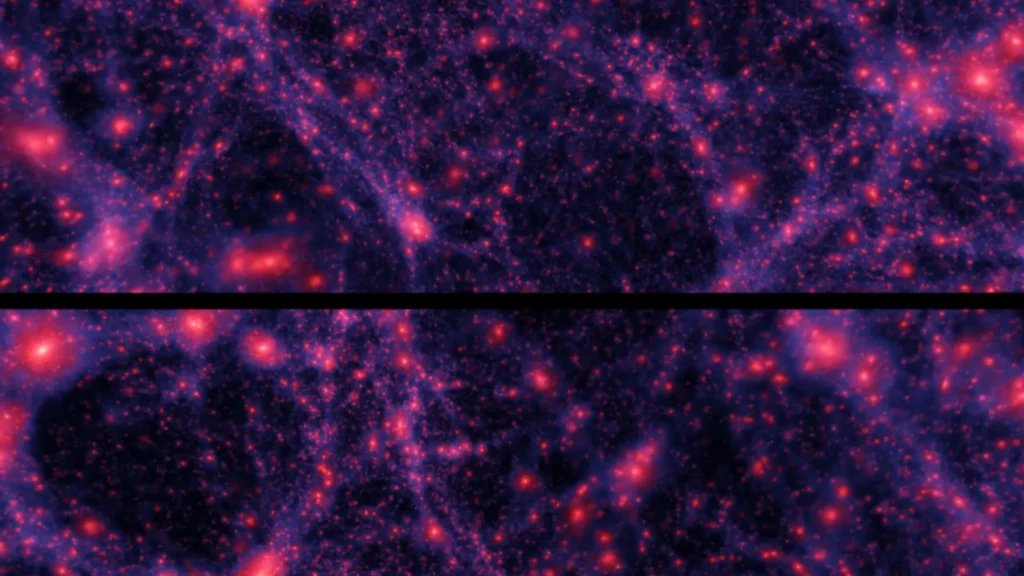
Investigating these BSM theories is an astronomically complex endeavor, both literally and figuratively. To test a new physical hypothesis, researchers must construct highly detailed computer simulations that model the evolution of the universe under different assumptions. These simulations are essentially virtual universes, meticulously crafted to represent how gravity, matter, and energy interact over billions of years, producing the cosmic structures we observe today. Each simulation requires defining specific parameters for the underlying physics – perhaps a different dark energy equation of state, a modified gravitational law, or a specific mass for neutrinos.
Generating these "N-body" or "hydrodynamic" simulations is a monumental computational undertaking. They involve tracking the gravitational interactions of billions of particles over vast cosmic timescales, often requiring petabytes of data storage and thousands of CPU-hours on some of the world’s most powerful supercomputers. The computational cost escalates dramatically with the complexity of the physical model being tested and the resolution required to capture subtle effects. Exploring the vast parameter space of potential new physics, therefore, becomes a bottleneck, limiting the speed and scope of theoretical investigations. This is where artificial intelligence, and specifically transfer learning, offers a transformative solution.
Transfer Learning: A Computational Shortcut
The research team, led by first author Veena Krishnaraj, an undergraduate student at Princeton University, and co-authored by Adrian Bayer, a cosmologist at the Flatiron Institute and Princeton University, investigated whether transfer learning could make this computationally intensive process significantly more efficient. Transfer learning is a sophisticated machine learning technique that allows an AI system to leverage knowledge gained from solving one task to improve its performance on a different but related task. In essence, it’s about not starting from scratch every time.
The core idea behind their approach was to exploit the relative simplicity and familiarity of the ΛCDM model. Instead of training a neural network from the ground up on the most complex and computationally costly BSM simulations, the team first "pretrained" the AI on a vast dataset of simpler, less expensive simulations based purely on ΛCDM. This initial phase allowed the AI to develop a foundational understanding of the universe’s behavior under the standard model, learning common patterns, correlations, and physical relationships.
"It’s basically a shortcut," explains Adrian Bayer. "Usually people train the AI directly on the most computationally expensive simulations. What we do instead is first use simpler and less expensive ΛCDM simulations to give the AI an idea of what’s happening, and only afterward move to the more complex models." Bayer draws an intuitive analogy to human learning: "You first read a basic book to get an idea of the knowledge, and then move to the really complicated book." This sequential learning strategy, according to Krishnaraj, prevents the AI from having to "digest everything at once," allowing it to build expertise incrementally.
Dramatic Efficiency Gains
The results of applying transfer learning were nothing short of striking. The study demonstrated that by pretraining the AI on ΛCDM simulations, the number of expensive BSM simulations required for subsequent training could be reduced by more than a factor of ten in some cases. This translates directly into substantial savings in computing time, energy consumption, and financial resources.
Such efficiency gains have profound implications for the future of cosmological research. Upcoming observational surveys, such as the Vera C. Rubin Observatory’s Legacy Survey of Space and Time (LSST), the European Space Agency’s Euclid mission, and NASA’s Nancy Grace Roman Space Telescope, are poised to collect unprecedented amounts of high-precision data. These observatories will generate petabytes of information, mapping billions of galaxies and probing the universe with exquisite detail. Analyzing such vast datasets and comparing them against theoretical predictions will require highly sophisticated and efficient computational tools. Transfer learning offers a pathway to rapidly process and interpret these complex observations, accelerating the pace at which cosmologists can test new theories and potentially uncover groundbreaking discoveries. Moreover, by reducing the computational barrier, it could democratize access to cutting-edge research, allowing more scientists to explore the frontiers of cosmology without needing constant access to the world’s largest supercomputing facilities for every iteration of their models.
The Peril of Prior Knowledge: Negative Transfer
While the efficiency benefits were clear, the study also unveiled a less obvious but equally crucial challenge: the phenomenon of "negative transfer." This occurs when prior knowledge, instead of being helpful, actually hinders the learning process for a new task. Continuing Bayer’s textbook analogy, imagine a medical student who has extensively studied common diseases. When confronted with a rare condition that shares superficial symptoms with a common ailment, their ingrained knowledge might inadvertently lead them to misdiagnose the rare disease as the more familiar one.
The same issue can arise in AI systems. The researchers observed that in certain scenarios, the subtle "signatures" of new physics in their simulations bore a striking resemblance to patterns that the pretrained AI had already strongly associated with specific parameters within the standard ΛCDM model. When this happens, the neural network, relying on its established understanding, struggles to correctly identify the truly novel effect, instead interpreting it through the lens of its existing knowledge base.
A prime example of this negative transfer was seen when the AI was tasked with analyzing simulations that included massive neutrinos. Neutrinos, often called "ghost particles," interact very weakly with matter but possess a tiny mass, which can subtly influence the large-scale structure of the universe. The observational signatures linked to neutrino mass – such as their impact on the clustering of matter – were found to closely resemble changes associated with an existing ΛCDM parameter known as σ8 (sigma-8). Sigma-8 is a crucial cosmological parameter that quantifies the amplitude of matter fluctuations in the universe, essentially measuring how strongly matter clusters together.
Because of this inherent physical degeneracy – where different physical processes produce very similar observable effects – the pretrained neural network initially had significant difficulty distinguishing between the influence of neutrino mass and variations in σ8. It tended to "explain away" the neutrino effects by adjusting its interpretation of σ8, leading to incorrect inferences about the underlying physics.
"The negative transfer is not random. It is driven by underlying physical degeneracies in the model," emphasizes Veena Krishnaraj. This insight is critical: the AI’s "mistake" is not arbitrary but rooted in the fundamental physics itself, where distinct parameters can yield similar observable outcomes. "So this is something we need to be aware of and try to mitigate," she concludes.
Navigating Physical Degeneracies
The discovery of negative transfer highlights a fundamental challenge not just for AI in cosmology, but for scientific discovery itself. Physical degeneracies are common in many scientific fields, where multiple theoretical models can equally well explain a given set of observations. Traditionally, human scientists use intuition, additional data, or complementary experiments to break these degeneracies. For AI, which learns purely from patterns in data, these degeneracies become potent sources of confusion and potential misdirection.
This raises important questions about the interplay between human scientific reasoning and machine intelligence. While AI can identify patterns and correlations far beyond human capacity, its current inability to "understand" physics in the same conceptual way as a human can lead to blind spots when confronted with subtle, degenerate signals. The risk is that an over-reliance on pretrained models might lead researchers to prematurely dismiss truly new physics as mere variations of known parameters, effectively limiting the scope of discovery to what the AI has already been taught to recognize.
Mitigating Bias and Ensuring Robustness
Recognizing the issue of negative transfer is the first step toward mitigating it. Researchers are already exploring several strategies to address this challenge. One approach could involve developing more sophisticated training protocols that specifically account for known physical degeneracies. This might include incorporating "adversarial training" techniques, where the AI is deliberately exposed to confusing or degenerate scenarios to force it to learn to distinguish them. Another strategy could involve hybrid approaches, where AI is used for initial data analysis and pattern recognition, but human experts remain central to interpreting ambiguous results and probing potential novel signals that the AI might initially misclassify.
Furthermore, techniques for uncertainty quantification are crucial. AI models should not only provide predictions but also transparently communicate their confidence levels and potential ambiguities, especially in regions of parameter space where physical degeneracies are known to exist. This would allow researchers to identify instances where negative transfer might be occurring and to dedicate additional computational resources or targeted observations to resolve the ambiguity.
From Simulations to Stargazing: Real-World Applications
So far, the transfer learning approach has been tested exclusively using synthetic data generated from computer simulations. The logical and necessary next step for the team is to apply these techniques to real astronomical observations. This transition from idealized simulations to the messy, imperfect data from telescopes presents its own set of challenges, including noise, observational biases, and instrumental effects. However, the potential rewards are immense.
As Adrian Bayer points out, the team believes transfer learning could become an "important tool for upcoming cosmological surveys." These surveys, designed to map the universe with unprecedented precision, will generate data that is too vast and complex for traditional analysis methods alone. AI will be indispensable for extracting meaningful scientific insights. If transfer learning can successfully accelerate the analysis of real data, it could significantly speed up our understanding of fundamental cosmic questions, from the nature of dark energy to the precise mass of neutrinos.
Foundation Models and the Future of Scientific Discovery
The findings of this study resonate with broader trends in artificial intelligence, particularly the development of "foundation models" and large language models (LLMs) like GPT-4. These models are characterized by their massive size, extensive pretraining on vast datasets, and their ability to be adapted ("fine-tuned") for a wide array of downstream tasks. The transfer learning approach employed in this cosmological study shares conceptual similarities with these powerful general-purpose AIs.
Just as LLMs can exhibit biases learned from their training data, or sometimes "hallucinate" information, AI models in science can inherit biases or misinterpret novel data based on their foundational training. This underscores a critical lesson: while AI offers unparalleled power to accelerate scientific discovery, it is not a magic bullet. Its application requires careful consideration of its limitations, a deep understanding of the underlying physics, and robust validation methods to ensure that we are truly discovering new truths about the universe, rather than merely confirming our preconceived notions. The paper, "Transfer Learning Beyond the Standard Model" by Veena Krishnaraj, Adrian E. Bayer, Christian Kragh Jespersen, and Peter Melchior, is a timely and insightful contribution to this ongoing scientific and technological dialogue, offering both a glimpse into a faster future for cosmology and a cautionary note about the intelligent tools that will help us navigate it.