The Massachusetts Institute of Technology has formally recognized Professor Anna-Christina Eilers for her dual contributions to the field of observational astrophysics and the advancement of graduate student well-being. As a recipient of the MIT Committed to Caring (C2C) honor, Eilers joins a select group of faculty members lauded for fostering a supportive, inclusive, and rigorous academic environment. The award, which is driven by graduate student nominations, highlights a mentorship style that balances high-level scientific inquiry with a profound commitment to the personal development of researchers.
Eilers, an Assistant Professor in the MIT Department of Physics and a member of the Kavli Institute for Astrophysics and Space Research, leads a research group dedicated to one of the most complex questions in modern cosmology: the origins of the first supermassive black holes and the evolution of the early universe. Her work focuses on the "cosmic dawn," the period when the first stars and galaxies formed and began to illuminate the dark, neutral hydrogen gas that filled the young cosmos.
The Science of the Cosmic Dawn
To understand the significance of Eilers’ mentorship, it is necessary to contextualize the high-stakes environment of her research. Eilers’ work involves analyzing data from the world’s most advanced observatories, including the James Webb Space Telescope (JWST) and the Magellan Telescopes in Chile. Her primary focus is on quasars—extremely bright objects powered by supermassive black holes at the centers of distant galaxies.
By observing these ancient light sources, Eilers and her team can look back more than 13 billion years into the past. One of the central mysteries her group addresses is the "black hole growth problem." Current cosmological models struggle to explain how black holes reached masses equivalent to billions of suns within a few hundred million years of the Big Bang. This research requires not only technical proficiency in data analysis and spectral modeling but also the resilience to navigate a field where new discoveries frequently challenge established theories.
In this high-pressure scientific landscape, Eilers has cultivated a laboratory culture that emphasizes collective problem-solving over individual competition. Her students report that while the scientific standards are exceptionally high, the emotional and professional scaffolding provided by Eilers ensures that the rigor does not lead to burnout.
Mentorship as a Constant Practice
The "Committed to Caring" initiative at MIT was established to recognize faculty who go beyond the standard requirements of academic advising. Since its inception, the program has sought to highlight the "hidden work" of academia—the emotional labor and interpersonal support that allow graduate students to thrive. For Eilers, this work is characterized by consistency rather than occasional grand gestures.
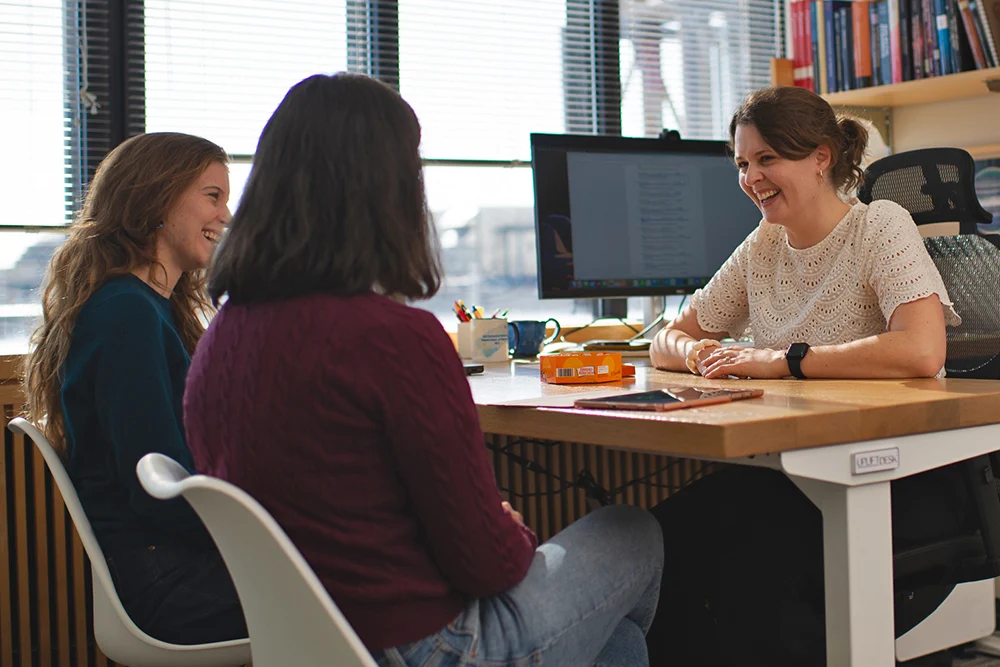
Students nominating Eilers emphasized her reliability. In an environment where faculty schedules are often dominated by grant writing, international conferences, and administrative duties, Eilers has maintained a reputation for being accessible. Her mentees noted that she provides timely, detailed feedback on research drafts and maintains a regular schedule of one-on-one and group meetings.
This level of attentiveness is particularly critical in the transition from student to independent researcher. The graduate school journey is often marked by the "imposter syndrome" and the "sophomore slump," periods where the initial excitement of research is replaced by the daunting reality of complex data and failed experiments. Eilers’ approach involves "keeping an eye out" for these transitions, ensuring that students do not navigate these psychological hurdles in isolation.
Institutional Advocacy and Conflict Resolution
A key component of Eilers’ mentorship that stood out in her C2C nomination was her role as an advocate. In the collaborative world of astrophysics, researchers often work in large international consortia involving dozens of institutions. These environments can sometimes lead to friction regarding authorship, data access, or research direction.
Graduate students are often the most vulnerable members of these collaborations. Eilers has been recognized for her willingness to intervene when professional obstacles arise. By identifying potential issues early—such as a stalled collaboration or a misunderstanding regarding research credit—she prevents minor friction from escalating into career-stalling crises. This proactive advocacy allows her students to focus on their science, knowing they have a mentor who will protect their professional interests.
Cultivating Community Through Tradition
The Eilers research group has developed several traditions designed to humanize the academic experience and foster a sense of belonging. These rituals serve to bridge the gap between individual research projects and the group’s collective identity.
One notable tradition involves the "travel treat." Whenever a member of the lab returns from a conference or a visit to an observatory, they bring back a local specialty—such as chocolates, cookies, or regional snacks—to share during the next group meeting. While seemingly minor, this practice facilitates informal knowledge exchange. As the group shares the treat, the traveler recounts the highlights of the conference, the researchers they met, and the new ideas they encountered. This transforms an individual professional development opportunity into a shared learning experience for the entire lab.
Additionally, Eilers celebrates milestones with personal touches. The publication of a peer-reviewed paper—the "currency" of the academic world—is marked by Eilers bringing the author’s favorite dessert to the group meeting. These celebrations serve to validate the hard work required to reach such milestones and reinforce a culture where colleagues are invested in one another’s success.
The Importance of the "Whole Person" Philosophy
Perhaps the most distinctive aspect of Eilers’ mentorship is her emphasis on work-life balance and identity. She explicitly advises incoming graduate students to find hobbies outside of physics, particularly activities that involve people outside of the academic sphere.
"Graduate school can be all-consuming," Eilers noted. "It’s easy to let your research become your entire identity."
This philosophy is backed by a growing body of data regarding graduate student mental health. A 2018 study published in Nature Biotechnology found that graduate students are more than six times as likely to experience depression and anxiety compared to the general population. Factors contributing to this include the "all-consuming" nature of research and the lack of a support system outside the lab.
By encouraging her students to maintain a life outside the laboratory, Eilers is not just promoting well-being; she is promoting sustainable scientific careers. Her view is that a researcher who has diverse interests and a robust social support system is better equipped to handle the setbacks and frustrations inherent in high-level scientific inquiry.
Historical Context and Influences
Eilers’ approach to mentorship is rooted in her own experiences as a trainee. She credits her own advisors for modeling a path that combines scientific excellence with personal integrity. This "generational" aspect of mentorship is a critical component of academic culture; the way current faculty treat their students often dictates how those students will eventually treat their own mentees.
Her career trajectory also informs her perspective. Having navigated the transition from a PhD student at the Max Planck Institute for Astronomy to a postdoctoral fellow and then an assistant professor at MIT, she is acutely aware of the shifting pressures at each stage of a researcher’s career. This empathy allows her to tailor her support to the specific needs of each student, whether they are just starting their first project or are preparing for the job market.
Broader Implications for the STEM Community
The recognition of Professor Eilers comes at a time when the broader STEM (Science, Technology, Engineering, and Mathematics) community is re-evaluating the traditional "sink-or-swim" model of graduate education. There is an increasing realization that the most productive research environments are those that prioritize the health and security of their members.
Eilers’ success demonstrates that care and academic excellence are not mutually exclusive; rather, they are symbiotic. A student who feels supported and seen is more likely to take the intellectual risks necessary for groundbreaking discoveries. By providing a "safety net" of professional and emotional support, Eilers allows her students to push the boundaries of what is known about the early universe.
The Committed to Caring honor serves as a signal to the rest of the institute and the wider academic world that mentorship is a core competency of a successful professor. As MIT continues to attract the world’s brightest minds, the presence of mentors like Eilers ensures that these students are not only trained as world-class physicists but also developed as resilient, collaborative, and well-rounded professionals.
In the final analysis, the impact of Anna-Christina Eilers’ work extends far beyond the spectral analysis of distant quasars. While her research helps map the "cosmic dawn" of the universe, her mentorship helps light the path for the next generation of scientists, ensuring that the future of astrophysics is as inclusive as it is ambitious. Through her commitment to the "everyday moments," Eilers is helping to redefine what it means to be a leader in the modern university.