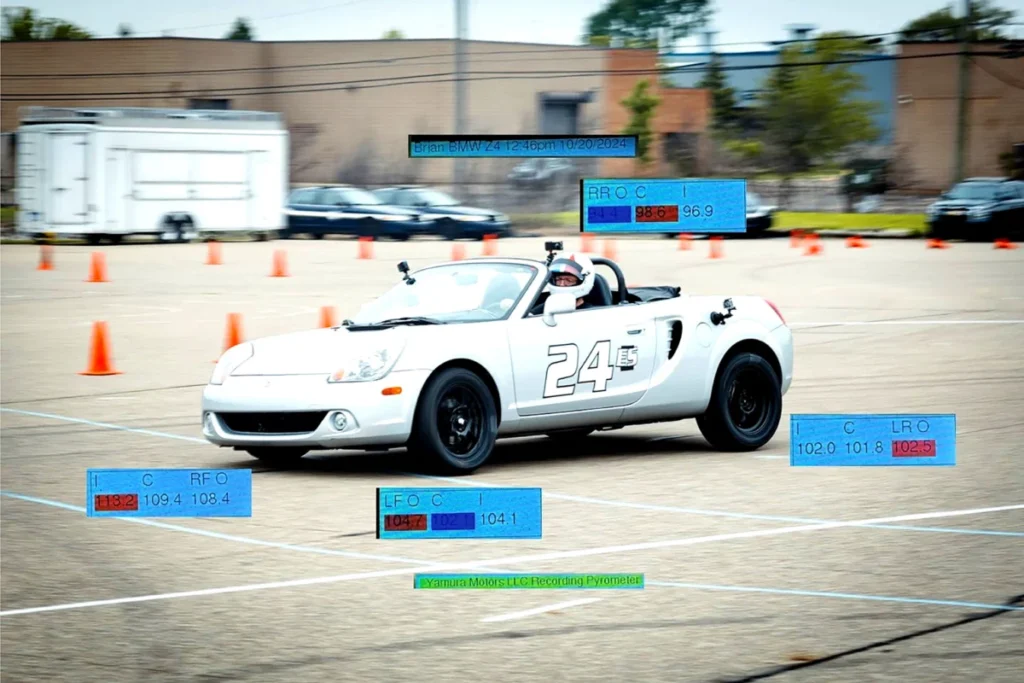
In the high-pressure environment of competitive autocross, where victories are often decided by thousandths of a second, the window of time between a driver’s runs represents a critical period for mechanical optimization and strategic adjustment. Unlike traditional circuit racing, which allows for multiple laps to bring components up to temperature, autocross demands peak performance from a standing start on a course the driver has likely only traversed on foot. Consequently, the ability to interpret tire data and implement immediate suspension or thermal adjustments is what separates the podium finishers from the rest of the field. As drivers return to the paddock after a run through the cones, they face a 10- to 15-minute interval—a period that must be utilized with surgical precision to ensure the vehicle’s contact patch is optimized for the next heat.
The Thermodynamics of the Contact Patch
The primary interface between a vehicle and the pavement is the tire’s contact patch, and its effectiveness is almost entirely dictated by its thermal state and internal pressure. During a standard 40- to 60-second autocross run, tires are subjected to intense lateral loads that generate significant internal friction and surface heat. The first priority for any driver upon exiting the course is the measurement of tire temperatures across three points: the inner edge, the center, and the outer edge.
If the center of the tire displays the highest temperature reading, the tire is likely overinflated, causing the tread to "balloon" and reducing the effective surface area in contact with the track. Conversely, a cooler center relative to the edges suggests underinflation, where the tire’s sidewalls are bearing the brunt of the load while the center of the tread bows inward. Industry data suggests that even a variance of 2 to 3 pounds per square inch (psi) can shift the temperature gradient by several degrees, significantly altering the coefficient of friction. Professionals recommend adjusting in small, documented increments—typically 0.5 to 1.0 psi—to find the "sweet spot" for a specific tire compound and ambient temperature.
Thermal Management and the "Greasy" Threshold
A recurring challenge in autocross is the accumulation of heat over successive runs. While a certain amount of heat is necessary to reach the tire’s "operating window"—the temperature range where the rubber compound becomes sufficiently pliable to key into the pavement’s micro-texture—excessive heat leads to a phenomenon known as "greasiness." When a tire exceeds its optimal thermal ceiling, the chemical bonds in the rubber begin to soften excessively, leading to a precipitous drop in lateral grip.
In top-tier competitions, such as those sanctioned by the Sports Car Club of America (SCCA), the use of tire blankets is permitted to retain heat on cold days, but active tire warmers (electric heating elements common in Formula 1) are strictly prohibited. This places the onus on the driver to manage heat manually. If the tires have exceeded their peak grip temperature by the third or fourth run, cooling measures must be employed. The most common technique is the application of water via a pressurized sprayer. By spraying the tread and sidewalls, drivers utilize evaporative cooling to draw heat out of the tire.
Strategic cooling is rarely uniform. A course with a majority of right-hand turns will place a disproportionate thermal load on the left-front tire. In such cases, a driver might only spray the outside tires or the specific tire showing the highest pyrometer reading. The goal is to return the rubber to its peak performance window just as the car reaches the starting line for the final, and usually fastest, run of the day.
Suspension Geometry and Alignment Corrections
While tire pressure addresses the shape of the contact patch, suspension adjustments dictate how that patch interacts with the road under load. Camber, the angle of the wheel relative to the vertical axis when viewed from the front, is the most frequently adjusted variable in the paddock. High temperatures on the inside edge of the tire are a definitive indicator of excessive negative camber, whereas high outside edge temperatures suggest the tire is "rolling over" onto its sidewall due to insufficient negative camber.
On vehicles equipped with four-wheel independent suspension, these adjustments can be made at each corner to balance the car’s handling. For those with solid rear axles, adjustments are limited to the front. However, camber is only one part of the equation. Toe—the direction the tires point relative to the vehicle’s centerline—also plays a vital role. Toe-out (where the fronts of the tires point away from each other) can improve turn-in response but increases tire scrub and heat.
Furthermore, adjustable shock absorbers and sway bars allow for real-time tuning of the car’s balance. If a car is experiencing "understeer" (pushing wide in corners), softening the front damping or softening the front sway bar can help the front tires find more bite. Conversely, "oversteer" (the rear sliding out) can be mitigated by softening the rear suspension. These adjustments are a response to the "feel" reported by the driver, cross-referenced with the hard data provided by the tire pyrometer.
Chronology of an Event and Surface Evolution
The lifecycle of an autocross event follows a predictable trajectory of track evolution. At the start of the day, the "green" track is often covered in a thin layer of dust, pollen, or residual oils, resulting in low initial grip levels. As the morning progresses, the passage of dozens of cars performs two functions: it "sweeps" the racing line clean of debris and begins to "rubber in" the surface. This process involves the deposition of microscopic layers of tire rubber into the pores of the asphalt or concrete, creating a rubber-on-rubber interface that offers significantly higher traction.
Analysis of historical event data shows that the fastest times are almost universally set in the final runs of the day, provided the ambient temperature does not become excessive. However, this evolution requires drivers to be proactive. A car that was perfectly balanced at 9:00 AM on a dusty track may become hopelessly unbalanced by 2:00 PM as the grip levels rise and the track surface temperature climbs.
Pavement type also dictates strategy. New concrete, often found at airfield sites, provides immense grip but is highly abrasive, leading to rapid heat buildup. Old, polished asphalt is much "slicker" and may require lower tire pressures to encourage the tire to deform and find grip. Successful competitors maintain detailed logbooks that track these variables—ambient temp, track temp, pressure, and suspension settings—over years of competition.
Expert Perspectives and Technical Implications
Veteran autocrossers and technical directors emphasize that data-driven decision-making is the only way to achieve consistency. "The biggest mistake a novice makes is chasing a feeling without checking the numbers," says one seasoned SCCA National Champion. "You might feel like the car needs more pressure because it feels ‘mushy,’ but if the pyrometer says the center is already hot, adding air will only make you slower."
From a technical analysis standpoint, the implications of these adjustments extend beyond just the immediate run. Proper thermal management prevents "blistering" and "cold tearing," both of which can permanently damage a set of expensive competition tires. In an era where a set of high-performance tires can cost upwards of $1,200, the ability to keep them within their optimal operating window is as much a financial necessity as it is a competitive one.
The broader impact of these paddock strategies is seen in the development of aftermarket performance parts and tire technology. Manufacturers like Bridgestone, Michelin, and Yokohama frequently use feedback from the autocross community to refine their "Extreme Performance Summer" tire categories. The requirements of the autocrosser—instant heat-up, high heat tolerance, and stiff sidewalls—drive innovations that eventually trickle down to standard consumer performance tires.
Conclusion: The Synthesis of Data and Intuition
The 10-to-15-minute interval between autocross runs is far from a rest period; it is a high-speed diagnostic session. By synthesizing tire temperature data, atmospheric conditions, and vehicle dynamics, a driver can transform a car’s behavior. The process of adjusting psi, managing thermal loads with water or blankets, and fine-tuning suspension geometry creates a feedback loop that leads to peak performance.
Ultimately, the mastery of these variables allows a driver to approach the final run with a vehicle that is perfectly synchronized with the evolved state of the track. In a sport where the margin of error is non-existent and the environment is constantly shifting, the winner is usually the one who best manages the invisible forces of thermodynamics and geometry in the quiet moments between the cones. As the day concludes and the final times are posted, it becomes clear that the work done in the paddock is just as influential as the work done behind the wheel.