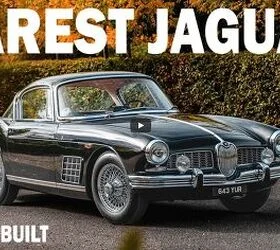
The automotive world often celebrates the pinnacle of design and engineering, and rarely does a vehicle encapsulate this pursuit quite like the Jaguar XK150S Bertone. This exceptionally rare, coachbuilt masterpiece stands as a testament to a golden era of automotive customization, where discerning clientele could commission Italian design houses to reimagine the chassis and mechanicals of British sports cars into breathtaking works of art. The footage, part of the TTAC Creators Series, offers a rare opportunity to examine this iconic vehicle up close, exploring its unique design and historical significance. It serves as a compelling example of cross-cultural collaboration in automotive design, blending the robust engineering of Jaguar with the avant-garde styling of Bertone, a partnership that resulted in a machine far removed from its production brethren.
The Genesis of a Unique Vision: Addressing Styling Desires
By the late 1950s, Jaguar’s XK150 had already established itself as a formidable sports car, a successor to the legendary XK120 and XK140. Introduced in 1957, the XK150 represented a significant technical evolution. Its chassis was more advanced, offering improved handling and stability. Interior space was expanded, providing greater comfort for occupants, and visibility was enhanced, contributing to a safer driving experience. Furthermore, the adoption of disc brakes on all four wheels was a cutting-edge feature for the era, underscoring Jaguar’s commitment to performance and safety. The car’s engines, particularly the 3.4-liter DOHC inline-six, delivered potent performance, with the high-performance XK150S variant, boasting triple SU carburetors, producing approximately 250 horsepower. This power output, coupled with a top speed exceeding 130 mph, positioned the XK150S firmly in the realm of serious sports cars, capable of challenging many of its European rivals.
However, despite these technical advancements and potent performance, a segment of Jaguar’s affluent clientele felt that the XK150’s styling had become somewhat staid and less elegant compared to the svelte lines of the XK120 and XK140. The design, while functional and modern for its time, lacked the dramatic flair that some of these wealthy patrons desired. This perceived conservatism in styling, juxtaposed with the car’s inherent mechanical prowess, created an opening for bespoke customization. It was this desire for a more distinctive and expressive aesthetic that led three discerning customers to approach the renowned Italian coachbuilder, Carrozzeria Bertone, with a bold proposition: to reimagine the Jaguar XK150.
Bertone’s Radical Transformation: A Futuristic Italian Statement
The commission to transform the Jaguar XK150 was entrusted to Bertone, a design house with a formidable reputation for innovation and a penchant for dramatic, forward-thinking automotive design. Under the guidance of visionary designer Franco Scaglione, Bertone embarked on a project that was far more ambitious than a mere styling tweak. Scaglione, who had previously penned the influential Alfa Romeo BAT (Berlinetta Aerodinamica Tecnica) concept cars, drew inspiration from this experimental work, infusing the Jaguar project with a similar sense of futuristic dynamism.
The result was a body that was almost entirely divorced from the standard XK150. While the underlying chassis and mechanical components remained quintessentially Jaguar, the exterior shell was a radical departure. Scaglione eschewed subtle refinements, opting instead for a dramatic reimagining that looked less like a British sports car and more like an Italian GT concept destined for a motor show. The design incorporated a compact, oval grille that was subtly integrated into the front fascia. The headlights were recessed, contributing to a sleeker profile. Wide, horizontal intakes were positioned at the front, hinting at the car’s performance capabilities, while prominent vents behind the front wheels added a touch of aerodynamic aggression.
The sweeping bodywork flowed seamlessly from front to rear, punctuated by subtle rear fins that evoked the era’s fascination with aeronautical design. Perhaps the most striking and defining feature of the Bertone XK150S was its enormous panoramic rear window. This expansive glass element not only contributed to the car’s futuristic appearance but also offered unparalleled rearward visibility, a practical consideration that complemented the dramatic styling. The overall effect was a car that looked utterly unique, a startlingly modern interpretation of a classic British sports car, embodying the cutting edge of automotive design in 1957. It was a bold statement that pushed the boundaries of what a sports car could look like, a testament to the creative freedom afforded by the coachbuilding industry of the period.
The Heart of the Beast: The Potent XK150S Mechanical Package
While the Bertone bodywork transformed the visual identity of the Jaguar XK150S, its mechanical heart remained a potent force, drawing from Jaguar’s most performance-oriented offering. The three commissioned cars were based on the XK150S variant, which represented the zenith of the XK150’s engineering. At its core was Jaguar’s renowned 3.4-liter DOHC (Double Overhead Camshaft) inline-six engine. This powerplant, a marvel of British engineering, was fed by a trio of SU carburetors, meticulously tuned to extract maximum performance. In this configuration, the engine was capable of producing approximately 250 horsepower.
For the automotive landscape of the late 1950s, 250 horsepower was a significant figure, placing the XK150S firmly in the upper echelons of performance cars. This robust power output translated into exhilarating acceleration and a top speed that comfortably exceeded 130 mph. Such figures were more than competitive; they were indicative of a true thoroughbred sports car, capable of thrilling even the most demanding drivers.
Beyond its raw power, the XK150S benefited from Jaguar’s pioneering use of four-wheel disc brakes. Introduced on the XK140 and refined on the XK150, this braking system was a revolutionary feature at the time, offering vastly superior stopping power and modulation compared to the drum brakes prevalent on many contemporary vehicles. This technological advantage, combined with the car’s potent engine and sophisticated chassis, made the Bertone-bodied XK150S a formidable machine, not just in appearance but in its ability to perform. It represented a compelling fusion of advanced mechanicals and audacious design, a rare confluence of attributes that contributed to its enduring mystique.
A Trio of Titans, One Enduring Legacy
The exclusivity of the Jaguar XK150S Bertone is underscored by its incredibly limited production run. Only three examples of this extraordinary coachbuilt automobile were ever constructed. This extreme rarity immediately elevates the car to the status of a collector’s dream. Over the years, the story of these three cars has become intertwined with a degree of mystery, particularly concerning the fate of two of the original trio.
The surviving example has, at various points in its history, been repainted. For a considerable period, it was finished in a striking red hue, a color that led many enthusiasts to believe it was its original factory finish. However, subsequent restoration efforts revealed its true factory-specified color: black. The narrator of the footage suggests that the deep, lustrous black finish better accentuates the subtle nuances of Scaglione’s design, allowing the car’s elegant lines and sculpted surfaces to command full attention. This return to its original livery not only corrected historical inaccuracies but also presented the car in a manner that arguably honors the designer’s original intent.
The whereabouts of the other two Bertone-bodied XK150S models remain largely unknown. They have effectively vanished from public view, adding an aura of intrigue to an already obscure and highly desirable automotive artifact. This disappearance from the public eye contributes to the car’s enigmatic allure, making the surviving example even more precious as the sole tangible link to this remarkable design experiment. The uncertainty surrounding the other two vehicles fuels speculation among automotive historians and collectors, further cementing the XK150S Bertone’s place in the annals of automotive legend.
The "What If" of Automotive History: Broader Implications
The significance of the Bertone-bodied Jaguar XK150S extends far beyond its mere rarity or its captivating aesthetics. The narrator posits that this unique creation offers a tantalizing glimpse into an alternative trajectory that Jaguar’s design language could have taken. At the time of the Bertone XK150S’s creation, Jaguar was on the cusp of developing its own iconic sports car, the E-Type. The E-Type, while a masterpiece in its own right, followed a more evolutionary design path, building upon the established Jaguar aesthetic. The Bertone XK150S, however, represents a radical departure, an exploration of a design philosophy heavily influenced by Italian exuberance and futurism. The fact that Jaguar ultimately did not pursue this particular Italian-influenced design direction for its subsequent production models makes the Bertone XK150S a fascinating "what if" in automotive history.
Furthermore, this car is a powerful emblem of a bygone era in the automotive industry. It highlights a period when wealthy and influential customers possessed the means and the desire to commission entirely bespoke vehicles from independent design houses. This was an era characterized by fewer regulatory constraints and a more open corporate landscape, allowing for a level of creative freedom that is rarely seen today. The ability for these patrons to commission such radical transformations meant that design houses like Bertone could push the boundaries of automotive styling, creating cars that were dramatically different from their mass-produced counterparts. This freedom fostered innovation and resulted in unique automotive sculptures that stand as testaments to the creative spirit of the mid-20th century.
The Bertone-bodied Jaguar XK150S, therefore, serves as more than just a rare and beautiful automobile. It is a historical artifact that encapsulates a specific moment in time, a confluence of British engineering prowess, Italian design innovation, and the desires of discerning collectors. Its combination of Jaguar’s legendary performance, Bertone’s audacious styling, and its ultra-limited production run makes it an unparalleled snapshot of the creative explosion that defined 1950s coachbuilding. It is a reminder of the boundless possibilities that existed when performance met style, and when imagination was allowed to run wild in the pursuit of automotive perfection. The footage that brings this remarkable vehicle to light allows a new generation of enthusiasts to appreciate its unique place in the rich tapestry of automotive history.