In the intricate landscape of modern industrial automation, the pursuit of high-precision motion control has transcended the mere selection of individual components. As outlined by Corey Foster, Director of Automation Sales & Application Engineering at Valin Corporation, achieving true precision necessitates a profound focus on holistic system integration. This article, the fourth and final installment in a comprehensive series, delves into the critical elements of bringing together diverse technologies – from mechanics to motors, drives, and controls – to unlock unparalleled performance in demanding applications.
The Imperative of Precision: Beyond Component Specifications
For decades, the standard approach to designing motion control systems often relied on a straightforward evaluation of component specifications. Actuators were chosen based on published figures for repeatability, accuracy, and load capability. While sufficient for many general applications, this component-centric view increasingly falls short as industries push the boundaries of performance. Modern applications in semiconductor manufacturing, biomedical engineering, aerospace, advanced robotics, and micro-machining demand micron-level, and often sub-micron-level, accuracy and repeatability. In these environments, system performance is not merely an aggregation of individual specifications but a complex interplay where subtle interactions dictate overall success or failure.
Previous articles in this series have systematically explored the foundational layers contributing to system performance. Part one illuminated the mechanics, highlighting often-overlooked factors such as bearing deflection, body stiffness, and structural smoothness that profoundly impact precision. The second installment scrutinized motors, examining their designs, construction, and inherent quality. Part three delved into the sophisticated designs and features of drives and controls, emphasizing their role in translating commands into precise motion. This final segment converges on the overarching discipline that binds these layers together: system integration. The consistent theme throughout this journey is that critical details, often absent from standard data sheets, possess the power to either realize or undermine the high-performance expectations of an entire system. As motion systems venture beyond traditional accuracy benchmarks, nuanced engineering decisions become paramount, underscoring the vital role of every choice made by engineers, designers, and system integrators.
The System Integration Paradigm: Bridging Theory and Reality
The concept of system integration extends far beyond simply connecting components; it is the deliberate engineering of a cohesive, optimized ecosystem where each element functions synergistically to achieve a predefined performance envelope. Foster likens this iterative process to refining a paper airplane: an initial design might fly, but to achieve greater distance and accuracy, the folds must become progressively more precise, crisper, and cleaner. Similarly, in motion control, an initial assembly might demonstrate functionality, but sustained high performance, especially under evolving requirements, demands meticulous integration. Optimal performance is not an inherent quality of any single sub-system but an emergent property of the meticulously engineered whole.
The consequences of neglecting this holistic approach can be substantial. A 2022 report by the National Institute of Standards and Technology (NIST) estimated that inadequate interoperability and integration issues cost the manufacturing industry billions annually in rework, delays, and lost productivity. While not exclusively focused on motion control, this data underscores the broader economic impact of fragmented system design. For high-precision applications, the stakes are even higher, where a micron of error can render an entire batch of semiconductors unusable or compromise the safety of a medical device.
Unveiling Hidden Assumptions: Common Pitfalls in Motion Control Deployment
Every component in a motion control system operates under a set of implicit assumptions about its operating environment and the surrounding infrastructure. When these assumptions are not met, even the most advanced hardware will fail to deliver its stated specifications. System integration is, therefore, the art of identifying and satisfying these hidden prerequisites.
-
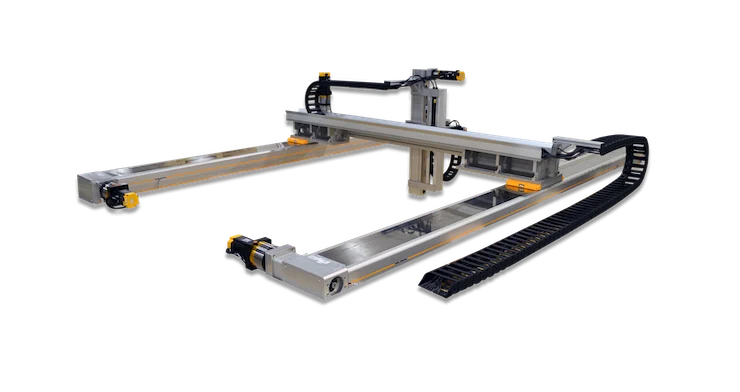
Mechanical Misalignment: A prime example involves the interaction between precision linear motors and their linear bearings. A linear motor typically relies on an external linear guide system to support the load and define its path. When these three components—the motor, and two parallel linear guides—are not aligned with extreme precision, mechanical binding can occur. Misalignment, even in the order of tens of micrometers, can introduce uneven friction, accelerate wear on bearings, increase motor current draw, and, in severe cases, completely impede motion. In gantry systems, where two parallel actuators drive a common load, the challenge is compounded. Variations in belt tension between two long linear belt and pulley actuators, for instance, can lead to discrepancies in distance per revolution. Over a two-meter travel length, a seemingly minor 5 mm variance between the two actuators at the end of travel can translate into significant rotational stress on the gantry structure and compromise the precision of the payload’s movement, necessitating sophisticated synchronization algorithms and precise mechanical tuning.
-
Environmental Challenges:
- Thermal Expansion: The operating environment’s temperature plays a critical role. Components are typically specified at a standard temperature (e.g., 20°C). However, in hot industrial environments, thermal expansion of materials can directly impact mechanical alignments. For example, steel expands by approximately 11-13 micrometers per meter per degree Celsius. In a large gantry system spanning several meters, a 10°C temperature fluctuation can induce several hundreds of micrometers of expansion or contraction, completely negating the intended precision. This can lead to increased stress, misalignment, and reduced performance.
- Vibration: External vibrations from factory machinery, HVAC systems, or even internal vibrations generated by the motion system itself (e.g., motor ripple) can severely degrade precision. Even seemingly isolated systems can transmit vibrations through shared foundations or air. These disturbances can cause position errors, impact encoder readings, and lead to premature wear.
- Contamination: Dust, moisture, and other airborne particulates, especially in non-cleanroom environments, can compromise sensitive components like optical encoders and linear bearings, leading to signal degradation or increased friction.
-
Electrical Interference and Power Quality: Control systems, drives, and sensors are highly susceptible to "dirty" power and electromagnetic interference (EMI). While a system may perform flawlessly in a controlled lab environment with clean power, deployment in an industrial setting often exposes it to voltage fluctuations, transients, and electromagnetic noise generated by heavy machinery, welding equipment, or variable frequency drives. These disturbances can corrupt sensor signals, induce errors in control algorithms, and lead to erratic behavior or complete system failure. Inadequate grounding, poor shielding, and improper cable routing (e.g., running high-power and low-power signal cables in parallel over long distances, or coiling excess high-power cables) exacerbate these issues, creating antennas for noise and compromising data integrity.
Engineering for Excellence: Best Practices in System Integration
To mitigate these challenges and achieve true precision, a disciplined approach to system integration is indispensable.
-
Precision Mounting and Verification: The foundation of any high-precision system is its mounting surface. Actuators require mounting surfaces that meet stringent flatness, parallelism, and stiffness standards, often specified in terms of micrometers or even nanometers. Utilizing dowel pins ensures repeatable assembly and disassembly, maintaining critical alignments. Laser interferometers, autocollimators, and precision granite squares are essential tools for verifying mounting surface quality and component alignment during installation.
-
Optimized Encoder Integration: Encoders, whether linear, rotary, or ring-type, are the eyes of the motion control system. Their proper alignment is paramount for accurate feedback. For optical encoders, even microscopic misalignment can lead to signal degradation or periodic errors. Specialized fixtures, calibration routines, and meticulous measurement tools are required to ensure optimal alignment and signal quality. The choice of encoder coupling (for rotary encoders) also significantly impacts performance, needing to accommodate minor misalignments without introducing its own errors.
-
Rigorous Thermal Management: Controlling temperature is critical. This involves more than just selecting materials with low thermal expansion coefficients. Active cooling systems (e.g., recirculating chillers, air conditioning units) maintain stable ambient temperatures. Passive strategies include designing for efficient heat dissipation, using thermally stable materials like Invar or granite, and insulating sensitive components. For ultra-high precision systems, active temperature compensation algorithms can be implemented in the controller, adjusting for minute positional changes caused by thermal drift.

-
Effective Vibration Isolation: Isolating the precision system from external and internal vibrations is crucial. This can range from passive elastomeric or pneumatic vibration isolators to active vibration cancellation systems. In the most demanding applications, entire motion systems are housed on separate concrete foundations, isolated from the rest of the facility to prevent ground-borne vibrations from interfering with operations.
-
Robust Electrical and Data Integrity: Adhering to strict electrical engineering principles is vital. This includes implementing robust grounding schemes, utilizing shielded cables for sensitive signals, employing EMI filters at power inputs, and physically separating high-power and low-power signal cables. Cable routing should avoid parallel runs over long distances and minimize coiling to prevent inductive coupling and signal degradation. Compliance with electromagnetic compatibility (EMC) standards (e.g., IEC 61000 series) is a non-negotiable requirement for reliable field operation.
-
Advanced Software and Control Strategies: The integration extends into the software domain. Sophisticated control algorithms, such as feedforward control, adaptive control, and model predictive control, can compensate for known system non-linearities and disturbances. Sensor fusion techniques combine data from multiple sensors (e.g., encoders, accelerometers, temperature sensors) to provide a more accurate and robust understanding of the system’s state. Diagnostic tools and predictive maintenance algorithms, often leveraging AI and machine learning, monitor system health, detect anomalies, and predict potential failures, ensuring continuous high performance.
A Systems Engineer’s Mindset: Critical Questions for Design and Deployment
Ultimately, the success of a high-precision motion control system hinges on adopting a systems engineer’s mindset, rather than merely selecting individual products. Corey Foster emphasizes that "it is the questions unasked that will come back to haunt the system." This requires a proactive, investigative approach throughout the design, build, and deployment phases. Engineers must consistently challenge assumptions and probe beyond surface-level specifications.
Here are some vital questions to consider during the integration process:
-
Mechanical Integrity:
- What are the precise flatness, stiffness, and parallelism requirements for all mounting surfaces, and how will these be verified during installation and over time?
- How will static and dynamic deflections of the mechanical structure under load be characterized and mitigated?
- What are the thermal expansion coefficients of all interacting mechanical components, and what is the comprehensive plan for managing temperature fluctuations and their resultant dimensional changes?
- How will the alignment of linear guides, motors, and other motion components be precisely achieved and maintained throughout the system’s operational lifespan?
- What is the wear mechanism for critical mechanical interfaces, and what is the maintenance schedule to ensure consistent performance?
-
Electrical and Control Systems:
- Is the electrical power supply sufficiently clean, stable, and adequately grounded to meet the strict requirements of precision drives and controllers? What measures are in place for surge protection and line conditioning?
- How are electromagnetic interference (EMI) and radio frequency interference (RFI) sources identified, quantified, and mitigated within the operational environment? What shielding and filtering techniques are employed?
- What is the detailed cable routing plan to prevent signal degradation, crosstalk, and noise induction between power and low-level signal lines?
- Are the chosen control algorithms robust enough to handle unexpected disturbances, varying loads, and dynamic changes in system parameters, and how will their performance be validated?
- How will sensor data be acquired, filtered, and processed to ensure maximum accuracy and minimal latency for real-time control?
-
Environmental Factors:
- What are the full range of ambient temperature, humidity, and atmospheric pressure conditions the system will encounter, and how will these be actively managed or compensated for?
- What are the potential sources of external and internal vibration, and what multi-layered isolation or damping strategies are implemented?
- What are the contamination risks (dust, chemicals, aerosols), and what protective measures (e.g., enclosures, cleanroom compatibility) are designed into the system?
-
System Validation and Maintenance:
- What comprehensive testing and validation protocols are in place to confirm that the integrated system meets all performance specifications, not just individual components?
- How will long-term drift, wear, and environmental changes be monitored, and what predictive maintenance strategies are integrated to ensure sustained precision?
- What diagnostic tools and procedures are available to quickly identify and resolve integration-related issues in the field?
Industry Perspective and Future Outlook
The insights from experts like Corey Foster and the practical experience of companies like Valin Corporation highlight a growing recognition across industries: the future of advanced manufacturing and scientific discovery hinges on mastering system integration. This holistic engineering approach leads to tangible benefits, including higher product yields, reduced downtime, lower operational costs, and the ability to tackle previously unattainable applications. The economic implications are substantial; a 2023 market analysis projected the global motion control market to reach over $20 billion by 2028, driven significantly by the demand for higher precision and integrated solutions across sectors like semiconductors, medical devices, and industrial robotics.
As industries move further into the era of Industry 4.0, with its emphasis on smart factories, interconnected systems, and artificial intelligence, the complexity of motion control integration will only increase. The ability to seamlessly combine mechanical, electrical, software, and environmental considerations into a harmonious, high-performing system will differentiate market leaders. The systems engineer, with their broad perspective and meticulous attention to detail, stands at the forefront of this technological evolution, shaping the capabilities of the next generation of precision machinery.
For any application demanding high performance, engineers must transcend the role of a product selector and embrace the comprehensive vision of a systems architect. Only through this integrated approach can true precision be achieved and maintained, pushing the boundaries of what is possible in motion control.
Related Reading:
Part 1: Layers of performance and specifications in motion control
Part 2: Layers of performance and specifications in motion control
Part 3: Layers of performance and specifications in motion control