In a landmark discovery that challenges long-held assumptions regarding particle transport, a collaborative team of experimental atomic physicists has identified a fundamental maximum limit to electrical resistance caused by particle collisions. The research, conducted by scientists from the University of Toronto, the École Normale Supérieure in Paris, and Lehigh University in Pennsylvania, provides a transformative look at how resistivity develops at the most granular, microscopic level. By utilizing ultracold potassium atoms to simulate the behavior of electrons in a solid, the team observed that while resistance initially scales with the frequency of particle interactions, it eventually reaches a plateau beyond which further collisions do not increase the resistivity of the system.
This phenomenon, known as resistivity saturation, has long been a subject of theoretical debate in condensed matter physics. The findings, published in the prestigious journal Physical Review Letters, offer a clear experimental demonstration of this upper bound in a highly controlled environment. The study not only clarifies the behavior of low-density metals but also provides a foundational framework for understanding "strange metals" and other quantum materials where conventional theories of electrical conduction often fail.
The Fundamental Mechanics of Electrical Resistivity
To appreciate the significance of this discovery, one must first understand the role of resistivity in modern technology and fundamental science. In everyday electronics, electrical resistance is the measure of the difficulty with which an electric current passes through a conductor. This resistance is primarily caused by electrons bumping into things—impurities in the metal, vibrations of the atomic lattice (phonons), and other electrons.
"Electron-on-electron collisions are known to increase resistivity in some pure materials," explains Professor Joseph Thywissen of the Department of Physics and the Centre for Quantum Information and Quantum Control at the University of Toronto. Thywissen, the senior author of the study, notes that this resistance is more than just a theoretical curiosity; it has massive practical implications. "The energy produced by electrical resistance shows up as heat. Transmission lines, for instance, lose up to eight percent of generated electrical power. Resistivity is also interesting to study because it can be a signature of new physics in materials."
In standard metals, resistivity typically increases linearly with temperature because higher temperatures cause more frequent collisions. However, in certain complex materials, this relationship breaks down. Understanding the limits of these collisions is essential for the development of more efficient power grids and the next generation of electronic devices.
Methodology: The Optical Lattice and Quantum Simulation
The primary challenge in studying electron-electron collisions in solid-state materials is the inherent "noise" of the environment. In a standard metal crystal, it is nearly impossible to isolate the effects of electron collisions from the effects of lattice vibrations or material defects. To overcome this, the international research team turned to the field of quantum simulation.
Instead of using solid copper or silicon, the researchers used a gas of potassium atoms cooled to nearly absolute zero—a temperature just a fraction of a degree above the point where all thermal motion ceases. At these extreme temperatures, the atoms behave according to the laws of quantum mechanics rather than classical physics.
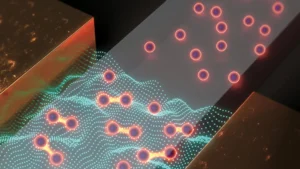
To mimic the structure of a solid, the team employed an "optical lattice." This is a grid created by intersecting laser beams that form a periodic pattern of light and dark spots. The atoms are trapped in the bright (or dark) regions of the lattice, effectively creating an artificial crystal where the atoms play the role of electrons. By adjusting the intensity and frequency of the lasers, the scientists could control the environment with a precision that is impossible in a naturally occurring mineral.
The Quantum Enhancement of Particle Size
One of the most striking observations made during the experiment was the effective size of the atoms during interactions. While a potassium atom is physically only a few nanometers in diameter, the quantum mechanical nature of the ultracold environment caused them to "perceive" each other as being much larger.
"We observed that the atoms bump into each other as if they were much larger," says Thywissen. This phenomenon is known as quantum enhancement. Because the atoms effectively take up more space in the lattice, the probability of a collision occurring at any given lattice site increases dramatically. This enhancement is what allowed the researchers to drive the system into a high-collision regime that would be difficult to reach in other experimental setups.
As the researchers increased the interaction strength between the atoms—and thus the frequency of collisions—the resistivity of the system began to climb as expected. However, as the system approached a specific threshold, the growth of resistivity slowed and eventually stopped entirely. This saturation suggests that there is a "speed limit" to how much resistance collisions can generate, a finding that mirrors the Mott-Ioffe-Regel (MIR) limit theorized in solid-state physics.
Chronology of the Research and Discovery
The journey toward this discovery spanned several years of theoretical development and experimental refinement. The collaboration began with the goal of answering a specific question: Is there an absolute maximum to how much particles can obstruct one another in a quantum system?
- Phase 1: Conceptualization and Setup (2019–2021): The teams at the University of Toronto and Lehigh University began designing the optical lattice parameters. They chose potassium-40, a fermionic isotope of potassium, because its behavior closely mimics that of electrons (which are also fermions).
- Phase 2: Achieving Ultracold Temperatures (2021–2022): The experimentalists at Toronto perfected the laser-cooling techniques required to reach the nano-Kelvin range. This involved a multi-stage process of magneto-optical trapping and evaporative cooling.
- Phase 3: Data Collection (2023): The researchers utilized Feshbach resonances—a tool in atomic physics that allows scientists to tune the interaction strength between atoms using an external magnetic field. By ramping up this field, they could force the atoms to collide more frequently.
- Phase 4: Analysis and Validation (Late 2023–2024): Working with theorists from the École Normale Supérieure, the team analyzed the data. They found that the resistivity did not grow infinitely but reached a plateau. This data was then cross-referenced with mathematical models of low-density metals.
The culmination of this timeline was the publication of their findings in Physical Review Letters, providing the first clear microscopic view of resistivity saturation in a controlled quantum simulator.
Data Analysis: The Saturation Limit
The data gathered by the researchers showed a clear trend. In the "weak interaction" regime, the resistivity of the potassium gas followed a predictable path, increasing linearly as collisions became more frequent. However, as the "mean free path" (the average distance a particle travels before hitting another) approached the distance between the sites of the optical lattice, the resistivity curve flattened.
This saturation is significant because it suggests that once collisions become frequent enough that a particle cannot even move one lattice spacing without hitting another, the system enters a new state. In this state, the conventional "particle-like" description of the atoms breaks down, and the system must be described in terms of collective wave-like excitations.
For the scientific community, this provides evidence for the "Planckian limit" of dissipation, a theory suggesting that the rate at which energy is lost in a quantum system is governed by fundamental constants of nature (Planck’s constant and the Boltzmann constant) rather than the specific properties of the material.
Global Implications and Official Responses
The implications of this research extend far beyond the laboratory. By understanding the upper limits of resistivity, engineers and physicists can better predict the behavior of new materials designed for high-performance computing and energy transmission.
"Our results provide a clear microscopic understanding of how resistivity works in low-density metals and open the door to new studies of strongly correlated atomic systems and quantum materials," says Professor Thywissen.
Related parties in the field of condensed matter physics have reacted with enthusiasm. Dr. Anirvan Sengupta, a theoretical physicist not involved in the study, noted, "This experimental verification of resistivity saturation in a cold-atom system is a tour de force. It bridges the gap between atomic physics and the physics of ‘bad metals,’ which are materials that conduct electricity but defy the standard rules of metallic behavior."
From a practical standpoint, the discovery could influence the development of:
- Superconductors: By understanding what limits resistance, researchers may find new pathways to creating materials that have zero resistance at higher temperatures.
- Quantum Computers: Quantum bits (qubits) are highly sensitive to their environment. Understanding the fundamental limits of particle collisions can help in designing more stable quantum architectures.
- Power Grid Efficiency: While we cannot currently replace power lines with ultracold potassium, the insights gained into how resistance develops can lead to the discovery of new alloys or composite materials that minimize heat loss in transmission.
Future Directions in Quantum Material Science
The success of the Toronto-Paris-Pennsylvania collaboration marks a new chapter in the study of quantum materials. The team plans to continue their investigation by exploring how "disorder"—the presence of random gaps or "potholes" in the optical lattice—affects the saturation limit. In real-world materials, atoms are rarely arranged in a perfect grid, and understanding how randomness interacts with collision limits will be crucial for applying these findings to industrial metallurgy.
Furthermore, the researchers are interested in studying the transition from a normal metal to a superfluid state. If they can observe how the saturation limit changes as the system becomes a superfluid (a state with zero viscosity), they might unlock the secrets of high-temperature superconductivity, one of the "holy grails" of modern physics.
In conclusion, the discovery of a maximum limit to collision-driven resistivity represents a major step forward in our understanding of the universe’s fundamental constraints. By cooling atoms to the brink of absolute zero and trapping them in webs of light, these physicists have revealed a hidden boundary in the nature of matter, proving once again that the most extreme conditions can yield the most profound insights.