In a landmark study that challenges long-held assumptions in the field of electrochemistry, a multi-institutional research team in South Korea has discovered that the catalytic behavior of silver (Ag) nanoparticles changes fundamentally depending on whether an energy device is generating electricity or producing hydrogen. The research, led by Professors WooChul Jung and Jeong Woo Han from the Department of Materials Science and Engineering at Seoul National University (SNU), in collaboration with Professor Sang Ouk Kim at the Korea Advanced Institute of Science and Technology (KAIST) and Dr. Beomgyun Jeong at the Korea Basic Science Institute (KBSI), provides a new blueprint for the design of high-efficiency next-generation energy conversion systems.
The study, which was featured as the Outside Back Cover article in the prestigious international journal Energy & Environmental Science, resolves a long-standing mystery regarding the precise location and mechanism of oxygen reactions on electrode surfaces. By pinpointing how silver nanocatalysts switch their active sites, the researchers have opened the door to a more granular approach to engineering electrodes for solid oxide cells (SOCs), a technology central to the global transition toward a hydrogen-based economy.
The Mechanics of Solid Oxide Cells and the Catalytic Challenge
Solid oxide cells represent a versatile class of electrochemical devices capable of performing two critical functions for the green energy transition. In one mode, known as a solid oxide fuel cell (SOFC), the device generates electricity through the chemical reaction of oxygen and a fuel, such as hydrogen or natural gas. In the reverse mode, known as a solid oxide electrolysis cell (SOEC), the device uses electricity to split water molecules, thereby producing "green hydrogen"—a carbon-neutral fuel source.
The efficiency of these processes is largely dictated by the kinetics of oxygen reactions at the air electrode. Specifically, the Oxygen Reduction Reaction (ORR) occurs during electricity generation, while the Oxygen Evolution Reaction (OER) occurs during hydrogen production. To accelerate these reactions, scientists often decorate electrode surfaces with metal nanocatalysts. However, because conventional electrodes possess highly complex, porous, and irregular microstructures, it has historically been nearly impossible to determine exactly where the catalytic activity occurs. Researchers have debated for decades whether the reaction takes place primarily on the surface of the catalyst itself or at the "triple phase boundary"—the specific interface where the catalyst, the electrode, and the gas phase meet.
Precision Engineering: The Model Electrode Approach
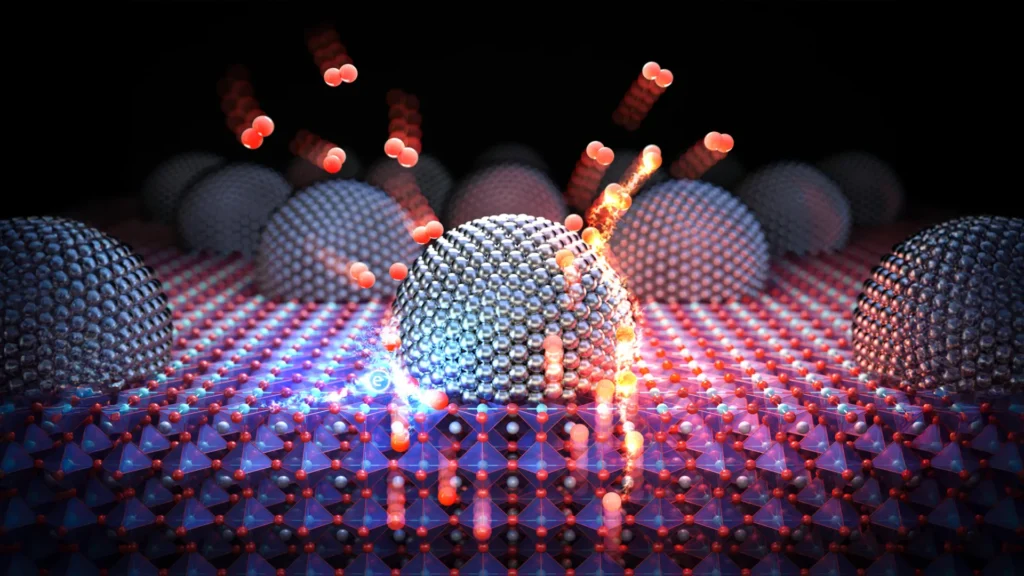
To overcome the limitations of studying irregular electrode structures, the SNU-led team developed a sophisticated model electrode system. Rather than using the random distribution of particles found in commercial cells, they employed advanced nanofabrication techniques to create a thin-film perovskite oxide electrode. Upon this surface, they deposited silver nanoparticles with uniform size and perfectly controlled spacing.
This "ordered array" served as a controlled laboratory environment, allowing the team to isolate variables and measure the performance of the catalyst with unprecedented precision. Before focusing on silver, the researchers benchmarked a variety of noble and transition metals, including cobalt, palladium, and platinum. While all these metals improved performance to some degree, silver emerged as the superior catalyst, demonstrating the highest level of acceleration for both ORR and OER processes.
The Discovery: Site-Specific Dynamic Behavior
The core of the team’s discovery lies in the realization that the "active site" of the silver catalyst is not a fixed location. By systematically varying the size of the silver nanoparticles and the length of the interface between the silver and the electrode, the researchers observed a distinct shift in behavior.
During the oxygen reduction reaction (electricity generation), the team found that the reaction rate was directly proportional to the length of the boundary where the silver touched the electrode. This confirmed that, in fuel cell mode, the interface is the primary engine of catalytic activity. In this capacity, the silver acts as a bridge, facilitating the transfer of electrons to oxygen molecules as they are reduced into oxygen ions.
Conversely, during the oxygen evolution reaction (hydrogen production), the data told a different story. The reaction rate correlated not with the boundary length, but with the total surface area of the silver nanoparticles. This indicates that in electrolysis mode, the entire surface of the silver particle becomes the active site. Here, the catalyst’s role shifts to assisting oxygen atoms in recombining into oxygen molecules and then releasing them from the electrode surface.
Atomic-Scale Analysis and Synchrotron Validation
To understand the "why" behind this site-switching behavior, the researchers utilized synchrotron-based Ambient Pressure X-ray Photoelectron Spectroscopy (AP-XPS) at the Pohang Accelerator Laboratory. This advanced imaging technique allowed them to observe the chemical and electronic states of the electrode surface in real-time while the cell was operating under high temperatures and varying gas pressures.
These experimental observations were supplemented by theoretical atomic-scale calculations. The combined data revealed that silver nanocatalysts fundamentally alter the electronic structure of the perovskite electrode. During ORR, the presence of silver lowers the energy barrier for oxygen adsorption at the interface. During OER, the silver surface provides a more favorable energetic pathway for the association of oxygen atoms, which is often the slowest and most difficult step in the water-splitting process.
Economic and Industrial Implications
The implications of this research are significant for the commercialization of clean energy technologies. By identifying that different sites are responsible for different modes of operation, engineers can now move away from a "one-size-fits-all" approach to catalyst design.
- Efficiency Gains in Distributed Energy: For building-integrated power systems or factory-based combined heat and power (CHP) units, optimizing the interface between catalysts and electrodes can lead to higher electricity yields and lower operating costs.
- Lowering the Cost of Green Hydrogen: One of the primary hurdles for green hydrogen is the high electricity cost required for electrolysis. By optimizing the catalyst surface area for the OER process, researchers can reduce the "overpotential" (the extra energy required to drive the reaction), making hydrogen production more economically viable.
- Advancing Reversible Systems: The discovery is particularly vital for Reversible Solid Oxide Cells (RSOCs). These systems are designed to switch back and forth between storing energy (as hydrogen) and producing power (from hydrogen). Understanding the dual-mode mechanism allows for the development of "bifunctional" electrodes that perform optimally in both directions.
Furthermore, the choice of silver as the primary catalyst offers a potential economic advantage. While platinum and palladium are highly effective catalysts, they are prohibitively expensive and scarce. Silver, while still a precious metal, is significantly more abundant and lower in cost, offering a more sustainable pathway for large-scale industrial deployment.
A New Paradigm for Catalyst Research
Professor WooChul Jung emphasized that this study represents a shift in how the scientific community should perceive nanocatalysts. "This research is significant because it quantitatively evaluates the performance of nanocatalysts while also identifying their actual reaction sites and operating mechanisms," Jung stated. "We have shown that a catalyst is not just a passive additive, but a dynamic component whose function is dictated by the electrochemical environment."
The research team plans to expand this "model electrode" platform to study other catalytic systems and energy conversion materials. The methodology could potentially be applied to lithium-air batteries, CO2 reduction systems, and advanced oxygen sensors, all of which rely on similar gas-solid electrochemical reactions.
Chronology and Future Outlook
The project was the result of several years of collaborative effort, supported by the Ministry of Science and ICT and the National Research Foundation of Korea. The timeline of the research progressed from the initial development of the nanoparticle array technology at KAIST to the electrochemical testing and theoretical modeling at SNU, culminating in the high-resolution synchrotron analysis at KBSI.
The lead researcher, Dr. Jinwook Kim, who spearheaded the experimental work, is currently continuing his research at Northwestern University in the United States. He is slated to join the University of Seoul as an assistant professor in the Department of Materials Science and Engineering. Dr. Kim’s future work is expected to focus on translating these fundamental insights into practical, high-performance electrode architectures that can withstand the rigorous demands of long-term industrial operation.
As the world moves toward the "Net Zero 2050" goals, the ability to precision-engineer the chemical reactions that power our grid and produce our fuel will be paramount. By uncovering the "shape-shifting" nature of silver nanocatalysts, this South Korean research team has provided a critical tool for the next generation of energy researchers, moving the industry one step closer to a truly sustainable energy cycle.