The discovery of a flickering quasar from the universe’s infancy has challenged the fundamental understanding of how supermassive black holes evolve. Astronomers from the Massachusetts Institute of Technology (MIT) and several international partner institutions have successfully detected a signal from a quasar dating back to the "cosmic dawn," a mere 850 million years after the Big Bang. This finding, published in the journal Nature Astronomy, marks the earliest instance of a flickering quasar ever recorded, providing a rare and perplexing glimpse into the structural maturity of the universe’s first gravitational giants.
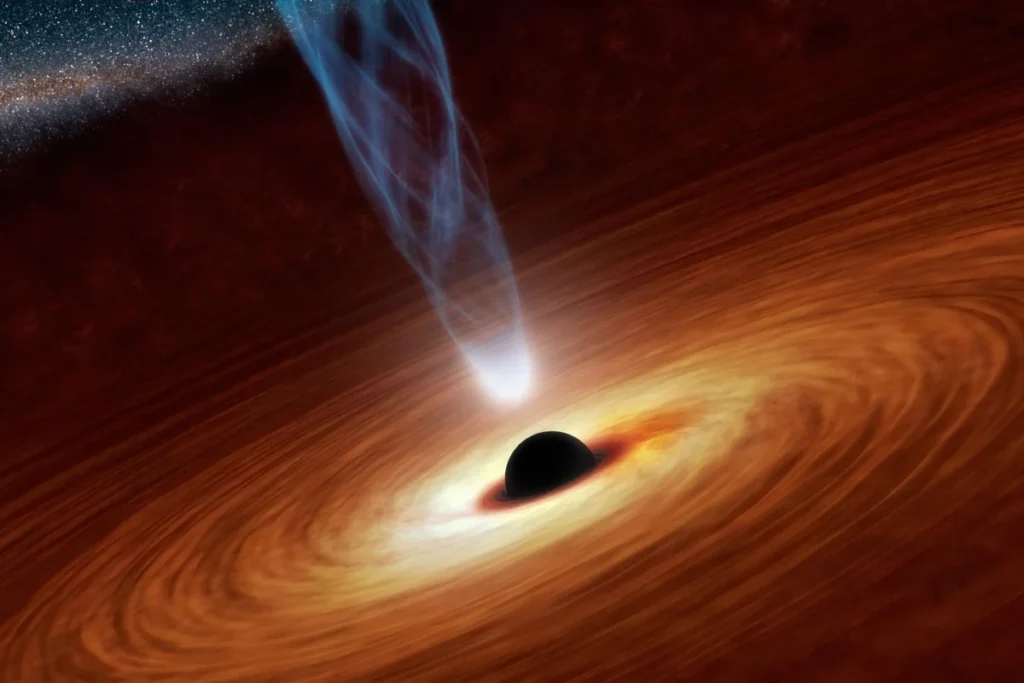
At the center of nearly every massive galaxy, including our own Milky Way, resides a supermassive black hole. While many of these entities remain relatively dormant, others are "active," acting as voracious engines that pull in vast quantities of surrounding gas, dust, and stellar debris. As this material spirals toward the event horizon, it forms an accretion disk—a high-temperature whirlpool of plasma that radiates immense amounts of energy across the electromagnetic spectrum. The most luminous of these active systems are known as quasars. These objects are so energetic that they can easily outshine the combined light of the hundreds of billions of stars within their host galaxies, making them visible across the vast expanses of the observable universe.
The Significance of the Flicker
The detection of a "flicker" in a quasar’s light output is a critical diagnostic tool for astrophysicists. This variability is caused by fluctuations in the rate at which the black hole consumes material. By analyzing the timing and intensity of these flickers, scientists can infer the physical characteristics of the accretion disk, such as its size, temperature distribution, and geometric shape.
"Although there have been a lot of quasars found in the cosmic dawn, this is the first time we actually see one flickering," stated Gene Leung, a postdoctoral researcher at the MIT Kavli Institute for Astrophysics and Space Research and the lead author of the study. This flickering allowed the team to probe the inner workings of a system that existed over 13 billion years ago, revealing a structure that was unexpectedly sophisticated for its age.
The data revealed that the accretion disk of this ancient quasar was remarkably thin and flat, resembling a "pancake." In the context of modern astrophysics, such a structure is typically associated with "mature" black holes—those that have settled into a stable, steady-state feeding cycle after billions of years of evolution. The presence of such a mature structure in the very early universe presents a significant chronological puzzle.
Technical Challenges and the Redshift Effect
Detecting light from 13 billion light-years away is a feat of extreme technical precision. Because the universe is expanding, light traveling from distant objects is stretched to longer, redder wavelengths—a phenomenon known as cosmological redshift. For objects as distant as those from the cosmic dawn, visible light is shifted entirely into the infrared spectrum.
Furthermore, the expansion of space-time also causes a time dilation effect. A flickering event that might take a few weeks to occur in the quasar’s local frame of reference appears to take months or even years when observed from Earth. To capture a meaningful pattern of variability, the MIT team required a dataset that spanned a significant duration and focused on infrared wavelengths.
"This was the technical challenge we had to overcome," explained Anna-Christina Eilers, assistant professor of physics at MIT. "We needed data at longer, infrared wavelengths taken repeatedly over very long timescales."
To solve this, the researchers turned to NASA’s Near-Earth Object Wide-field Infrared Survey Explorer (NEOWISE). Originally designed to hunt for asteroids within our solar system, the NEOWISE satellite has scanned the entire sky in infrared light multiple times over a 14-year period. By reprocessing archival data from this mission—a project spearheaded by former MIT postdoc Kishalay De, now a faculty member at Columbia University—the team was able to extract a consistent signal from the ancient quasar.
Data Analysis and Findings
The team’s analysis showed the quasar flickering randomly over the 14-year observation window, much like the erratic dancing of a candle flame. The object’s baseline luminosity is staggering, estimated to be equivalent to the light of 12 trillion suns. The observed flickering represented a 20 percent fluctuation in brightness, meaning the energy output was swinging up and down by an amount equal to 2 trillion suns.
By tracking the flicker across different infrared wavelengths, the researchers mapped the temperature zones within the accretion disk. Higher-frequency flickers generally originate from hotter material closer to the black hole, while slower, lower-frequency flickers come from the cooler, outer regions of the disk. The data consistently pointed to a thin, stable disk geometry.
This "pancake" shape is the hallmark of a system that has reached a balance between the inward pull of gravity and the outward pressure of radiation. According to current cosmological models, black holes in the early universe should still be in a chaotic, rapid-growth phase. During such a stage, the accretion disks are expected to be "puffy," turbulent, and disorganized as they struggle to process massive amounts of incoming matter. Finding a stabilized, flat disk so soon after the Big Bang suggests that the transition from chaos to maturity happens much faster than previously theorized.
The Mystery of Supermassive Growth
The existence of supermassive black holes—some weighing billions of times the mass of the sun—within the first billion years of the universe remains one of the greatest mysteries in modern cosmology. Standard models suggest that black holes grow by merging with others or by slowly accreting gas. However, both processes take time.
If a black hole starts as a "light seed"—the remnant of a single massive star—it should not have enough time to reach billions of solar masses by the time the universe is 850 million years old. This has led to the "heavy seed" hypothesis, which suggests that massive clouds of gas in the early universe collapsed directly into medium-sized black holes, giving them a "head start" in growth.
The MIT findings support the idea that these early systems underwent an incredibly intense and rapid growth phase that concluded well before the quasar became visible to our telescopes.
"I think what this suggests is that all the messy, very rapid growth phases that we expect all black holes to go through at some point happen very, very early on," Eilers said. "That’s the picture that’s emerging."
Implications for Galactic Evolution
Supermassive black holes are not merely passive residents of galaxies; they are active participants in their evolution. Through a process known as "feedback," the energy emitted by a quasar can heat up or even blow away the gas in its host galaxy. Since gas is the raw material needed to create stars, a highly active black hole can effectively shut down star formation, regulating the size and shape of the galaxy.
The discovery that these black holes were already mature and highly energetic 850 million years after the Big Bang implies that galactic ecosystems were being shaped much earlier than astronomers once thought. If the "engines" of these galaxies were already stabilized and efficient, the surrounding galactic structures must have also been undergoing rapid, sophisticated development.
Future Research and the James Webb Space Telescope
While the NEOWISE data has provided a breakthrough, it is only the beginning of a new era of "time-domain" cosmology. Astronomers are now looking toward the James Webb Space Telescope (JWST) and future observatories like the Vera C. Rubin Observatory to find even more distant flickering quasars.
By observing quasars at even higher redshifts, scientists hope to catch a black hole in its "unsettled" phase—the period before the accretion disk flattens into a pancake. Finding the transition point between a chaotic, puffy disk and a stable, flat one would provide the definitive "smoking gun" for how the first massive structures in the universe were built.
The research conducted by Leung, Eilers, and their colleagues, supported in part by NASA, provides a vital roadmap for these future investigations. As we peer further into the cosmic dawn, each discovery brings us closer to understanding the origins of the massive structures that define our universe today. The "flicker" of a distant light, once thought to be mere noise, has now become a powerful lens through which we can view the very beginning of time.