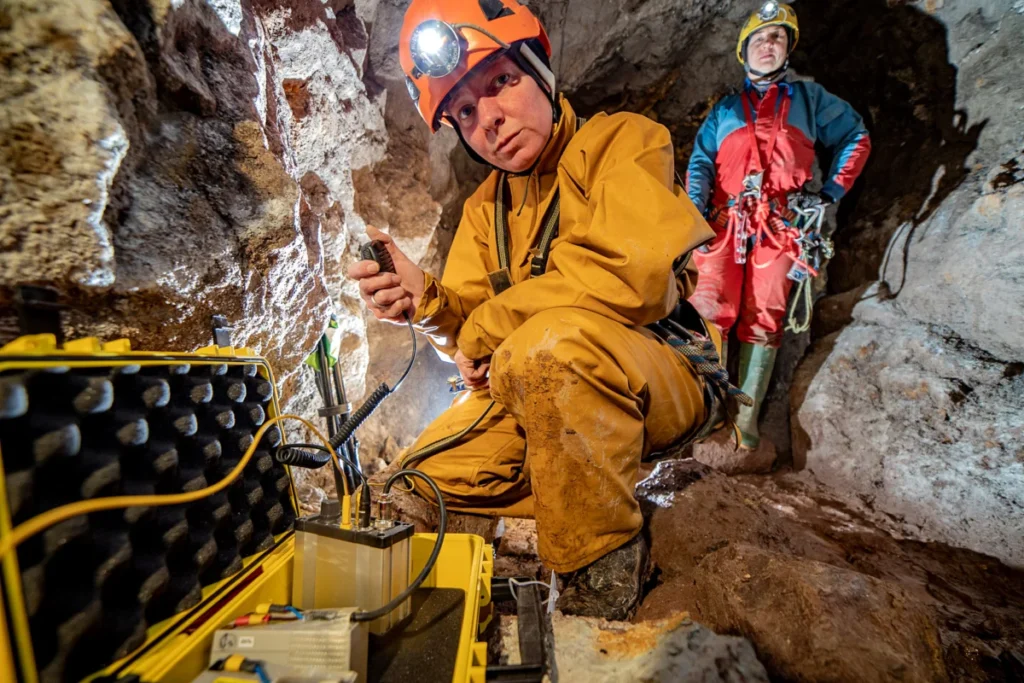
The physical barriers presented by hundreds of meters of solid limestone, granite, or basalt have long rendered conventional wireless communication impossible in subterranean environments. While a standard smartphone or FM radio signal vanishes almost immediately upon entering a tunnel or mine shaft, the evolution of specialized "cave radio" technology has bridged this gap. Utilizing a combination of low-frequency physics, magnetic induction, and modern digital mesh networking, the maker community and specialized engineers have developed systems that allow voice and data to permeate solid rock. This technology is not merely a hobbyist’s curiosity; it is a critical component of modern cave rescue operations and geological exploration.

The Physics of Subterranean Signal Attenuation
The primary obstacle to underground communication is the high rate of attenuation that electromagnetic waves experience when traveling through conductive media like rock and soil. In the vacuum of space or the Earth’s atmosphere, high-frequency signals—such as the Gigahertz (GHz) waves used by 5G networks or the Megahertz (MHz) waves used by VHF radios—travel vast distances with minimal loss. However, when these waves encounter solid earth, they are absorbed and converted into heat.
The depth to which an electromagnetic wave can penetrate a conductor is known as "skin depth." This value is inversely proportional to the square root of the frequency. Consequently, as frequency increases, the penetration depth decreases exponentially. For limestone—the primary rock type in which most caves form—standard radio frequencies are absorbed within a few meters. To overcome this, subterranean communication must utilize much lower frequencies, typically in the Low Frequency (LF) band between 30kHz and 300kHz, or even audio frequencies (VLF) below 3kHz.

While these low frequencies can penetrate hundreds of meters of rock, they present a significant hardware challenge: antenna size. A standard resonant antenna for an 87kHz signal would theoretically need to be approximately 1.75 kilometers long. Since such dimensions are impossible to manage in a cramped cave passage, engineers utilize "near-field" magnetic induction or earth conduction arrays rather than traditional "far-field" radiation.
The Evolution of Cave Communication: A Chronology
The history of subterranean communication has moved from heavy, physical tethers to sophisticated wireless digital nodes.

The Era of Hardwired Telephones (Early 20th Century – 1960s)
The earliest form of communication in mines and caves relied on field telephones. During World War II, surplus military field phones became the standard. These evolved into Single Wire Telephones (SWTs), which used a single insulated copper wire for the signal and the earth itself as the return path. While reliable, the weight of the wire and the high risk of it being severed by falling rocks or moving cavers made it a cumbersome solution for deep exploration.
The Rise of Inductive Loop Systems (1970s – 1990s)
In the 1970s, researchers began experimenting with Through-the-Earth (TTE) wireless systems. The most famous of these was the "HeyPhone," developed by the late John Hey for the British Cave Rescue Council. These systems used large, multi-turn loop antennas to create a magnetic field. Because magnetic fields at low frequencies are less affected by rock than electric fields, they allowed for voice communication through hundreds of meters of solid strata.

The Digital and Mesh Revolution (2000s – Present)
In the last two decades, the focus has shifted toward digital data and text transmission. Modern systems now utilize the LoRa (Long Range) protocol and other spread-spectrum techniques. These systems often bypass the "through-rock" problem by using "guided" paths or "leaky feeders," or by deploying a series of small, low-power repeater nodes that "hop" the signal around corners and through passages.
Core Technologies in Through-the-Earth (TTE) Radio
To achieve wireless communication through solid rock, two primary antenna configurations are employed: loop antennas and earth arrays.

Magnetic Loop Antennas
A loop antenna, typically one meter in diameter and consisting of many turns of wire, acts as the primary winding of a massive, air-core (or rock-core) transformer. When an alternating current flows through the transmitting loop, it generates a fluctuating magnetic field. A second loop at the surface or elsewhere in the cave detects this field.
The primary drawback of loop systems is the "inverse cube law." The signal strength of a magnetic near-field decreases at a rate of $1/d^3$, where $d$ is the distance. This means that to double the communication range, a transmitter must increase its power eightfold. Despite this, loops remain popular for "point-to-point" communication where the exact location of the subterranean party is known relative to the surface.

Earth Arrays
The earth array antenna has largely superseded the loop in modern TTE applications due to its superior range-to-weight ratio. An earth array consists of two electrodes—often metal stakes or "earth pins"—driven into the ground approximately 50 to 100 meters apart. The radio injects a signal directly into the ground between these two points.
The signal propagates via conduction and the creation of a massive virtual loop through the earth’s crust. This method can achieve ranges of up to one kilometer through solid rock, allowing surface teams to remain in comfortable base camps or vehicles rather than standing directly above the cavers on a jagged mountainside.

Alternative Communication Methods: Guidewires and Leaky Feeders
When Through-the-Earth communication is not feasible—such as in extremely deep systems or areas with high mineral conductivity—cavers use "guided" radio.
- Guidewire Radio: A single wire is laid through the cave passage. Handheld radios (often operating at 27MHz) are held close to the wire. The wire acts as a passive carrier, picking up the signal via induction and re-radiating it along its length. This allows for clear communication around multiple sharp bends where line-of-sight would fail.
- Leaky Feeders: Commonly used in subways and industrial mines, a leaky feeder is a coaxial cable with a "gappy" shield that allows radio signals to "leak" in and out along its entire length. While professional-grade leaky feeders are prohibitively expensive for recreational cavers, researchers have discovered that low-cost domestic TV coaxial cables can often achieve similar results for short-term expeditions.
- Digital Repeaters (LoRa): Utilizing the 868MHz or 915MHz bands, cavers can drop small, battery-powered "breadbox" repeaters at intervals. These nodes form a mesh network. Even if the passage is narrow or winding, the digital signal is refreshed at each node, allowing text-based communication over several kilometers of passage.
The Role of the Maker Community
Because the market for cave-specific communication is too small for major aerospace or telecommunications firms, nearly all innovation in the field has come from the "maker" and amateur radio communities. Organizations like the British Cave Research Association’s Cave Radio & Electronics Group (CREG) publish technical journals detailing DIY builds.

One accessible project for enthusiasts involves repurposing audio equipment for TTE communication. By using a standard 10W-20W audio amplifier and a 100V line transformer (wired in reverse to match the high impedance of the earth), a maker can create a functional VLF transmitter. Using the ground as an antenna, voice signals can be transmitted through hundreds of feet of soil. On the receiving end, a simple high-gain microphone preamp connected to a second earth array can capture these signals, which can then be filtered using digital signal processing (DSP) on a laptop to remove the 50Hz/60Hz "hum" from the power grid.
Critical Application: Cave Rescue Operations
The most vital application of cave radio is in the "Golden Hour" of medical emergency. In a deep cave system, transporting an injured person on a stretcher can take 10 to 20 times longer than the time it took for the person to enter. A rescue that involves vertical pitches and narrow "squeezes" can easily last 48 to 72 hours.

Without cave radio, communication between the rescue "front" and the surface controller is relegated to "runners"—cavers who must physically traverse the distance to deliver messages. This creates a dangerous lag in information. Cave radio allows:
- Real-time Triage: Medics underground can describe injuries to doctors on the surface, who can then provide specialized guidance.
- Logistics Coordination: Rescue teams can request specific equipment (e.g., extra ropes, chemical heaters, or specialized cutting tools) without sending a runner back.
- Psychological Support: Maintaining a link to the surface provides a significant morale boost to both the casualty and the exhausted rescue team.
Safety and Environmental Considerations
The exploration of caves for the purpose of testing radio equipment carries inherent risks. The subterranean environment is characterized by 100% humidity, constant mud, and absolute darkness. Electronics must be "ruggedized"—housed in waterproof, shock-resistant cases such as Peli-boxes.

Experts advise that initial testing of TTE or LoRa systems should occur in "safe" underground environments, such as abandoned railway tunnels or decommissioned bunkers, before being attempted in "wild" cave systems. Furthermore, caving is a team activity; solo underground exploration is strongly discouraged. Prospective cave radio experimenters are encouraged to join local grottos or caving clubs to learn essential vertical and horizontal movement techniques.
Broader Implications and Future Outlook
The techniques developed for cave radio have implications beyond hobbyist exploration. Urban search and rescue (USAR) teams utilize similar TTE technology to communicate with victims trapped under collapsed buildings or in subway tunnels following disasters. Additionally, as we look toward lunar and Martian exploration, where "lava tube" caves are primary candidates for human habitats, the physics of low-frequency through-rock communication will become essential for planetary base operations.

As digital processing power increases and battery consumption decreases, the future of cave radio lies in automated, self-healing mesh networks. These systems will likely combine atmospheric sensing, location tracking, and voice-over-data, turning the once-silent depths into a fully connected frontier. Through the persistence of the maker community and the application of fundamental physics, the "solid rock" barrier is effectively becoming a thing of the past.