For decades, the scientific and industrial communities have grappled with understanding the precise mechanisms behind one of the most promising methods for producing syngas – a vital mixture of hydrogen (H₂) and carbon monoxide (CO) essential for fuels and a vast array of chemicals – through the partial oxidation of methane (POM). This method, celebrated for its potential to be more energy-efficient and environmentally benign than conventional processes, has long been thought to rely on metallic nickel (Ni) nanoparticles as its primary catalytic drivers. However, this assumption has been shadowed by a persistent and critical unresolved question: whether the metallic nickel observed after a reaction was indeed the active species during catalysis, or merely a byproduct formed when nickel oxide is reduced by syngas at the high temperatures inherent to the process. This fundamental uncertainty has hindered the rational design of more efficient and sustainable catalysts, leaving a significant gap in our comprehension of this industrially crucial reaction.
The Quest for Syngas: An Industrial Imperative
Syngas stands as a cornerstone of the modern chemical industry. It is the indispensable precursor for producing methanol, a versatile chemical building block, and ammonia, a critical component in fertilizers that sustain global food production. Beyond these, syngas is instrumental in the Fischer-Tropsch process, converting natural gas into liquid fuels, and serves as a primary source of hydrogen for various applications, including fuel cells and refining processes. The global demand for syngas continues to climb, driven by an expanding industrial base and the ongoing transition towards cleaner energy sources.
Traditional industrial methods for syngas production, such as steam methane reforming (SMR) and autothermal reforming (ATR), are energy-intensive processes that often generate substantial carbon dioxide (CO₂) emissions. SMR, while highly mature, operates at very high temperatures (700-1100°C) and requires significant external heat input, leading to a large carbon footprint. ATR combines aspects of SMR and POM, involving both partial oxidation and steam reforming, which can offer better energy integration but still faces challenges in terms of operational complexity and emissions. The allure of POM lies in its simpler stoichiometry, lower energy demand, and higher potential for selectivity towards desired products, making it a "greener" and more economically attractive pathway. The direct conversion of methane, a potent greenhouse gas, into value-added chemicals also holds significant environmental promise, addressing both resource utilization and climate concerns.
Nickel’s Enigmatic Role: A Decades-Old Debate
Nickel-based catalysts have been central to POM research due to nickel’s abundance, relatively low cost compared to noble metals like platinum or palladium, and its known catalytic activity for C-H bond activation. For years, the prevailing hypothesis, supported by ex situ characterization techniques performed on catalysts after the reaction, suggested that metallic Ni nanoparticles were the active sites. The logic seemed sound: metallic surfaces are often excellent at adsorbing and activating reactant molecules.
However, the high-temperature redox conditions prevalent in POM reactions present a complex environment where nickel can undergo rapid and reversible changes in both its oxidation state and atomic arrangement. At temperatures often exceeding 600°C, and in the presence of methane, oxygen, and products like H₂ and CO, nickel species are far from static. Nickel can readily transition between its metallic (Ni⁰) state and various oxidized states (e.g., NiO, Ni₂O₃). This dynamic nature made it exceedingly difficult to conclusively determine the true structure responsible for catalysis while the reaction was actively occurring. Researchers understood that what they observed after cooling a reactor might not accurately reflect the catalyst’s state at operating temperatures, leading to what became known as the "material gap" or "pressure gap" in catalysis research—the discrepancy between conditions under which catalysts are studied (often idealized laboratory settings or ex situ) and their actual operating environments. This challenge underscored the critical need for advanced in situ characterization techniques that could peer into the reactor and capture these fleeting, active structures.
A Breakthrough in Nature Catalysis: Unveiling the True Active Site
This long-standing puzzle has now been addressed by a groundbreaking study published in the prestigious journal Nature Catalysis. The research, spearheaded by a collaborative team from the Dalian Institute of Chemical Physics (DICP) of the Chinese Academy of Sciences (CAS), Xi’an Jiaotong University, and Cardiff University, has fundamentally reshaped our understanding of POM catalysis. The investigation, led by Professors Tao Zhang, Aiqin Wang, and Xiaoyan Liu from DICP, along with Prof. Wei Liu from DICP, Prof. Tao Yang from Xi’an Jiaotong University, and Prof. Graham J. Hutchings from Cardiff University, leveraged sophisticated in situ analytical techniques to observe catalysts under realistic operating conditions. Their findings revealed that highly active catalytic structures do not pre-exist but rather form dynamically when the surface of nickel oxide (NiO) undergoes reconstruction during the POM reaction itself. This discovery provides atomic-scale insight into the source of catalytic activity and emphatically underscores the necessity of in situ observation to accurately identify true active sites.
Crafting an Exceptional Catalyst: Performance Beyond Expectation
To unravel the complex catalytic process, the research team meticulously designed and synthesized a nickel-based catalyst with a remarkably low nickel content. Using a microemulsion method, they prepared a Ni/Al₂O₃ catalyst containing only 0.8 weight percent (wt%) nickel. This low loading was a deliberate choice, intended to minimize the presence of metallic nickel and focus on potential oxide-derived species.
Despite its significantly reduced nickel content—a mere fraction of what is typically employed in industrial catalysts—this novel material demonstrated exceptional performance in POM. Under optimal reaction conditions, the catalyst achieved a methane conversion rate of 92%, a figure comparable to or exceeding many high-loading industrial catalysts. Furthermore, the selectivity towards the desired syngas components, CO and H₂, reached an impressive 87.0%, with the H₂/CO molar ratio consistently maintained at approximately 2.0, which is ideal for many downstream chemical syntheses, such as methanol production.
One of the most striking and counter-intuitive findings was the near-absence of metallic nickel in the catalyst after the reaction. This observation directly challenged the long-held assumption that metallic Ni was the primary active site. Even more compelling was a direct comparison: this 0.8 wt% Ni/Al₂O₃ catalyst, prepared via the microemulsion method, exhibited overall performance on par with a conventional 8.0 wt% Ni/Al₂O₃ catalyst produced through the impregnation method, despite containing only one-tenth the amount of nickel. This stark contrast highlighted not just the efficiency of the newly identified active site, but also the critical role of the catalyst preparation method in dictating its ultimate structure and performance.
Further validating their findings, the researchers compared their high-performing low-loading catalyst with another 0.8 wt% Ni/Al₂O₃ material prepared using the more common impregnation method. Under identical reaction conditions, the impregnation-derived catalyst proved largely ineffective for POM, primarily showing only methane complete combustion activity—a wasteful pathway that converts methane directly to CO₂ and water, rather than desired syngas. This critical distinction cemented the idea that simply having nickel present was not enough; its specific structural arrangement and dynamic behavior under reaction conditions were paramount.
The team also observed that any metallic Ni nanoparticles present at the beginning of the reaction quickly underwent oxidation to the NiO phase when exposed to the high-temperature, oxidative environment of POM. This provided an initial clue that NiO might play a more central role than previously thought. However, pure-phase NiO alone, when tested as a catalyst, showed no activity for POM and instead exclusively catalyzed the complete oxidation of methane. These collective experimental results built a compelling narrative: neither metallic nickel nor bulk, pre-formed nickel oxide was the true active species. The answer had to lie in a dynamic transformation occurring within the NiO structure itself.
The Dynamic Transformation: From NiO to Active Site
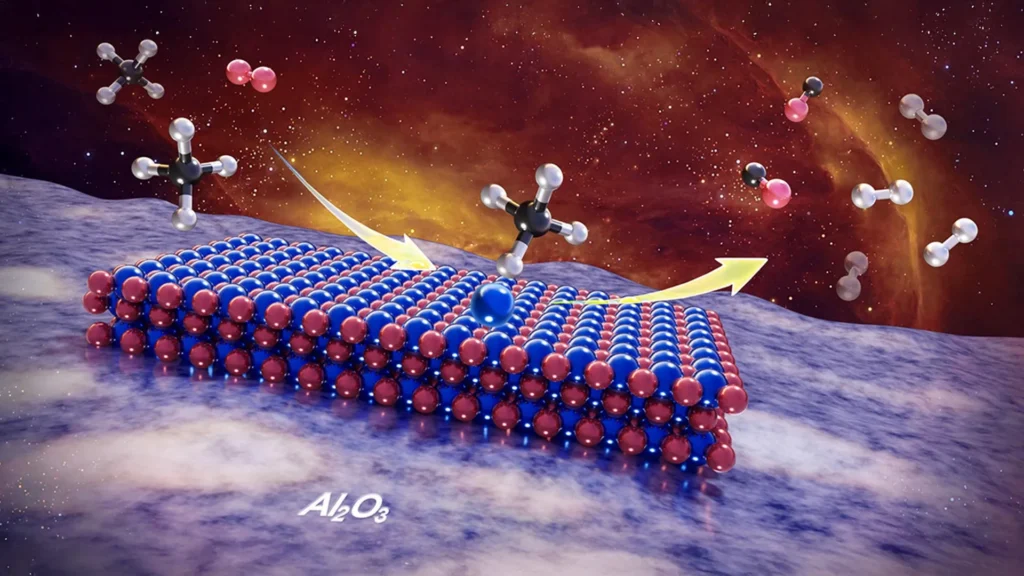
Armed with these critical insights, the research team deployed advanced in situ characterization techniques, such as in situ X-ray absorption spectroscopy (XAS) and environmental transmission electron microscopy (ETEM), which allowed them to observe the catalyst’s atomic structure and electronic state during the reaction. This real-time, atomic-level scrutiny revealed the secret: during the POM reaction, the surface of the NiO(100) plane underwent a remarkable atomic reconstruction. The researchers successfully captured the in situ formation of a specific, highly active structural unit: a [Ni₁O₄Ni₄] motif. This unique arrangement emerged dynamically from the NiO surface under the reactive atmosphere, challenging the long-held static view of catalyst structures.
Quantum Mechanics Confirms the Mechanism: DFT Calculations
To provide theoretical underpinning and validate their experimental observations, the team performed extensive Density Functional Theory (DFT) calculations. DFT is a powerful quantum mechanical modeling method used in physics and chemistry to investigate the electronic structure (or nuclear structure) of many-body systems, particularly atoms, molecules, and condensed phases. In catalysis, DFT allows researchers to calculate reaction pathways, activation energies, and the stability of various surface structures at an atomic level.
The DFT calculations provided compelling quantitative evidence supporting the reconstructed [Ni₁O₄Ni₄] unit as the true active center. These calculations specifically focused on the activation barrier for the initial, rate-determining step in methane activation: the breaking of the C-H bond. For the newly identified reconstructed [Ni₁O₄Ni₄] structural unit on the NiO(100) surface, the calculated activation barrier for C-H bond breaking was remarkably low, at just 12.5 kcal·mol⁻¹.
This value represented a substantial kinetic advantage when compared to other potential active sites. The intact, unreconstructed NiO(100) surface, for instance, showed a significantly higher activation barrier of 38.5 kcal·mol⁻¹. Even the metallic Ni(111) surface, previously thought to be the active site, exhibited a higher barrier of 15.7 kcal·mol⁻¹. The nearly threefold reduction in activation energy on the reconstructed surface compared to intact NiO, and a notable reduction compared to metallic Ni, provided robust theoretical support for the experimental conclusion. This substantial kinetic advantage strongly indicated that the dynamically formed, reconstructed [Ni₁O₄Ni₄] structure was indeed the true active center responsible for the exceptional performance observed in POM.
Together, the meticulous experimental observations and sophisticated theoretical calculations delivered a conclusive message: the catalytic activity for partial oxidation of methane does not simply arise from bulk metallic nickel or ordinary nickel oxide. Instead, it originates from a specific, dynamically formed atomic structure that emerges and operates while the reaction is actively taking place. This discovery marks a significant paradigm shift in how we understand and approach heterogeneous catalysis.
Implications for Catalyst Design and Industrial Sustainability
The implications of this research are profound and far-reaching, impacting both fundamental catalysis science and practical industrial applications.
Firstly, it highlights the critical role of in situ characterization techniques in identifying dynamic active structures under realistic reaction conditions. Many catalytic processes involve complex surface chemistry and structural rearrangements that are invisible to traditional ex situ methods. This study serves as a powerful testament to the necessity of pushing the boundaries of analytical chemistry to observe catalysts in their working state, thereby bridging the "pressure gap" and "material gap" that have long plagued catalyst development.
Secondly, the discovery that a dynamically reconstructed nickel oxide surface, rather than metallic nickel, is the true active site, opens up new avenues for the rational design of catalysts. Instead of focusing on stabilizing metallic nanoparticles, researchers can now direct their efforts towards engineering specific surface reconstructions on transition metal oxides or developing precursor materials that readily form these active structures in situ. This shift in understanding could lead to the design of catalysts with superior activity, selectivity, and stability for a wide range of reactions beyond POM.
Thirdly, the ability of a low-loading catalyst (0.8 wt% Ni) to achieve high performance comparable to or better than much higher-loading conventional catalysts holds immense economic and environmental benefits. Nickel, while abundant, still represents a significant cost factor in industrial processes. Reducing the required metal loading by a factor of ten translates directly into lower material costs for catalyst production, conservation of resources, and potentially less waste. This aligns perfectly with the principles of green chemistry and sustainable manufacturing, offering a pathway to high-performance catalysts that are both efficient and environmentally responsible. The reliance on high metal loadings can be drastically reduced, addressing concerns about resource scarcity and the environmental impact associated with mining and processing metals.
Finally, the insights gained from this study could extend beyond methane partial oxidation. Many other catalytic reactions involving transition metals and redox conditions might similarly involve dynamically forming active sites that have been overlooked. This research provides a template for investigating other complex catalytic systems, potentially unlocking new efficiencies and pathways for synthesizing a variety of chemicals and fuels.
Expert Commentary and Future Outlook
"Our study highlights the critical role of in situ characterization in identifying dynamic active structures under reaction conditions," affirmed Professor Liu, emphasizing the methodological breakthrough. "Dynamic reconstruction enables low-loading catalysts to achieve high performance, offering new opportunities for the rational design of efficient catalysts while reducing reliance on high metal loadings." This statement encapsulates the core impact of the research: a scientific paradigm shift with tangible industrial and environmental benefits.
The findings from this international collaboration are expected to stimulate significant further research in the field of heterogeneous catalysis. Scientists will likely intensify their efforts to apply advanced in situ techniques to other industrially important reactions, seeking to uncover similarly dynamic and previously unseen active sites. The long-term vision is to move away from empirical catalyst discovery towards a more predictive and rational design approach, where catalysts are engineered at the atomic scale to perform specific functions with unparalleled efficiency. This will not only accelerate the development of next-generation catalysts but also contribute significantly to a more sustainable chemical industry, reducing energy consumption, minimizing waste, and maximizing resource utilization in the ongoing global transition towards a greener future. The discovery of the reconstructed [Ni₁O₄Ni₄] structural unit on NiO(100) as the true active site for POM stands as a landmark achievement, promising to redefine catalyst design principles for years to come.