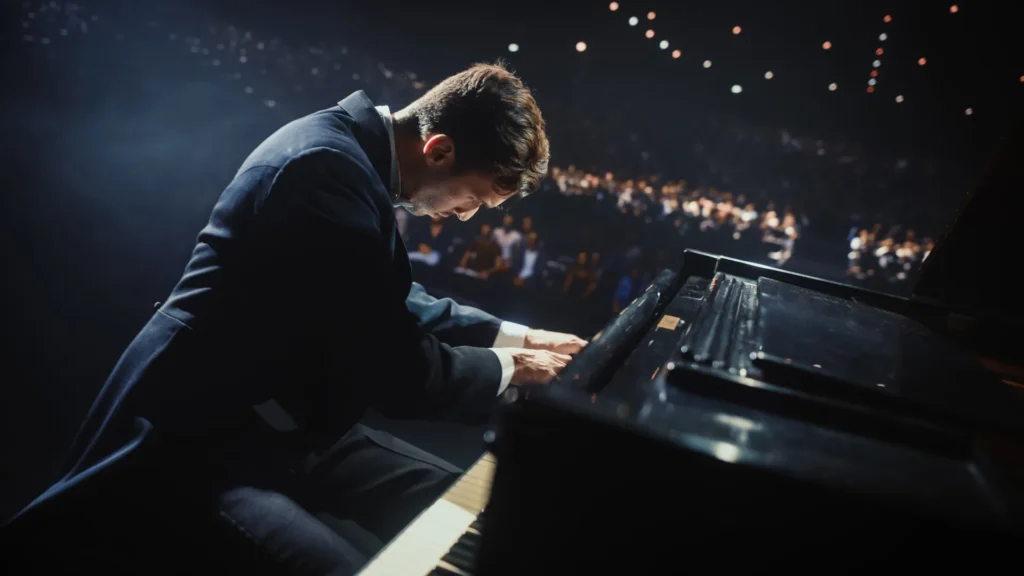
For generations, pianists and music teachers have passionately insisted that a performer’s unique touch can profoundly change the character of a piano’s sound, imbuing it with warmth, brilliance, or weight. This artistic intuition, however, often clashed with a more mechanistic scientific view, where skeptics argued that once a piano hammer strikes a string, the resulting tone — its timbre — is determined almost entirely by the instrument’s inherent physical properties. Now, a groundbreaking scientific study has provided some of the clearest and most compelling evidence yet, definitively proving that pianists truly can shape a piano’s timbre through the subtle nuances of their touch alone, settling a debate that has spanned more than a century.
The comprehensive research, spearheaded by Dr. Shinichi Furuya of the esteemed NeuroPiano Institute and Sony Computer Science Laboratories, Inc., leveraged cutting-edge ultra-high-speed sensing technology to meticulously uncover the previously hidden movements that underpin expressive piano playing. Their seminal findings, which have been peer-reviewed and published in the prestigious Proceedings of the National Academy of Sciences (PNAS), unequivocally demonstrate that the minute, almost imperceptible motions of a pianist’s fingers and hands exert a measurable influence on how listeners perceive qualities such as brightness, heaviness, clarity, and even emotional resonance in musical notes. This revelation not only validates the deeply held beliefs of countless musicians but also establishes a new scientific framework for understanding the intricate interplay between human motor control, acoustic physics, and aesthetic perception.
A Century of Contention: The Great Piano Timbre Debate
The question of whether a pianist possesses the genuine ability to alter a piano’s timbre through their touch has been a hotly contested topic since the early 20th century, becoming one of the most enduring and passionate debates in both musicology and psychoacoustics. Musicians, steeped in centuries of pedagogical tradition, routinely employ vivid descriptive language to articulate the nuances of piano sound, referring to tones as "warm," "dark," "bright," "singing," or "heavy." Legendary pianists like Josef Hofmann and Leopold Godowsky famously championed the concept of a unique "golden touch," believing their individual physical approach could coax an unparalleled breadth of tonal colors from the instrument.
Conversely, a significant segment of the scientific community, particularly those focused on the physics of sound production, often viewed these descriptions as largely subjective, metaphorical, or purely psychological constructs. Early acousticians, such as Otto Ortmann, whose influential work in the 1920s often focused on the mechanical aspects of piano playing, argued that the hammer’s velocity at the moment of impact was the primary, if not sole, determinant of a note’s sound quality once the string was set into vibration. They contended that any perceived differences in timbre beyond simple changes in volume (loudness) or timing (rhythm and tempo) were either an illusion or merely correlated with, rather than caused by, variations in touch. According to this view, the instrument itself, with its specific hammer felt, string tension, soundboard characteristics, and acoustic properties of the room, was the dominant factor in shaping the final sound. The debate was further complicated by the limitations of early recording and analytical technologies, which lacked the precision to isolate and measure the extremely subtle physical parameters of human performance that might influence timbre. Without objective data, the discussion often remained trapped in a cycle of anecdotal evidence versus theoretical physics.
Unveiling the Mechanics of Expressive Touch
The new research from Dr. Furuya’s team directly challenges and ultimately overturns this long-standing scientific assumption. Their methodological innovation lies in the development and deployment of a custom-built, highly sophisticated noncontact sensing system dubbed "HackKey." This remarkable technology was engineered to record the movements of all 88 piano keys with unparalleled precision, capturing data at an astonishing rate of 1,000 frames per second and with microscopic spatial resolution. The noncontact nature of HackKey was critical, as it ensured that the measurement process itself did not interfere with the natural, uninhibited playing movements of the pianists, thereby preserving the authenticity of their expressive gestures.
To rigorously test their hypothesis, the research team recruited a cohort of twenty internationally acclaimed pianists, representing a diverse range of pedagogical backgrounds and artistic styles. These virtuosos were tasked with a specific challenge: to play individual notes and short musical phrases while intentionally striving to produce distinctly contrasting tonal qualities. For instance, they were asked to play the same note with the explicit goal of making it sound "bright" versus "dark," or "light" versus "heavy." This experimental design allowed the researchers to directly correlate specific physical inputs (the pianist’s touch) with desired sonic outputs (perceived timbre).
The subsequent listening tests provided compelling evidence for the efficacy of the pianists’ intentional efforts. Listeners, including both musically trained individuals and those with no formal musical background, consistently and accurately recognized the intended timbres. For example, when a pianist aimed for a "bright" sound, listeners overwhelmingly identified it as such, distinguishing it clearly from a "dark" rendition of the same note. Professional pianists participating in the listening tests demonstrated an even greater sensitivity to these subtle differences, underscoring the validity of the performers’ skill and the listeners’ ability to perceive these nuances. This consistent recognition across a broad listener base strongly indicated that the differences were not merely subjective interpretation but grounded in objectively perceivable acoustic distinctions.
The Hidden Choreography Behind Musical Expression
Delving deeper into the mountains of high-resolution data collected by HackKey, the researchers identified the precise physical mechanisms responsible for these perceived changes in timbre. Their analysis revealed that only a select handful of extremely precise movement features were robustly and consistently connected to alterations in perceived timbre. These critical features included minute variations in the acceleration profile of the key press, highly refined timing adjustments between successive notes, and subtle synchronization patterns between the movements of the left and right hands.
One particularly significant finding was the demonstration that manipulating even a single one of these specific movement features could reliably and predictably change how listeners described the sound. This provided direct, causal evidence that touch itself—the specific way a pianist interacts with the keys—plays a fundamental role in shaping timbre, rather than simply accompanying other musical effects like changes in loudness (dynamics) or tempo. For instance, a slightly different acceleration curve in the key press, even when resulting in the same hammer velocity at impact, could subtly alter the harmonic content or attack envelope of the sound, leading to a perception of "brightness" or "darkness." The study meticulously described these subtle gestures not as accidental variations, but as integral components of a highly refined shared motor skill, meticulously developed and honed through years of advanced piano training and dedicated practice. This implies that the artistry behind a truly expressive piano tone is not merely a metaphorical concept or a subjective interpretation; it is demonstrably grounded in measurable, repeatable physical actions.
As Dr. Furuya articulated, this groundbreaking work successfully bridges a long-standing chasm between artistic intuition and scientific understanding. "Our findings support what many pianists have believed for decades," he stated, "while also offering a clearer, scientifically rigorous understanding of how skilled movement creates the rich emotional and aesthetic experiences that define music." The study thus moves the discussion beyond anecdotal evidence, providing an empirical foundation for a core tenet of piano pedagogy.
Implications Far Beyond the Concert Hall
The profound implications of this research extend significantly beyond the confines of concert halls and music conservatories, reaching into diverse scientific and technological domains.
Transforming Music Education: The research team believes that these discoveries hold the potential to revolutionize music education by making the teaching and learning of expressive techniques far more tangible and accessible. Historically, piano pedagogy has often relied on somewhat vague, albeit poetically rich, instructions such as "play warmer," "use a lighter touch," "bring out the singing tone," or "imagine the sound blossoming." While these metaphors resonate deeply with experienced musicians, they can be challenging for developing students to translate into concrete physical actions. In the future, this study suggests, advanced training systems may be able to provide students with real-time biofeedback, visually demonstrating the exact physical movements—the precise acceleration profiles, timing nuances, and inter-hand coordination—associated with specific desired tonal qualities. Imagine a system where a student sees a visual representation of a master pianist’s touch mapped onto their own, highlighting the minute differences that contribute to a "singing" tone versus a "percussive" one. Such objective, data-driven feedback could accelerate skill acquisition, enhance understanding, and foster a deeper connection between a pianist’s physical actions and their artistic intent. This could also help musicians train more efficiently, potentially reducing the risk of injury often associated with years of intense, repetitive practice, by optimizing movement patterns.
Advancing Neuroscience and Rehabilitation: The findings offer crucial insights into the intricate relationship between advanced motor control and sensory perception, a topic of immense interest in neuroscience. The study illuminates how the human brain orchestrates extremely fine motor skills to produce complex and desired sensory outcomes, providing a unique window into the brain’s capacity for integrating movement and sensory experience. Understanding how subtle physical gestures translate into distinct perceptual qualities can inform our knowledge of motor learning, motor planning, and sensory processing pathways. In rehabilitation science, these discoveries could lead to innovative therapeutic approaches. For individuals recovering from neurological injuries or those seeking to improve fine motor dexterity and coordination, musical movement—specifically piano playing—could be harnessed as a powerful rehabilitative tool. Tailored exercises based on the precise movements identified in this study could offer targeted interventions, potentially accelerating recovery and improving quality of life.
Pioneering Robotics and Human-Computer Interaction: The research holds significant promise for the fields of robotics and human-computer interaction. Researchers in related disciplines are already actively exploring technologies inspired by the nuances of expressive musical performance. Recent advancements in artificial intelligence and music technology have increasingly focused on modeling the complexities of timbre, generating highly realistic piano motion, and developing sophisticated systems capable of reproducing subtle expressive nuances in robotic or digital performances. The insights from Dr. Furuya’s team provide a critical blueprint for how to imbue artificial agents and digital instruments with human-like expressivity. This could lead to the development of more intuitively responsive digital musical instruments, smarter AI-driven training tools that understand and respond to a player’s expressive intent, and even robotic systems capable of performing music with unprecedented emotional depth and artistic sensitivity. Beyond music, the principles could apply to designing human-computer interfaces that respond more dynamically and subtly to nuanced human input, enhancing interaction across various applications.
The Science of Creativity: A New Frontier
This study also makes a substantial contribution to a burgeoning scientific effort aimed at understanding the very essence of creativity itself. For many decades, scientific research into perception in music predominantly concentrated on easily measurable and quantifiable elements such as pitch, loudness (amplitude), and rhythm (timing). Timbre, however, has proven to be far more elusive and challenging to study objectively, precisely because it involves higher-level sensory interpretation, complex harmonic analysis, and often evokes profound emotional responses that are difficult to quantify.
By definitively identifying specific, measurable physical actions linked to the perception of timbre, Dr. Furuya and his colleagues have opened a crucial new door. They have provided a concrete, empirical pathway to studying how artistic expression, which often feels abstract and subjective, truly emerges from the intricate and dynamic interaction between the human body, the brain, and the resulting sound. This work is a cornerstone of a broader, interdisciplinary movement sometimes referred to as "dynaformics," which aims to establish a rigorous science of music performance. Supporters of dynaformics believe that a deeper, scientific understanding of the physical processes involved in musical expression can not only help musicians train more effectively and avoid injury but also empower them to overcome physical limitations and achieve new levels of artistry.
The widespread excitement surrounding these findings stems from more than just solving a long-standing musical mystery. It underscores a profound realization: some of the most potent emotional power and aesthetic beauty in music may originate from movements so exquisitely small and subtle that they are nearly invisible to the naked eye, yet precise enough for the human ear and mind to distinctly feel and interpret the difference. This research elevates the art of piano playing from a purely subjective realm to a quantifiable science, revealing the hidden mastery within every expressive touch.