As the summer season enters its final stretch, the world of horology continues to offer a captivating array of timepieces for collectors and enthusiasts. This week’s "What’s Selling Where" column from Hodinkee delves into a diverse selection, from the refined elegance of vintage Patek Philippe to the robust functionality of vintage Seiko and the cosmic allure of a modern Jaeger-LeCoultre. The offerings highlight enduring design principles, innovative complications, and the persistent appeal of well-crafted watches across different eras and price points.
Market Trends and Summer’s Lull
The dog days of summer often bring a slight slowdown in the auction and retail markets as many industry professionals and collectors take their annual breaks. This year is no exception, with a palpable sense of a seasonal siesta pervading the horological community. Yet, even during this period, significant pieces continue to surface, demonstrating the consistent demand for quality watches. The article touches upon this, noting the temporary closure of businesses in August, a tradition that underscores a desire for respite and a re-evaluation of work-life balance. This sentiment, while personal, subtly reflects a broader appreciation for slowing down and savoring finer things, much like the appreciation for a meticulously crafted timepiece.
Notable Auction Results and Lingering Lots
Last week’s featured watches saw varied success. The Wittnauer 235T was nearing its auction end with a bid of $800, indicating a modest but engaged interest. The Blancpain achieved a significant sale price of €20,000, underscoring its desirability in the vintage luxury market. Meanwhile, the Eberhard and Cleto Munari pieces remained available, suggesting that while some watches quickly find buyers, others require more time to connect with the right collector. This fluctuation in sale speed and price is a common characteristic of the secondary watch market, influenced by rarity, condition, provenance, and current market sentiment.
A Trio of Notable Vintage Finds
The Crownless Harwood Automatic: A Pioneer in Automatic Watchmaking
The first highlight is a Harwood automatic watch from the 1920s, a piece that deserves particular attention due to its historical significance. Harwood, alongside Leroy, is credited with pioneering early automatic winding mechanisms. This particular example, measuring a petite 30mm, is notable not only for its size but also for its innovative crownless design. The time is set not by a traditional crown, but through the unmarked bezel, a feature that adds to its unique character and technical ingenuity. The scarcity of such early automatic watches, especially those with such novel setting mechanisms, makes them highly sought after by collectors interested in the foundational innovations of watchmaking. The inclusion of this piece, even after its auction concluded, serves as a reminder of the historical depth present in the vintage watch market.
The Smiths Imperial: A Glimpse into Mid-Century British Watchmaking
For those with an appreciation for classic mid-century British horology, a Smiths Imperial watch, part of a three-watch lot, warrants consideration. While Smiths may not command the same global recognition as some Swiss counterparts, the brand played a crucial role in the British watch industry, particularly during the mid-20th century. The Imperial line represented some of their more refined offerings, often featuring robust movements and classic designs. The presence of this watch in a lot suggests an opportunity for collectors to acquire a piece of British horological heritage, potentially at a more accessible price point than comparable Swiss pieces. Further investigation into the specific reference and movement would provide more context on its technical merits and collectibility.
The 1964 Rolex 1601: A Rose Gold Classic
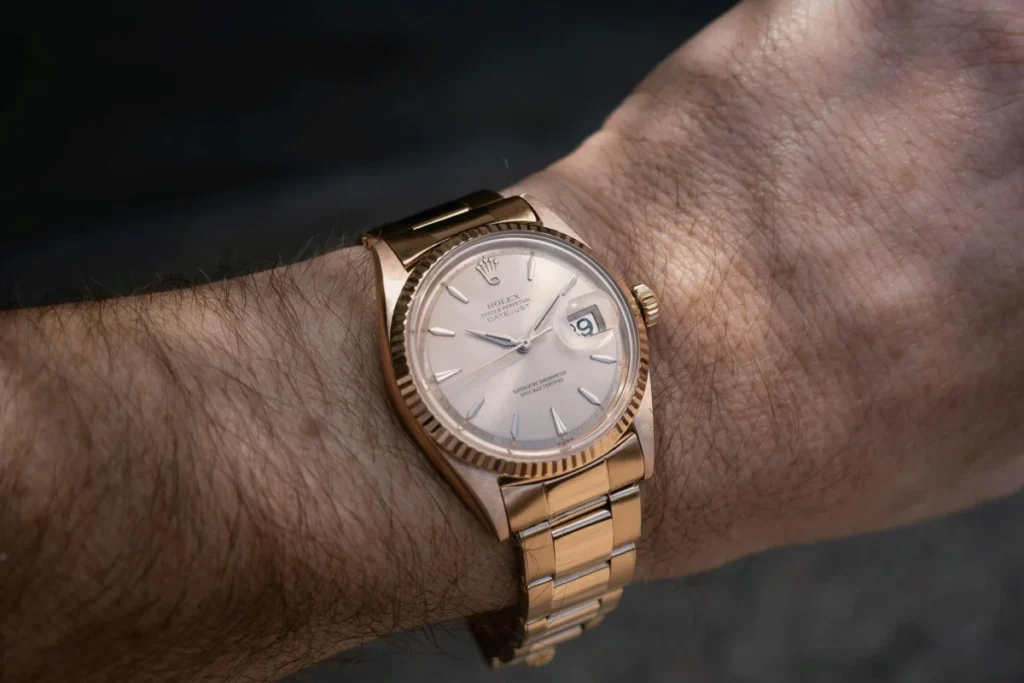
A particularly striking find is a 1964 Rolex 1601 in 18k rose gold, offered by Tropical Watch. The immediate reaction to this timepiece, described as eliciting an involuntary sound of delight, speaks volumes about its aesthetic appeal. The Rolex Datejust, particularly in precious metal variants from this era, remains a benchmark for elegant, everyday luxury. The rose gold case, coupled with a dial that likely complements its warmth, presents a sophisticated and visually arresting combination. The reference 1601, part of the iconic Datejust line, is known for its fluted bezel and timeless design. This specific example, with its apparent excellent condition and the allure of rose gold, represents a highly desirable vintage Rolex that transcends trends. The co-signing with Tiffany & Co. further enhances its provenance and desirability, adding another layer of prestige.
The Patek Philippe 5000R: An Ode to Simplicity and Refinement
The Allure of Asymmetric Design and the 5000R
The article highlights a Patek Philippe 5000R, a watch that resonates with collectors who appreciate asymmetric design elements and understated elegance. The author draws a parallel between this Patek Philippe and other esteemed timepieces known for their off-center sub-seconds hands, such as the Dufour Duality, Romain Gauthier’s C, F.P. Journe’s Chronomètre Bleu, and even the more accessible Baltic MR Classic. This comparison situates the 5000R within a lineage of watches that prioritize aesthetic balance and refined execution over overt complication. The Patek Philippe 5000R, released in 1992, predates the Dufour Duality by a few years, showcasing an early exploration of this design philosophy by a major manufacture.
A Watch Designed for the Essence of Time
The 5000R is described as an "almost pure dress watch," notably lacking a date display. This minimalist approach appeals to a desire for a simpler relationship with time, a sentiment the author articulates as an aspiration to "need only to know the time." In an era of constant data influx and demanding schedules, the idea of a watch that strips away extraneous information to focus on the fundamental measurement of time is particularly compelling. The Patek Philippe 6000 is mentioned as an alternative for those who desire a date function within a similar aesthetic framework, offering a more contemporary interpretation with that added utility.
Technical Specifications and Rare Variant
The Patek Philippe 5000R is a limited production model, with fewer than 2,000 examples ever produced. The rose gold case, measuring a contemporary yet refined 35mm, is highlighted as a less common and particularly attractive variant. The watch’s aesthetic is further elevated by its black feuille hands and a pink dial adorned with applied gold indices, creating a legible and visually captivating display. The fact that this particular example is co-signed by Tiffany & Co. adds a significant layer of collectibility and provenance, a hallmark of highly desirable vintage luxury watches. The inclusion of the original box, papers, strap, and deployant clasp further enhances its value and appeal to discerning collectors. Offered by Craft + Tailored for $38,000, this Patek Philippe 5000R represents a significant investment in a piece of horological artistry with a rich backstory, rumored to have design inspirations potentially linked to Ferrari.

The Seiko 7018-8000: An Underrated Chronograph Gem
The Appeal of Functional Complications and Compact Design
The Seiko 7018-8000 is presented as a watch that "should be better known," a sentiment that often accompanies the discovery of exceptional vintage timepieces that have flown under the radar. The article references Christian Danneman’s perspective on chronograph watch preferences, emphasizing the importance of size, date functionality, hour recorders, automatic winding, and the desirability of a flyback complication. These criteria, often difficult to meet within a specific budget, highlight the challenges faced by collectors seeking functional yet accessible chronographs. The Seiko 7018, and its close sibling the 7016, are posited as strong contenders that largely fulfill these requirements.
Technical Nuances and Value Proposition
The distinction between the Seiko 7016 and 7018 lies primarily in the chronograph subdial at 6 o’clock: the 7016 features a stacked hour recorder, while the 7018 has a 30-minute counter. Both models share key characteristics, including the absence of a running seconds hand, the presence of day and date complications, and a well-proportioned 37.5mm case size. The example under consideration, up for auction on the 9th, is described as being "one scuffed crystal away (and, perhaps, a service) from glory." Its dial is noted as excellent, with matching lume on the dial and hands, and the case appearing to retain its original finish, potentially with the original bracelet. The flyback chronograph function adds a significant layer of desirability and technical sophistication, a feature typically found in much more expensive watches. The author makes an educated assessment that this specific watch is likely a 7018-8000, differentiating it from the -7000 model based on subtle variations in case finishing and bracelet. With bids at a mere $25 at the time of writing, these Seiko chronographs represent an exceptional value proposition for their complexity and wearability.
The Zodiac "Poor Man’s Heuer" Reference 7721: Accessible Chronograph Charm
Understanding the "Poor Man’s Heuer" Phenomenon
The Zodiac chronograph reference 7721, often referred to as a "Poor Man’s Heuer" (PMH), offers a compelling entry point into the world of vintage chronographs, particularly for those who admire the aesthetic of iconic Heuer models but seek a more accessible price point. The article clarifies the origin of this designation: these watches often share cases and even movements with their more illustrious Heuer counterparts, but were produced by other brands under licensing agreements. The Zodiac 7721, powered by the robust Valjoux 7733 movement, is a 36mm reverse panda chronograph that provides significant visual appeal and functional utility for its cost.
A Legacy of Shared Cases and Movements
The reference 7721 stamped between the lugs of this Zodiac is significant, as it was also a reference number used by Heuer for similar watches. This practice of shared components and designs was common in the watch industry, allowing brands like Heuer, Tradition, Hamilton, Dugena, and LeJour to offer chronographs that mirrored the popular styles of the era without the extensive in-house development costs. The primary trade-off, as noted by the author, is the absence of the distinctive lugs found on iconic 1960s Carrera models, a stylistic compromise for those who prioritize the exact Heuer aesthetic.
A Well-Preserved Example with Enduring Appeal
The specific Zodiac example appears to be in good condition, with no visible wear-through on the chrome-plated case and nicely aged lume. The Valjoux 7733 movement is celebrated for its reliability and widespread production, suggesting a long lifespan with proper care. The reverse panda dial, a classic configuration for chronographs, offers excellent legibility and a timeless aesthetic. With no bids and a starting price of $700 for an auction on the 9th, this Zodiac chronograph presents a sound investment for collectors looking for a functional, stylish, and historically relevant timepiece that captures the essence of vintage chronograph design.
The Jaeger-LeCoultre Master Calendar Moonphase Meteorite: A Cosmic Masterpiece
The Enduring Appeal of the Triple-Date Moonphase
The article revisits the enduring classic of the triple-date moonphase complication, a function pioneered by Jaeger-LeCoultre in 1945. This complication, which displays the day, date, month, and moonphase, offers a comprehensive yet elegantly presented array of information. While vintage examples from the 1950s and 60s are available, they often show significant wear. For those seeking a contemporary interpretation of this classic complication, the Jaeger-LeCoultre Master Calendar offers a compelling option.
A Modern Interpretation with Celestial Allure
This JLC Master Calendar is presented as a contemporary alternative that retains the classic layout of the triple-date moonphase. The date and month are positioned at the top, the moonphase and running seconds at 6 o’clock, and the date indicated around the periphery of the dial. The watch features quick-set correctors for easy adjustment of the calendar functions. Significantly, this modern iteration is automatic and has been upsized to a more contemporary 40mm case. The dial, made from meteorite, adds a unique and romantic element, connecting the wearer to the cosmos. The inherent symmetry and romance of a moonphase watch featuring a dial crafted from "literal space stuff" is undeniable, offering a narrative that extends beyond mere timekeeping.
A Complete Package with a Premium Price Tag
This Jaeger-LeCoultre Master Calendar comes complete with its box, papers, and signed deployant clasp, ensuring its provenance and completeness. Offered by Subdial for £8,950, it represents a significant investment in a high-quality, modern timepiece that pays homage to a rich horological heritage while incorporating unique and captivating materials. This watch is a testament to JLC’s continued innovation and their ability to blend classic complications with contemporary design and materials.