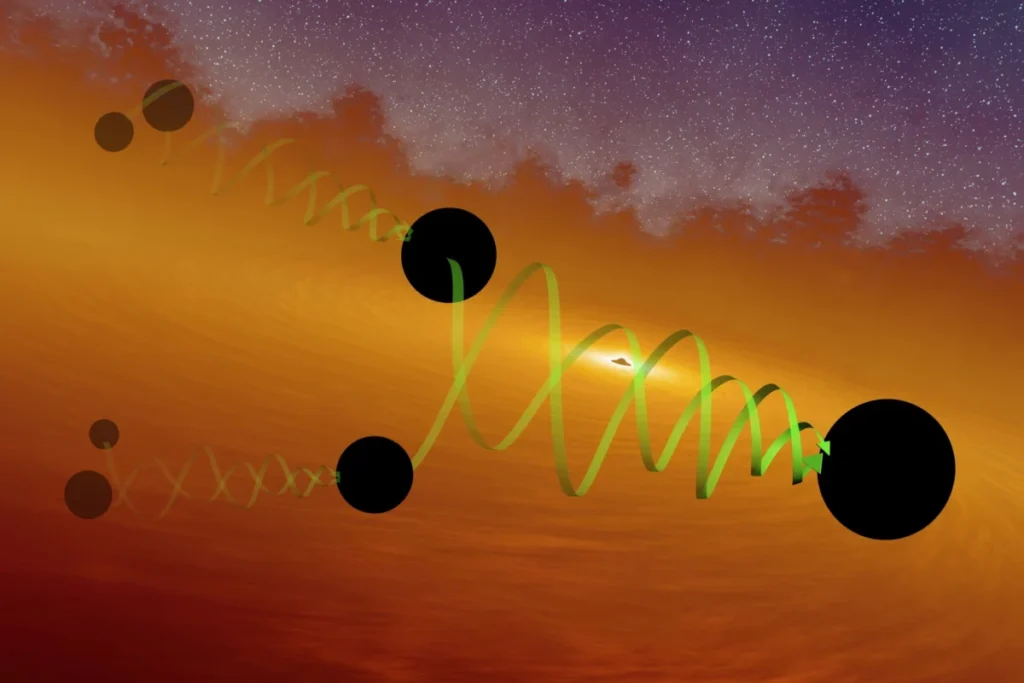
The traditional narrative of black hole formation—a massive star exhausting its fuel, collapsing under its own gravity, and detonating in a supernova—is being expanded by a groundbreaking study from the Massachusetts Institute of Technology. While the "textbook" origin story remains a fundamental pillar of astrophysics, new data suggests that the universe employs a more iterative process to create some of its most massive and rapidly spinning enigmas. According to a recent analysis of gravitational-wave data, a significant portion of merging black holes are not "first-generation" objects born directly from stars, but are instead "second-generation" entities formed from the previous collisions of smaller black holes.
This alternative pathway, known as hierarchical merging, appears to account for approximately 14 percent of the black hole mergers detected to date. The findings, published this week in the journal Physical Review Letters, provide a new lens through which scientists can view the evolution of the cosmos and the life cycles of the densest objects in existence. By analyzing 155 pairs of binary black holes, the research team has established that for many of these cosmic titans, the act of merging is "not their first rodeo."
The Shift from Stellar Collapse to Hierarchical Evolution
For decades, the scientific community focused on the stellar-mass black hole—the remnant of a single massive star. In this scenario, when a star at least 20 times the mass of our sun reaches the end of its life, its core collapses into a singularity. Because much of the star’s angular momentum is lost during the violent explosion of its outer layers, the resulting black hole is expected to have very little spin.
However, the advent of gravitational-wave astronomy has challenged this singular view. Since the first detection of gravitational waves in 2015, the Laser Interferometer Gravitational-Wave Observatory (LIGO) in the United States, along with the Virgo detector in Italy and the KAGRA observatory in Japan, have cataloged hundreds of merger events. Many of these events involve black holes with masses and spins that do not fit the traditional stellar collapse model.
Hierarchical merging offers an explanation for these anomalies. In dense stellar environments, such as globular clusters or the centers of galaxies, black holes are packed tightly together. In these "cosmic laboratories," a black hole formed from a supernova can find a partner and merge. The resulting "second-generation" black hole is not only more massive but also inherits the orbital angular momentum of the collision, causing it to spin at incredible speeds—often reaching 70 percent of its theoretical maximum spin.
Deciphering the "Wobble" in Gravitational Waves
To identify these second-generation black holes, the MIT team, led by graduate student Cailin Plunkett and Associate Professor Salvatore Vitale, focused on a phenomenon known as orbital precession, or "wobbling."
When two black holes orbit each other before a merger, they typically do so in a flat, disk-like plane. If the black holes have little to no spin—as expected of first-generation objects—the orbital plane remains stable. However, if one or both black holes possess a high degree of spin, and if that spin is misaligned with the orbital plane, the entire system begins to wobble. This precession leaves a distinct imprint on the gravitational waves emitted by the system, which can be detected by the LIGO-Virgo-KAGRA network.
"The degree to which the whole plane wobbles, or precesses, can tell us about the balance of masses and spins between the two spiraling black holes," the researchers noted. By developing a sophisticated analytical model to capture these specific wobbles, the team was able to sift through the Gravitational Wave Transient Catalog 4.0 (GWTC-4.0). Their analysis revealed that roughly one out of every seven detected mergers involved a lopsided pair, where one partner was significantly more massive and faster-spinning than the other—a clear hallmark of a hierarchical merger.
Solving the Mystery of the "Mass Gap"
One of the most compelling aspects of the MIT study is its ability to explain black holes that theoretically should not exist. Stellar evolution models suggest a "mass gap" between roughly 45 and 130 solar masses. This is due to a phenomenon called a pair-instability supernova. When a star is massive enough to produce a core in this range, the explosion is so violent that it completely obliterates the star, leaving behind no remnant at all.
"Stellar evolution theory predicts you shouldn’t be able to form black holes in that mass range at all from just a supernova," Plunkett explained. "Yet we have seen black holes that are that massive. And the question is: Where did they come from?"
The data suggests they come from the repeated merging of smaller black holes. The MIT analysis found that while 10 and 30 solar-mass black holes are common "first-generation" products, the second-generation population tends to cluster around 20 solar masses, 40 solar masses, and higher. By bypassing the limitations of stellar death, hierarchical merging allows the universe to build massive black holes that the traditional supernova process cannot produce.
A Chronology of Discovery: From 2015 to GWTC-4.0
The journey to this discovery has been marked by a decade of rapid technological and theoretical advancement. The timeline of gravitational-wave astronomy illustrates how the scientific community moved from proving the existence of black holes to understanding their complex family trees:
- September 2015: LIGO makes the first-ever detection of gravitational waves (GW150914), confirming a merger of two black holes and proving Einstein’s General Theory of Relativity.
- 2017-2020: The Virgo and KAGRA detectors join the global network, allowing for better localization of events in the sky. Multiple "observing runs" (O1, O2, O3) increase the catalog of events from a handful to nearly 100.
- 2023-2024: The fourth observing run (O4) begins, utilizing upgraded sensitivity to detect more distant and fainter signals.
- Early 2024: Scientists identify two specific signals, GW241011 and GW241110. These events serve as the catalyst for the MIT study, as they show clear evidence of lopsided mergers involving highly spinning components.
- Late 2024: The MIT team publishes their comprehensive analysis of 155 events, establishing the 14 percent hierarchical merging frequency.
Implications for Dense Stellar Environments
The confirmation of hierarchical merging as a significant pathway has profound implications for our understanding of where black holes "live." For these mergers to occur repeatedly, black holes must exist in environments where they are frequently brought into close proximity.
"You might have a ton of stars whizzing around each other, and if some are massive and explode, they become black holes. The black holes continue to whizz around, and can capture each other and merge," Plunkett said.
This points toward globular clusters—ancient, tightly packed groups of stars—and the active galactic nuclei (AGN) at the centers of galaxies as the primary "factories" for second-generation black holes. In these regions, the gravitational influence of thousands of stars and the presence of gas disks can force black holes to interact, facilitating the multi-stage merging process. This research suggests that the universe is far more dynamic than a collection of isolated stellar deaths; it is a system of constant recycling and growth.
Future Outlook and Broader Scientific Impact
The MIT study, supported by the National Science Foundation and the Brinson Foundation, marks a turning point in gravitational-wave phenomenology. As the sensitivity of the LIGO-Virgo-KAGRA network continues to improve, and as next-generation detectors like the Einstein Telescope and Cosmic Explorer are planned, the percentage of identified hierarchical mergers is expected to grow.
Beyond just identifying the "generation" of a black hole, this research allows physicists to test the limits of General Relativity in extreme gravity environments. Each merger is a high-energy event that ripples the fabric of spacetime, and understanding the starting parameters—the masses and spins—of the colliding objects is essential for accurate modeling.
The realization that 14 percent of merging black holes are second-generation products changes the way astrophysicists calculate the population density of black holes in the universe. It suggests that the "population" of black holes is not a static number determined by the birth and death of stars, but a shifting demographic that evolves through cosmic time.
As Salvatore Vitale, associate professor of physics at MIT, noted, the discovery of these fast-spinning, "heavy" black holes provides the missing link in the story of cosmic evolution. By recognizing that black holes can be the "parents" of even larger black holes, science has moved one step closer to understanding the true complexity of the dark, invisible side of our universe. The "textbook" origin story hasn’t been discarded; it has simply been revealed as the first chapter in a much longer and more violent cosmic history.