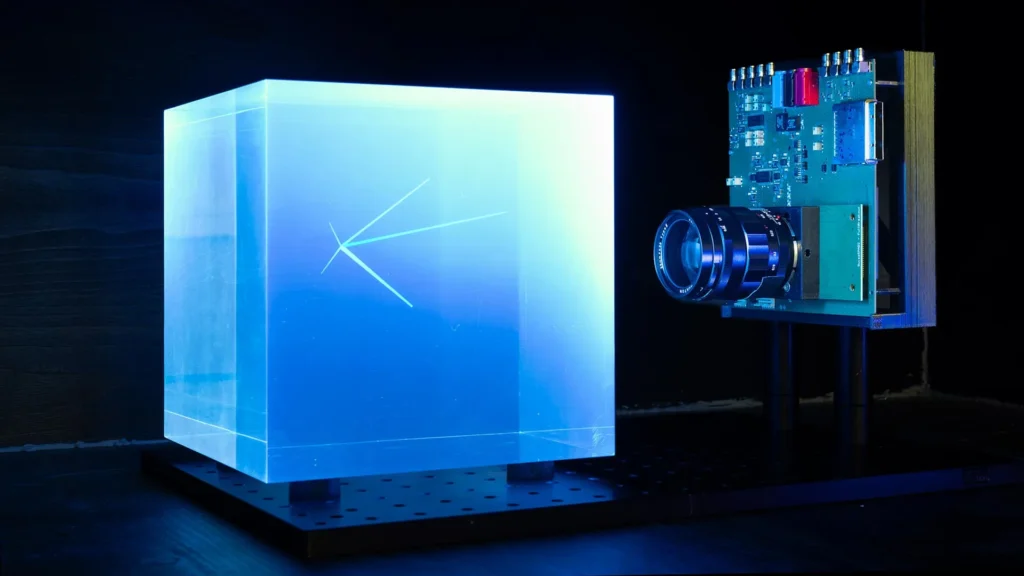
Some breakthroughs in physics come from brand new inventions. Others begin with a new theory. But many advances happen when researchers combine familiar technologies in an unexpected way and create something more powerful than the individual parts. This principle is now at the heart of a groundbreaking development in particle detection, promising to revolutionize how scientists hunt for elusive particles like neutrinos and dark matter, and potentially transform medical imaging. Researchers at ETH Zurich and EPFL have unveiled a prototype detector, dubbed PLATON, that leverages advanced camera technology to achieve ultrafast, high-resolution three-dimensional (3D) particle imaging within a large, unsegmented block of scintillator material, circumventing the growing complexities and costs of traditional segmented detectors.
The Enduring Challenge of Detecting Elusive Particles
The quest to understand the fundamental building blocks of the universe often hinges on detecting particles that are notoriously difficult to observe. Among the most challenging are weakly interacting particles, such as neutrinos and hypothetical dark matter candidates. Neutrinos, often called "ghost particles," are incredibly light and interact with ordinary matter only through the weak nuclear force, meaning they can pass through entire planets without leaving a trace. Similarly, dark matter, which constitutes about 27% of the universe’s mass, interacts gravitationally but has eluded direct detection due to its minimal interaction with electromagnetic and strong nuclear forces.
To catch the faint signals produced by these elusive entities, physicists typically employ massive detectors. These instruments aim to increase the probability of interaction by using vast quantities of sensitive material and striving for ever-finer spatial resolution to pinpoint where an interaction occurred. However, this traditional approach has led to a burgeoning problem: complexity and cost. Building larger detectors with improved resolution usually means segmenting the sensitive material into millions of tiny, individually read-out units, transforming the engineering and financial landscape of high-energy physics experiments. The same demands for precision and scale apply to calorimeters, vital devices in collider experiments that measure the energy carried by particles.
The Bottleneck of Traditional Detector Design
The core requirement for most particle physics experiments is the ability to reconstruct the 3D paths of elementary particles as they traverse dense materials. Scintillators are a common choice for this task. When a charged particle passes through a scintillator, the material emits tiny flashes of visible light. By detecting these flashes, scientists can infer the particle’s trajectory and how it interacted with the detector medium.
To achieve high spatial precision, scintillators are traditionally divided into a vast number of small, active sections. Optical fibers collect the photons produced in each section, guiding them to photodetectors like photomultiplier tubes (PMTs) or silicon photomultipliers (SiPMs), which then count the photons. While highly precise, this segmented approach faces significant scalability challenges.
Consider the T2K (Tokai to Kamioka) neutrino-oscillation experiment in Japan, designed to study how neutrinos change from one type to another. Its detector utilizes approximately two tons of sensitive material, meticulously constructed from about two million individual scintillator cubes and interwoven with 60,000 optical fibers. At CERN, the European Organization for Nuclear Research, and the Paul Scherrer Institute, experiments like LHCb (Large Hadron Collider beauty) and Mu3e achieve sub-millimeter spatial resolution by employing millions of thin scintillating optical fibers. These technological marvels undeniably demonstrate the power of segmented detectors, but they also highlight a critical and escalating problem. As detectors grow in size and complexity, the manufacturing, assembly, calibration, and readout of millions of individual components become an immense technological and financial bottleneck, pushing the limits of current engineering capabilities and budget allocations.
PLATON: A Paradigm Shift in Particle Tracking
Addressing this escalating challenge, researchers at ETH Zurich and EPFL (Swiss Federal Institute of Technology Lausanne) have proposed and successfully prototyped a radically different strategy. Instead of fragmenting the detector into myriad tiny units, their system employs advanced camera technology to reconstruct the origin of light within a single, large, unsegmented block of scintillator material. This innovative approach, detailed in a recent publication in Nature Communications, promises to simplify detector construction, reduce costs, and open new avenues for particle physics research.
The interdisciplinary team behind PLATON includes PhD student Till Dieminger, senior scientist Dr. Saúl Alonso-Monsalve, Professor Davide Sgalaberna and his group at ETH Zurich, alongside members of the Advanced Quantum Architecture Lab at EPFL in Lausanne, led by Professor Edoardo Charbon. Their collaboration has culminated in the first prototype designed to perform ultrafast, high-resolution 3D particle imaging, marking a significant departure from conventional methods.
Turning Light Field Photography into a Physics Tool
The ingenuity of PLATON lies in its inspiration from plenoptic cameras, commonly known as light field cameras. Unlike conventional cameras that primarily record the intensity of incoming light to create a 2D image, a light field camera captures not only the intensity but also crucial information about the direction from which the light arrived. This additional directional data enables the camera to recover depth information and reconstruct a scene in three dimensions, much like a human eye perceives depth.
The technology relies on a micro-lens array (MLA), a precisely manufactured grid of microscopic lenses, positioned between the camera’s main lens and its imaging sensor. Each microscopic lens functions as a tiny individual camera, capturing the same scene from a slightly different angle. When the vast amount of information from all these micro-lenses is processed and combined, the system can reconstruct a "light field," a comprehensive description that includes the intensity, position, and direction of all incoming light rays.
For particle detection, this capability is profoundly valuable, especially given that the light signals produced within a scintillator by a weakly interacting particle can be exceedingly faint, often consisting of only a handful of photons. The true breakthrough comes when plenoptic cameras are paired with Single-Photon Avalanche Diode (SPAD) array sensors. SPADs are semiconductor devices capable of detecting individual photons with high efficiency and precise timing. This combination allows PLATON to potentially reconstruct particle tracks even when very little light is available, a critical advantage in low-signal environments. Despite their obvious promise, light field cameras had not been previously explored for particle tracking applications, making PLATON a pioneering effort in this domain.
Inside the PLATON Prototype: Engineering and Functionality
The development of the new system was made possible through the PLATON project, generously funded by the Swiss National Science Foundation, underscoring Switzerland’s commitment to cutting-edge scientific research. The ETHZ-EPFL team constructed a robust proof-of-concept detector by seamlessly integrating a custom-designed micro-lens array with a state-of-the-art SPAD imaging sensor.
The heart of the imaging system is the SwissSPAD2 sensor, a highly advanced SPAD array developed by the EPFL team, renowned for its sensitivity and speed. The micro-lens array, crucial for capturing directional light information, was designed by Raytrix GmbH, a company specializing in light field technology, and meticulously mounted directly onto the SwissSPAD2 sensor to form the complete plenoptic imaging system.
A key feature of the SwissSPAD2 sensor is its capability for "gated photon detection." This functionality means the sensor can be programmed to record photons only within precisely defined time windows. This timing control is instrumental in distinguishing genuine scintillation light signals, which occur in a very specific time frame after a particle interaction, from random background noise and other spurious counts that would otherwise obscure the faint signals of interest. This active filtering dramatically improves the signal-to-noise ratio, enhancing the detector’s sensitivity and accuracy.
Rigorous Testing and Validation: Proving the Concept
The researchers subjected the PLATON prototype to a series of rigorous laboratory experiments to evaluate its spatial resolution under various conditions. They tested the detector’s performance across a wide range of light levels, from several hundred detected photons down to an astonishingly low count of just five photons. This demonstrated its remarkable sensitivity, crucial for detecting weakly interacting particles.
Beyond light level tests, the team also assessed the prototype’s ability to detect actual charged particles. They successfully used a strontium-90 radioactive source to produce electrons and then reconstructed their positions within a block of plastic scintillator material. Strontium-90 is a commonly used beta emitter, providing a reliable source of electrons for such calibration and testing.
A critical aspect of the validation process involved comparing the laboratory measurements with extensive computer simulations. The strong agreement between the experimental data and the simulation results provided the researchers with high confidence that their theoretical models accurately describe the detector’s performance, laying a solid foundation for future development and scaling. These early results from the first demonstrator have already been instrumental in shaping the team’s plans for the next, more advanced version of PLATON.
The Road Ahead: Faster Timing, Greater Sensitivity, and AI Integration
Building on the success of the prototype, the ETH Zurich and EPFL teams are now focused on developing a new generation of SPAD array sensors. This upgraded sensor is designed to achieve even greater photon detection efficiency and, crucially, provide sub-nanosecond timing resolution for individual photons. While the current system assigns photons to fixed time windows, the future version will equip each detected photon with its own precise time stamp. This added timing information will be invaluable, enabling the system to determine the origin of each photon with unprecedented accuracy and significantly improving the reconstruction of complex particle tracks.
Concurrently, the researchers are optimizing the plenoptic camera’s optical design to expand its field of view and collect even more light. Simulations presented in their Nature Communications paper strongly suggest that these enhancements, combined with improved timing, will further boost PLATON’s spatial resolution, pushing the boundaries of what is achievable in unsegmented detectors.
One of the most exciting advancements in the next phase involves the integration of artificial intelligence for signal processing. The team used simulations to estimate the performance of an upgraded PLATON system in detecting neutrinos, incorporating a novel image-processing method based on a neural network (NN). This NN utilizes a Transformer architecture, a sophisticated design commonly employed in large language models, but adapted here to analyze patterns within physical data. Instead of processing words, this Transformer examines the intricate correlations among the scintillation photons recorded by the detector – specifically, where and when these photons appear. This allows the AI to reconstruct the original particle interaction with high fidelity, even amidst noise and ambiguity.
The simulations are highly encouraging, indicating that an unsegmented PLATON detector with a modest volume of (10x10x10) cm³ could realistically achieve a spatial resolution below 1 mm. Furthermore, the simulations suggest that the system could identify neutrino interactions that produce final-state low-momentum protons with both high purity and high efficiency. This capability is critical for neutrino oscillation experiments, where the precise identification of interaction products is key to understanding fundamental neutrino properties and potentially uncovering new physics beyond the Standard Model.
Scaling Up: A Vision for Next-Generation Detectors
The true transformative potential of PLATON lies in its scalability. The researchers also explored how this technology might perform in a much larger detector. Due to the immense computational resources required for full neutrino simulations in a cubic-meter volume, they modeled a simplified point-like source of photons within a one-cubic-meter block of unsegmented scintillator.
The results of these simulations are striking: they suggest that a detector of this size could achieve a spatial resolution of a few millimeters. This performance places it on par with state-of-the-art segmented plastic scintillator detectors currently in operation. The crucial distinction, however, is that PLATON achieves this performance without dividing the scintillator into millions of individual pieces. This eliminates the manufacturing, assembly, and readout complexities that plague current large-scale experiments, offering a pathway to significantly simpler, more robust, and potentially more cost-effective next-generation detectors. The authors are optimistic that with additional improvements to the optical design and other system components, sub-millimeter resolution could eventually be achieved in PLATON-type detectors with volumes exceeding 1m³. This could pave the way for future flagship experiments, such as DUNE (Deep Underground Neutrino Experiment) or Hyper-Kamiokande, to be constructed with unprecedented scale and precision.
Beyond Particle Physics: Broad Societal Impact
The implications of the PLATON technology extend far beyond the realm of fundamental particle physics experiments and high-energy colliders. Because PLATON is fundamentally designed to reconstruct the 3D position of faint light signals with high precision, it holds the potential to improve a wide array of imaging systems across various scientific and medical disciplines.
In a tangible demonstration of this broader applicability, Dieminger, Alonso-Monsalve, and Sgalaberna have already filed three separate patents related to the use of PLATON technology in Positron Emission Tomography (PET). PET is a vital medical imaging method that tracks radioactive tracers introduced into the body to visualize metabolic activity and blood flow in organs and tissues, crucial for diagnosing cancers, heart disease, and neurological conditions. The patents encompass both the innovative scanner design derived from PLATON’s principles and the advanced image-processing techniques, including the neural network developed by Alonso-Monsalve.
By enhancing the resolution and speed of PET scanners, PLATON could enable earlier and more accurate disease detection, more precise localization of tumors, and potentially reduce radiation doses for patients by allowing for shorter scan times or lower tracer concentrations. This would represent a significant leap forward in medical diagnostics.
The history of particle physics is replete with examples of fundamental research yielding technologies that later find widespread societal applications. The World Wide Web, for instance, was conceived at CERN to facilitate information sharing among physicists. Similarly, proton therapy, a highly precise form of radiation treatment for cancer, grew directly from advances in particle accelerators and radiation physics. PLATON is poised to become another illustrious example of how investments in fundamental physics research can lead to transformative technologies with major scientific, industrial, and medical applications, underscoring the profound and often unexpected dividends of pushing the boundaries of human knowledge.






