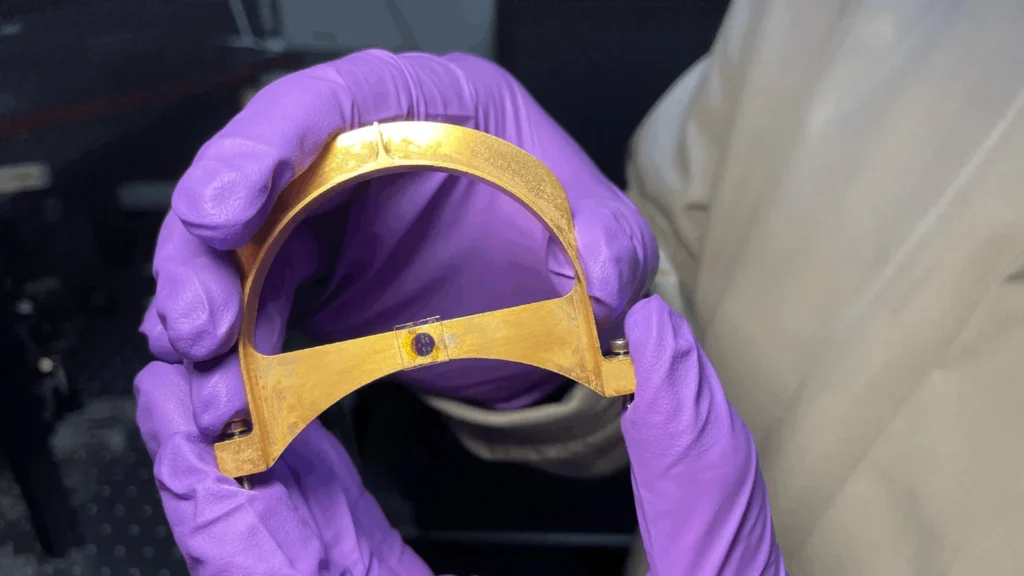
A significant hurdle in the advancement of quantum computing and communication—the need for extreme refrigeration—may soon become a relic of the past, thanks to a groundbreaking development by researchers at Stanford University. The team has engineered a nanoscale optical device capable of operating efficiently at room temperature, a stark departure from the ultra-cold environments typically required for maintaining the delicate quantum states essential for computation and communication. This innovation, which successfully links the quantum properties of light and electrons, represents a pivotal step towards developing smaller, lower-cost, and more practical quantum technologies, potentially enabling the transmission of quantum information over long distances without the formidable infrastructure currently demanded.
The Cryogenic Conundrum: A Major Hurdle in Quantum Computing
For decades, the promise of quantum computing has been tempered by the immense practical challenges associated with its implementation. Most quantum computers today are notoriously difficult and expensive to operate, primarily because they require temperatures near absolute zero—approximately -459 degrees Fahrenheit, or just a few millikelvin above 0 Kelvin. This extreme cold is not merely a preference but a necessity, serving to suppress thermal noise and environmental interference that can cause fragile quantum states to collapse, a phenomenon known as decoherence. Maintaining these cryogenic conditions involves sophisticated and costly dilution refrigerators, which are bulky, energy-intensive, and limit the scalability and portability of quantum systems. The logistical complexities and exorbitant energy consumption of these systems have confined quantum research largely to specialized laboratories, hindering its widespread adoption and commercial viability. Overcoming this cryogenic barrier has been a holy grail for quantum physicists and engineers, promising to unlock a new era of quantum innovation beyond the confines of highly controlled environments.
A New Paradigm: Room-Temperature Quantum Entanglement
The Stanford breakthrough directly addresses this fundamental challenge. The newly developed nanoscale optical device functions robustly at ambient temperatures, marking a significant departure from the prevailing paradigm. At its core, the device facilitates entanglement between photons, the fundamental particles of light, and electrons. This intricate quantum connection is universally recognized as a foundational requirement for the realization of future quantum communication systems, including the elusive quantum internet. By achieving this entanglement without the need for supercooling, the Stanford team has opened up new avenues for research and development that could dramatically reduce the size, cost, and complexity of quantum hardware.
"The material in question is not really new, but the way we use it is," explains Jennifer Dionne, a professor of materials science and engineering at Stanford and the senior author of the study, which was published in Nature Communications. "It provides a very versatile, stable spin connection between electrons and photons that is the theoretical basis of quantum communication. Typically, however, the electrons lose their spin too quickly to be useful." This statement underscores the ingenuity of the approach: rather than inventing new exotic materials, the researchers found a novel method to harness existing ones to overcome a critical limitation. The stability achieved at room temperature is particularly noteworthy, given the inherent fragility of quantum states.
Unpacking the Science: Molybdenum Diselenide and Twisted Light
The device’s architecture is a testament to sophisticated materials science and nanophotonics. It combines a thin, patterned layer of molybdenum diselenide (MoSe2) with a nanopatterned silicon substrate. Molybdenum diselenide belongs to a family of materials known as transition metal dichalcogenides (TMDCs), which have garnered considerable attention in recent years for their exceptional optical, electronic, and quantum properties. These two-dimensional (2D) materials exhibit strong light-matter interaction and spin-valley coupling, making them ideal candidates for quantum applications. MoSe2, in particular, is known for its robust exciton (bound electron-hole pair) physics and strong spin-orbit coupling, which is crucial for manipulating electron spin.
According to the researchers, the silicon nanostructures embedded within the device play a critical role by generating what they refer to as "twisted light." "The Silicon nanostructures enable what we call ‘twisted light,’" explains Feng Pan, a postdoctoral scholar in Dionne’s lab and the paper’s first author. "The photons spin in a corkscrew fashion, but more importantly, we can use these spinning photons to impart spin on electrons that are the heart of quantum computing."
This "twisted light" refers to photons carrying orbital angular momentum (OAM), a property distinct from their polarization (spin angular momentum). While traditional optics primarily manipulates the polarization of light, OAM adds another degree of freedom, allowing light to carry more information and interact with matter in unique ways. The silicon nanostructures are meticulously designed to impart this OAM onto the photons, causing them to propagate in a helical or corkscrew-like trajectory. This precise manipulation of light’s angular momentum then allows for the efficient transfer of quantum information, specifically spin, to electrons within the MoSe2 layer.
Dionne notes that the patterned structures are incredibly small, roughly comparable in size to visible light wavelengths and imperceptible to the naked eye. "The patterned nanostructures are imperceptible to the human eye, about the size of the wavelength of visible light," Dionne adds. "But they help us manipulate photons very precisely to make them spin—to twist them—in a specific direction, for example, up or down." This level of nanoscale engineering is crucial for achieving the strong light-matter coupling necessary to preserve quantum coherence at higher temperatures. The intimate interaction between the twisted photons and the electrons in the TMDC material creates a stable entangled state, a feat previously challenging to achieve outside of cryogenic environments.
Qubits and Decoherence: The Building Blocks and Their Fragility
To appreciate the full impact of this Stanford innovation, it’s essential to understand the fundamental principles of quantum information. In conventional computing, information is represented by bits, which exist in one of two states: 0 or 1. In quantum technologies, the basic building blocks are qubits (quantum bits). Unlike classical bits, qubits can leverage quantum mechanical effects like superposition and entanglement. Superposition allows a qubit to exist in a combination of 0 and 1 simultaneously, while entanglement links the fates of two or more qubits, such that the state of one instantaneously influences the state of the others, regardless of distance. These properties empower quantum computers to process and transmit information in entirely new, profoundly powerful ways, potentially solving problems intractable for even the most powerful classical supercomputers.
However, one of the biggest challenges facing quantum technologies is maintaining these stable quantum states. Qubits are incredibly fragile and highly susceptible to environmental disturbances such as stray electromagnetic fields, vibrations, or even thermal fluctuations. This susceptibility leads to decoherence, a process where the delicate quantum information stored in a qubit is lost, causing it to revert to a classical state. In many existing quantum systems, extreme cooling is necessary precisely to prevent decoherence by isolating the qubits from thermal energy, which is a major source of environmental noise. The energy associated with even slight temperature increases can be enough to disrupt quantum entanglement and superposition.
Because the new device operates at room temperature, it effectively circumvents one of the major obstacles that has historically limited the widespread use and scalability of quantum technologies. By achieving stable quantum entanglement at ambient conditions, the Stanford device demonstrates a pathway to systems that are inherently more robust against thermal decoherence, reducing the need for costly and cumbersome cryogenic infrastructure. This compact design is also described as relatively inexpensive and practical compared with many current quantum systems, which often resemble room-sized laboratories rather than integrated circuits.
Implications for a Quantum Future
The potential ramifications of this breakthrough are far-reaching, touching upon various sectors poised for disruption by quantum technologies.
- Quantum Communication and the Quantum Internet: The ability to entangle photons and electrons at room temperature is a crucial step toward building robust quantum communication networks. Such networks could enable ultra-secure communication through quantum key distribution (QKD), where the laws of quantum mechanics guarantee that any eavesdropping attempt would be immediately detectable. A global quantum internet, allowing for secure data transmission and distributed quantum computing, moves closer to reality with devices that don’t require specialized cooling stations at every node.
- Advanced Sensing: Quantum entanglement can lead to sensors with unprecedented precision, far exceeding classical limits. Room-temperature quantum devices could revolutionize medical imaging, navigation systems, and fundamental scientific instruments, allowing for more accurate measurements of magnetic fields, gravity, and time.
- High-Performance Computing and Artificial Intelligence: While directly building a room-temperature quantum computer is a more complex challenge, this work contributes foundational elements. Stable, room-temperature qubits could simplify the architecture of quantum processors, making them more accessible for specific computational tasks. In AI, quantum algorithms hold the promise of accelerating machine learning, pattern recognition, and optimization problems.
- Accessibility and Miniaturization: The compact and relatively inexpensive nature of the new device stands in stark contrast to the massive and costly cryogenic systems currently dominating the field. Removing the need for extreme cooling dramatically reduces the footprint and operational costs of quantum components, paving the way for miniaturization and integration into a wider array of devices. This could democratize access to quantum technologies, moving them from niche laboratory tools to more mainstream applications.
Collaborative Research and Future Directions
The success of this project is also a testament to interdisciplinary collaboration. The team specifically selected TMDC materials because of their unusual quantum characteristics, and they collaborated with Stanford researchers Fang Liu and Tony Heinz, who specialize in these materials and their unique properties. This synergy between materials science, nanophotonics, and quantum physics was essential for overcoming the complex challenges involved.
"It all comes down to this material and our Silicon chip," Pan emphasizes. "Together, they efficiently confine and enhance the twisting of light to create a strong coupling of spin between photons and electrons. This stabilizes the quantum state that makes quantum communication possible." The combination allows light and matter to interact more strongly, helping preserve the quantum properties needed for communication and computing tasks, even under ambient conditions.
Looking ahead, the researchers are continuing to improve the device, exploring additional TMDC materials and novel material combinations that could deliver even better performance and efficiency. They are also investigating whether these new systems might reveal novel quantum capabilities that are not currently possible at room temperature, potentially uncovering new physics or new applications. A longer-term goal involves integrating devices like this into larger, more complex quantum networks. Achieving that ambitious vision will require concurrent improvements in supporting technologies such as high-efficiency light sources, rapid modulators, sensitive detectors, and robust interconnects capable of transmitting quantum information across vast distances.
Broader Context: The Race for Quantum Supremacy
This Stanford breakthrough occurs within a global race for quantum supremacy, where nations and technology giants are investing billions in quantum research and development. Companies like IBM, Google, Microsoft, and Intel are all striving to build fault-tolerant quantum computers and robust quantum networks. Governments, including the U.S., China, and the European Union, have launched national quantum initiatives, recognizing the strategic importance of quantum technologies for national security, economic competitiveness, and scientific advancement. The ability to operate quantum devices at room temperature significantly lowers the barrier to entry, potentially accelerating research and development across the entire quantum ecosystem. It moves quantum technology from a distant theoretical possibility to a more tangible, engineering-focused challenge.
Ultimately, researchers hope that quantum components can be miniaturized enough to be incorporated into everyday electronics, transforming everything from secure messaging to personal computing. While that future remains many years away, the work represents a monumental step toward making quantum technology more accessible, practical, and pervasive. "If we can do that, maybe someday we could do quantum computing in a cell phone," Pan says with a smile. "But that’s a 10-plus-year plan." This vision, while ambitious, highlights the transformative potential of removing the cryogenic shackles from quantum science, bringing the quantum revolution closer to everyday reality.