A groundbreaking advancement in additive manufacturing, developed by researchers at EPFL’s School of Engineering, is poised to revolutionize the creation of intricate metal and ceramic objects. This innovative approach overcomes the inherent limitations of traditional vat photopolymerization, a popular 3D printing method, by decoupling the printing process from material composition. This allows for the fabrication of unprecedentedly strong, dense, and complex structures with significantly reduced shrinkage and warping, opening doors to a new era of high-performance materials for advanced technological applications.
The Challenge of Traditional Vat Photopolymerization
Vat photopolymerization, a cornerstone of many 3D printing applications, relies on a light-sensitive liquid resin. In this process, a build platform is submerged in a vat of this liquid, and a laser or ultraviolet light selectively cures or solidifies specific areas, layer by layer, to form a three-dimensional object. While this method offers remarkable precision and the ability to create complex geometries, its utility has been historically confined to materials that are inherently photopolymerizable. This means that the direct printing of robust materials like metals and ceramics using this technique has been largely out of reach.
While some researchers have explored indirect methods, attempting to convert printed polymer structures into metals or ceramics, these approaches have been plagued by significant drawbacks. Daryl Yee, the leader of the Laboratory for the Chemistry of Materials and Manufacturing at EPFL, highlights the critical issues: "These materials tend to be porous, which significantly reduces their strength, and the parts suffer from excessive shrinkage, which causes warping." This inherent porosity and shrinkage limit the structural integrity and dimensional accuracy of the final components, hindering their application in demanding fields. The dream of directly 3D printing high-performance metal and ceramic parts with the finesse of photopolymerization remained largely unfulfilled until now.
A Paradigm Shift: Printing the Framework First
The EPFL team’s innovative solution, detailed in a recent publication in the prestigious journal Advanced Materials, represents a fundamental departure from previous methodologies. Instead of attempting to directly print with a resin already imbued with metal or ceramic precursors, they have devised a two-stage process that prioritizes the creation of a precise structural scaffold.
The first stage involves utilizing a simple, water-based gel known as a hydrogel. This readily available and biocompatible material serves as the printing medium. Researchers employ standard vat photopolymerization techniques to print a highly detailed, three-dimensional framework from this hydrogel. This framework acts as a mold or blueprint for the final object.
The true innovation lies in the subsequent "growth" phase. Once the hydrogel framework is printed, it is submerged in a solution containing metal salts. Through a series of carefully controlled chemical reactions, these metal salts are converted into tiny, metal-containing nanoparticles. These nanoparticles are then chemically bonded and dispersed throughout the hydrogel matrix. This process is not a one-off event; it is repeated multiple times, known as "growth cycles." Each cycle infuses more metal salts, which are then converted into nanoparticles, leading to a progressively higher concentration of metal within the hydrogel structure. This iterative approach allows for the creation of composites with exceptionally high metal content, far exceeding what was previously achievable with direct printing methods.
From Gel to Dense Metal: The Final Transformation
After approximately 5 to 10 of these meticulously controlled "growth cycles," the hydrogel framework has been thoroughly infiltrated with metal nanoparticles. The final step involves removing the hydrogel component. This is achieved through a simple heating process, which vaporizes the water and decomposes the hydrogel, leaving behind a dense, solid object composed entirely of metal or ceramic. Crucially, this resulting object precisely replicates the intricate shape of the original printed hydrogel template.
A significant advantage of this sequential approach is its inherent material flexibility. Because the metal salts are introduced after the printing of the hydrogel framework, the same generic hydrogel template can be used to produce a wide array of different materials. By simply changing the specific metal salt solutions used in the growth cycles, researchers can create objects from various metals, ceramics, or even complex composite materials, all from the same initial 3D printed blueprint. This adaptability significantly broadens the potential applications and simplifies the manufacturing workflow.
Unprecedented Strength and Precision
The implications of this new technique are profound, particularly concerning the strength and dimensional stability of the printed objects. Daryl Yee articulates the core achievement: "Our work not only enables the fabrication of high-quality metals and ceramics with an accessible, low-cost 3D printing process; it also highlights a new paradigm in additive manufacturing where material selection occurs after 3D printing, rather than before." This paradigm shift fundamentally alters how complex material structures can be designed and manufactured.
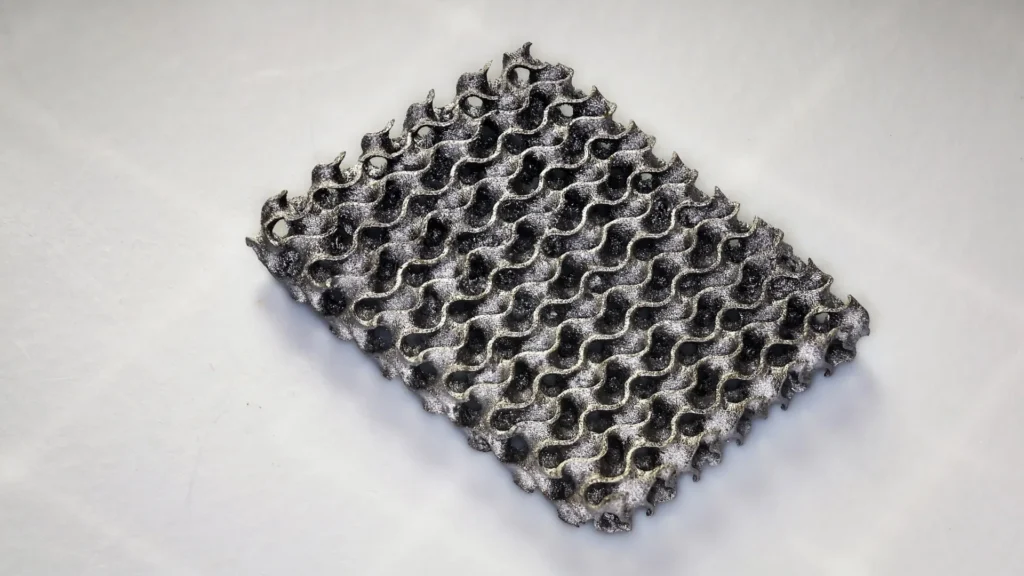
To validate the efficacy of their method, the research team focused on fabricating intricate mathematical lattice structures known as gyroids. These gyroids were produced using iron, silver, and copper. The choice of gyroids is significant; these structures are known for their high surface area and complex internal architecture, making them ideal for applications requiring both strength and specific functional properties.
The strength of these gyroid structures was rigorously tested using a universal testing machine. This device applies increasing pressure to a sample until it deforms or fractures, providing quantitative data on its mechanical resilience. The results were remarkable. "Our materials could withstand 20 times more pressure compared to those produced with previous methods, while exhibiting only 20% shrinkage versus 60-90%," reports PhD student Yiming Ji, the first author of the study. This dramatic improvement in strength and reduction in shrinkage directly addresses the critical limitations of earlier indirect conversion methods. The ability to produce structures that are both exceptionally strong and dimensionally stable opens up entirely new avenues for innovation.
Targeting Advanced 3D Architectures and Future Applications
The EPFL team’s technique is particularly well-suited for the fabrication of advanced 3D architectures that demand a combination of high strength, low weight, and intricate complexity. Such requirements are paramount in a range of cutting-edge fields.
1. Sensors: The high surface area and controllable porosity achievable with this method are ideal for creating advanced sensor components. For instance, intricate metal frameworks can be designed to efficiently capture and detect specific chemical or biological analytes. The ability to precisely control the nanostructure of the metal allows for tunable sensitivity and selectivity.
2. Biomedical Devices: The biocompatibility of hydrogels, coupled with the potential to create dense, non-porous metal or ceramic implants, makes this technique highly relevant for the medical field. For example, custom-designed bone implants with intricate porous structures for bone ingrowth, or advanced surgical tools with superior strength and durability, could be manufactured with unprecedented precision.
3. Energy Conversion and Storage Devices: This technology holds immense promise for enhancing the efficiency and performance of devices crucial for energy technologies. Metal catalysts, essential for reactions that convert chemical energy into electricity, can be fabricated with optimized surface areas and pore structures to maximize catalytic activity. Furthermore, high-surface area metals with advanced cooling properties could be developed for applications ranging from efficient heat exchangers to advanced battery components.
4. Catalysis: The precise control over the nanostructure and surface area of metal components is critical for catalytic applications. The EPFL method allows for the creation of highly efficient catalysts for various chemical processes, potentially leading to more sustainable and cost-effective industrial reactions.
5. Aerospace and Automotive Components: The demand for lightweight yet incredibly strong components is a constant in these industries. The ability to produce complex metal geometries with enhanced mechanical properties could lead to the development of lighter aircraft parts, more durable engine components, and more resilient automotive chassis elements, contributing to fuel efficiency and safety.
The Road Ahead: Industrial Adoption and Process Optimization
While the current findings represent a significant leap forward, the research team is actively pursuing further enhancements to facilitate broader industrial adoption. One key area of focus is increasing the material density even further, pushing the boundaries of what is achievable.
Another crucial aspect is speed. The iterative nature of the "growth cycles," while essential for achieving high metal content, inherently makes the process more time-consuming compared to some traditional 3D printing techniques that convert polymers to metals. To address this, the team is already exploring automation solutions. "We are already working on bringing the total processing time down by using a robot to automate these steps," Yee states, indicating a commitment to streamlining the workflow for industrial scalability.
The potential for this technology to democratize the production of high-performance materials is substantial. By leveraging accessible hydrogels and established photopolymerization techniques, followed by a chemically driven mineralization process, the barrier to entry for creating complex metal and ceramic parts is significantly lowered. This could empower smaller research labs, startups, and even specialized manufacturing facilities to produce components previously only achievable by large, well-resourced organizations.
Broader Impact and Future Outlook
The EPFL team’s innovation moves beyond incremental improvements; it represents a fundamental rethinking of how additive manufacturing can be utilized. By separating the geometric definition (the printed hydrogel) from the material composition (the infiltrated metal or ceramic), they have unlocked a level of versatility and performance previously unattainable.
This work underscores a broader trend in materials science and engineering: the pursuit of multifunctional materials that can be precisely engineered at multiple scales. The ability to create structures with tailored mechanical, thermal, and chemical properties from the nanoscale up to macroscopic objects has far-reaching implications.
The development is a testament to interdisciplinary collaboration, combining expertise in polymer chemistry, materials science, and additive manufacturing. As the technology matures and the process is further optimized for speed and material density, it is poised to become a transformative force in industries ranging from advanced manufacturing and aerospace to healthcare and energy. The future of 3D printing robust, high-performance materials has just become significantly brighter, thanks to this ingenious approach at EPFL.