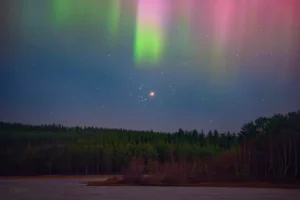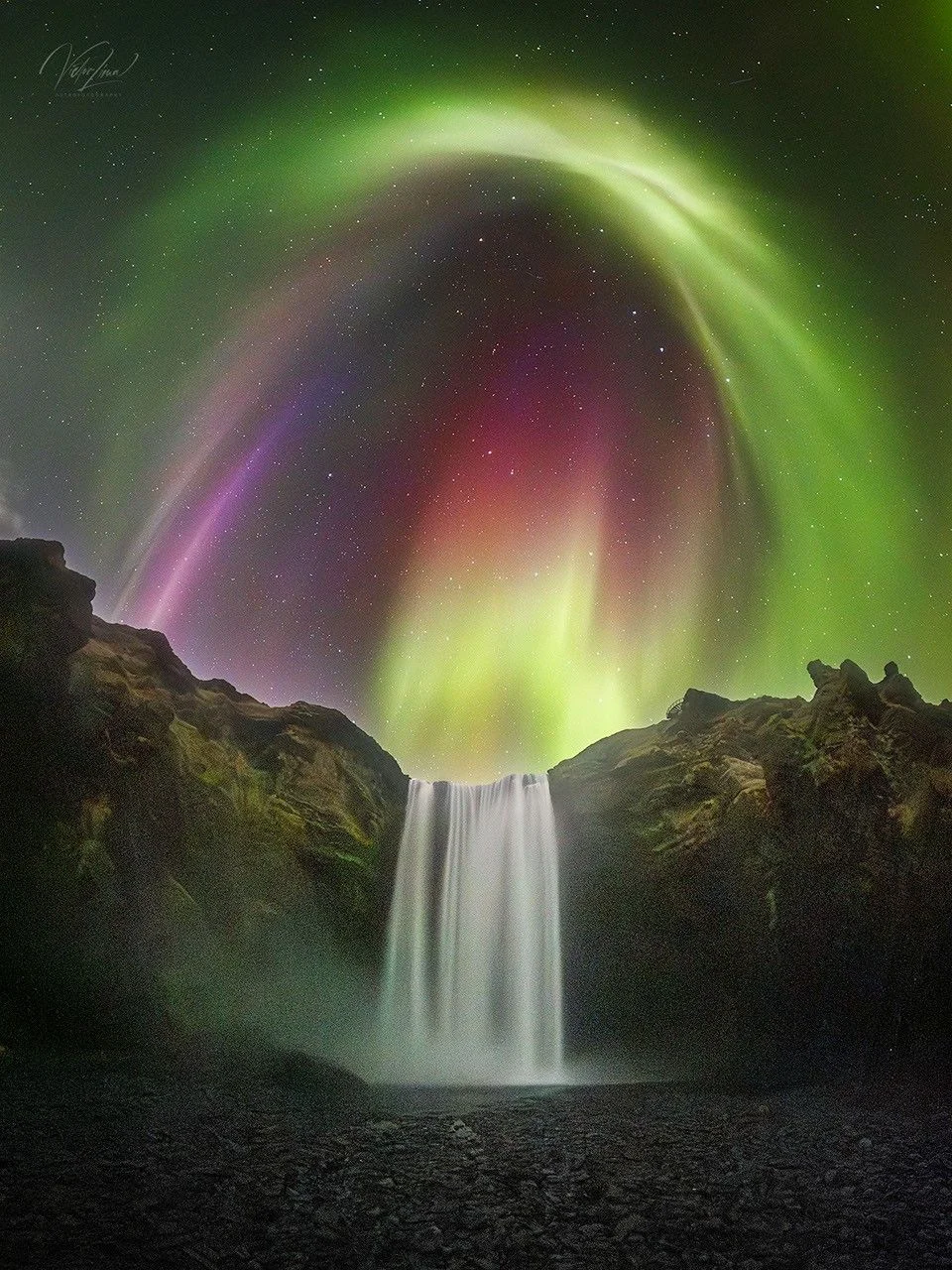
The Astronomy Picture of the Day (APOD) program, a cornerstone of NASA’s public outreach, has once again captivated audiences with a breathtaking image. The featured photograph, captured in April 2025, showcases a vibrant aurora borealis dancing above the iconic Skógafoss waterfall in Iceland. This single, five-second exposure encapsulates the ephemeral beauty of the northern lights, a phenomenon that continues to inspire awe and scientific curiosity. The APOD team, dedicated to sharing the universe’s wonders, highlights this image as a testament to the dynamic interplay between our planet and the sun.
The Celestial Canvas: An Aurora’s Dance Above Iceland
The image depicts a night sky ablaze with a symphony of colors – greens, pinks, and yellows – cascading over the thundering curtain of Skógafoss. The waterfall, a majestic natural landmark on Iceland’s south coast, provides a dramatic terrestrial foreground to the celestial spectacle. The aurora, often referred to as the northern lights, is a natural light display that illuminates the sky in high-latitude regions. Its appearance is a direct consequence of solar activity interacting with Earth’s atmosphere and magnetic field. This particular capture, taken during a single five-second exposure, suggests a period of intense auroral activity, allowing the photographer to capture the full spectrum of colors and the dynamic movement of the lights.
The Science Behind the Spectacle: Unraveling Auroral Mysteries
Auroras are not mere atmospheric occurrences; they are visible manifestations of a complex astrophysical process. The phenomenon begins with the sun, which constantly emits a stream of charged particles known as the solar wind. This solar wind, composed primarily of electrons and protons, travels across the solar system at incredible speeds. When these charged particles encounter Earth, they are largely deflected by our planet’s magnetosphere, a protective magnetic shield generated by the molten iron core.
However, the magnetosphere is not an impenetrable barrier. At the magnetic poles, where the magnetic field lines converge and point towards the Earth, some of these charged particles are guided into the upper atmosphere. As these energetic particles collide with atoms and molecules of atmospheric gases, they excite them to higher energy states. When these excited atoms and molecules return to their ground state, they release the excess energy in the form of light, creating the mesmerizing auroral displays.
The colors of the aurora are determined by the type of gas molecule being struck and the altitude at which the collision occurs. Oxygen atoms, for instance, emit green light at lower altitudes (around 100-300 kilometers) and red light at higher altitudes (above 300 kilometers). Nitrogen molecules contribute to the blue and pink hues, with blue light typically appearing at lower altitudes and pink light at the lowest altitudes. The vibrant mixture of green, pink, and yellow observed in the Skógafoss image indicates interactions with both oxygen and nitrogen at various atmospheric layers.
Factors Influencing Auroral Visibility: A Cosmic Lottery
Witnessing an aurora is a dream for many, but it is an experience that requires a confluence of specific conditions. The primary driver is high solar activity, which leads to a more robust solar wind and a greater influx of charged particles towards Earth. This activity is cyclical, with the sun experiencing an approximately 11-year solar cycle, characterized by periods of increased sunspot activity and solar flares. The year 2025, when this photograph was taken, likely coincided with a period of heightened solar activity, contributing to the intensity of the aurora.
Beyond solar activity, other factors play a crucial role:

- Dark and Clear Skies: Auroras are faint light phenomena that are best observed in the absence of light pollution and under clear atmospheric conditions. This image, taken at night, benefits from the darkness of the Icelandic landscape.
- High Latitude Location: Auroras are most commonly seen in regions close to the Earth’s magnetic poles. This is because the charged particles are channeled towards these areas. Iceland, situated at a high latitude, is a prime location for auroral viewing.
- Southern vs. Northern Lights: While the mechanism is the same, auroras are more frequently observed and documented in the Northern Hemisphere. This is largely due to the distribution of landmass. There is significantly more land and human habitation at high northern latitudes compared to the high southern latitudes. The Antarctic Circle, for example, encompasses a vast continent with limited permanent human settlements, making the aurora australis (southern lights) more challenging to observe from populated areas.
The Photographer’s Perspective: A Moment Frozen in Time
While the original article did not provide the photographer’s name, the brief description of the image being taken in a single five-second exposure offers a glimpse into the technical skill and fortunate timing involved. Capturing such a dynamic event requires careful camera settings, including a wide aperture to gather sufficient light, a high ISO sensitivity to enhance the faint light, and a relatively fast shutter speed to freeze the motion of the aurora without excessive blurring. The photographer’s presence at Skógafoss, a location known for its dramatic beauty, further enhances the narrative of the image. It suggests a deliberate pursuit of capturing a unique natural spectacle, combining geological wonder with celestial artistry.
A Timeline of Discovery and Understanding
The fascination with auroras is ancient, with various cultures developing myths and legends to explain these celestial lights. However, the scientific understanding of auroras is a more recent development, built upon centuries of observation and inquiry.
- 17th Century: Galileo Galilei is credited with coining the term "aurora borealis" in 1619, inspired by the Roman goddess of dawn, Aurora, and the Greek name for the north wind, Boreas.
- 18th-19th Centuries: Scientists like Anders Celsius and Edmund Halley began to connect auroral displays with magnetic disturbances. The concept of the Earth’s magnetic field started to take shape.
- Early 20th Century: Kristian Birkeland, a Norwegian physicist, proposed the "Birkeland current" theory, suggesting that charged particles from the sun were responsible for the auroras, guided by Earth’s magnetic field. His experiments with vacuum chambers and electron beams provided compelling evidence.
- Mid-20th Century onwards: The space age revolutionized auroral research. Satellites equipped with advanced instruments allowed scientists to directly measure the solar wind, study Earth’s magnetosphere in detail, and observe auroras from above. This led to a deeper understanding of the complex interactions between the sun and Earth.
The image from April 2025 represents the culmination of this scientific journey, showcasing a phenomenon that was once shrouded in mystery and is now understood through the lens of physics and space science.
NASA’s APOD: A Gateway to the Cosmos
The Astronomy Picture of the Day (APOD) program, initiated in 1995, has been instrumental in making astronomy accessible to the public. By featuring a new image or photograph of the universe each day, accompanied by a concise explanation from a professional astronomer, APOD offers a daily dose of cosmic wonder. The program’s commitment to showcasing diverse celestial phenomena, from nebulae and galaxies to planetary landscapes and auroral displays, has fostered a global community of astronomy enthusiasts. The transition of APOD’s main NASA site from apod.nasa.gov to science.nasa.gov/apod signifies a strategic move to integrate its vast educational resources within the broader framework of NASA’s scientific endeavors, further solidifying its role as a premier science communication platform.
Broader Implications: Space Weather and Planetary Defense
The study of auroras is not merely an academic pursuit; it has significant practical implications. Auroral activity is a key indicator of "space weather," the conditions in space that can affect Earth and technological systems. Intense solar storms, which can lead to spectacular auroras, can also pose risks to:
- Satellites: High-energy particles can damage sensitive electronic components, leading to malfunctions or failures.
- Power Grids: Geomagnetic storms can induce currents in long conductors, such as power lines, potentially causing widespread blackouts.
- Communication Systems: Radio waves and GPS signals can be disrupted by changes in the ionosphere, which is heavily influenced by auroral activity.
- Astronauts: Increased radiation levels in space during solar storms pose a health risk to astronauts on the International Space Station or during future space missions.
Understanding the processes that generate auroras helps scientists to forecast space weather, enabling authorities to take protective measures. The image of the aurora over Skógafoss, while visually stunning, serves as a reminder of the powerful forces at play in our solar system and the importance of monitoring our sun and its influence on our planet.
Conclusion: A Timeless Fascination
The Astronomy Picture of the Day’s selection of the aurora over Skógafoss is more than just a beautiful photograph; it is a window into the dynamic and awe-inspiring relationship between Earth and the sun. It underscores the ongoing scientific endeavor to unravel the universe’s mysteries and highlights the enduring human fascination with the celestial wonders that grace our night skies. As NASA continues to explore the cosmos, programs like APOD remain vital in sharing the excitement of discovery and inspiring the next generation of scientists and explorers. The image serves as a potent reminder that even on Earth, we are constantly bathed in the cosmic phenomena that connect us to the vastness of space.