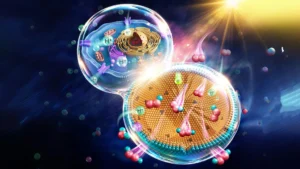
Engineers at The University of Texas at Austin have announced a groundbreaking advancement in materials science, transforming a seemingly ordinary combination of water, oil, and a standard laboratory centrifuge into a revolutionary 3D-printable material. This innovative substance is engineered to precisely replicate the selective filtering capabilities inherent in biological tissues, holding profound implications for fields as diverse as regenerative medicine, advanced robotics, next-generation computing, and sustainable energy and environmental solutions. The team’s discovery addresses long-standing challenges in creating scalable, tissue-like materials, promising to unlock new possibilities for human organ growth, the recovery of critical battery metals, and the development of brain-inspired computing architectures.
The Genesis of JIBEs: Mimicking Nature’s Design
At the heart of this innovation lies what researchers term JIBEs – Jammed Interconnected Bilayer Emulsions. This material functions as a sophisticated, selectively permeable membrane, mirroring the intricate architecture and functionality of living cells and tissues. Biological tissues, from the lining of our intestines to the complex filtering units of our kidneys, possess an unparalleled ability to selectively absorb vital nutrients while expelling waste. This selective permeability is fundamental to life, governing everything from cellular communication to nutrient uptake and waste management. Replicating this biological marvel in a synthetic material has been a holy grail for material scientists, offering a pathway to creating materials that can interact with their environment with unprecedented specificity and intelligence.
For decades, scientists have grappled with the challenge of synthetically recreating these delicate, highly functional biological structures. While microscopic tissue-like constructs could be painstakingly crafted in laboratory settings, the monumental task of scaling these micro-droplets into robust, usable macroscopic materials proved elusive. The processes were often excruciatingly slow, prone to instability, and prohibitively expensive, relegating such advancements to niche laboratory experiments rather than practical applications. The UT Austin team’s breakthrough directly confronts this scalability hurdle, offering a method that is not only rapid but also highly reproducible and cost-effective.
A Scalable Solution: Centrifuge Science at its Core
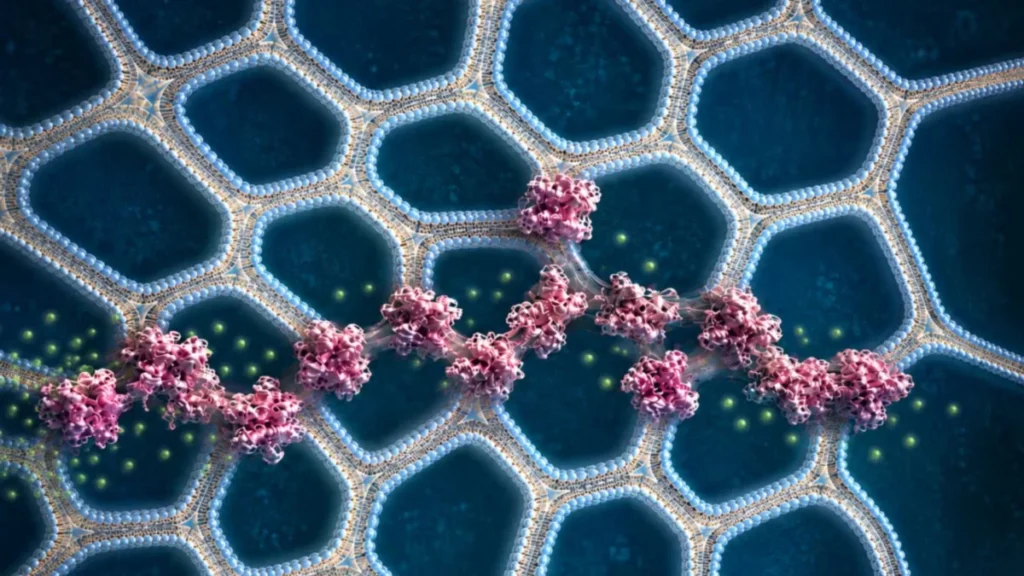
The innovation stems from a surprisingly simple, yet ingeniously applied, methodology. Researchers developed a fast, scalable technique capable of constructing large, tissue-like materials in a matter of minutes. This process leverages basic mixing and centrifuge techniques to tightly pack billions of microscopic water droplets. Crucially, these droplets are enveloped by ultra-thin membranes that interlink, thereby meticulously mimicking the cellular organization found in human tissues, but on a much larger, macroscopic scale. This ability to form dense, interconnected networks of droplets so quickly and efficiently is what sets JIBEs apart.
A pivotal moment in this research came through the insights of Aida Fica, a PhD researcher at UT Austin. Fica’s ability to synthesize disparate ideas encountered at an academic conference provided the conceptual leap needed to overcome the decade-long frustration in the field. Her team devised a method involving the mixing of two different oils with varying solubilities. This strategic combination facilitates the formation of tiny water droplets. Subsequently, these droplets are subjected to forceful packing within a standard laboratory centrifuge. The centrifugal force, a common principle in various scientific and industrial processes, plays a critical role in tightly compressing these droplets, compelling their surrounding membranes to link up and form the stable, interconnected network characteristic of JIBEs.
Professor Manish Kumar, a leading figure in the Cockrell School of Engineering’s Fariborz Maseeh Department of Civil, Architectural and Environmental Engineering and the McKetta Department of Chemical Engineering, underscored the biological relevance of this design. "Tissues can separate and transport ions and molecules; that’s how our kidneys or intestines work, taking only what they need and leaving the rest behind," Kumar explained. This statement highlights the profound biomimetic quality of JIBEs – their capacity to selectively sort and transport substances, a function vital to countless biological processes. By encapsulating each droplet in an ultra-thin membrane that links with its neighbors, the material effectively recreates the fundamental structural and functional units of living organs.
Revolutionizing Industries: A Multitude of Applications
The implications of this 3D-printable, biocompatible material are expansive, poised to impact numerous industries from healthcare to computing and environmental stewardship. Its inherent flexibility and tissue-like structure make it an adaptable platform with transformative potential.
In Healthcare and Regenerative Medicine: The ability of JIBEs to facilitate precise tissue growth opens up unprecedented avenues for human organ grafts. The global shortage of transplantable organs is a critical public health crisis, with millions awaiting life-saving procedures. For instance, in the United States alone, over 100,000 individuals are currently on the national transplant waiting list, with a new person added every 9 minutes. The current limitations of organ transplantation, including donor availability, immune rejection, and the complexity of preserving organs, underscore the urgent need for innovative solutions. JIBEs could provide a scalable platform for bioprinting functional tissues and potentially entire organs, offering hope for personalized medicine where organs could be grown from a patient’s own cells, thereby circumventing immune rejection issues. Beyond full organ transplantation, this material could also be used to develop advanced drug screening platforms, allowing pharmaceutical companies to test new medications on physiologically relevant human tissues, reducing the reliance on animal testing and improving drug development success rates.
In Soft Robotics: The material’s flexible, tissue-like nature is a boon for the burgeoning field of soft robotics. Unlike traditional rigid robots, soft robots are designed to be compliant, adaptable, and inherently safer for interaction with humans and delicate environments. This makes JIBEs ideal for crafting delicate surgical instruments, capable of navigating complex internal anatomies with minimal invasiveness, or for developing rescue bots that can safely interact with fragile structures in disaster zones. The bio-compatibility of the material further ensures that these robots can operate within biological systems without causing adverse reactions, a critical factor for medical and even environmental applications.
In Neuromorphic Computing: Perhaps one of the most intellectually stimulating applications lies in the realm of computing. By embedding specialized proteins within the JIBEs, the material can be engineered to conduct ionic currents. This capability lays the foundational groundwork for brain-inspired neural computing, also known as neuromorphic computing. Traditional computers operate on a binary system (0s and 1s) and separate processing from memory, leading to energy inefficiency and limitations in handling complex, unstructured data. Neuromorphic computing, in contrast, aims to mimic the brain’s parallel processing, energy efficiency, and ability to learn and adapt. The selective ion transport capabilities of JIBEs, analogous to the ion channels and pumps in biological neurons, could enable the creation of synthetic neural networks that process information in a fundamentally different, more brain-like manner, paving the way for significantly more powerful and energy-efficient artificial intelligence.
In Environmental Science and Resource Recovery: The material’s selective membrane properties also present significant opportunities for environmental sustainability. Customized variations of JIBEs can act as highly efficient filters for critical resource recovery and pollutant remediation. A prime example is the extraction of valuable resources like lithium. Lithium is a cornerstone of the modern technological economy, indispensable for electric vehicle batteries, portable electronics, and grid-scale energy storage. The global demand for lithium is projected to skyrocket, with estimates suggesting a five-fold increase by 2030. Traditional lithium extraction methods, primarily from hard rock mines and brine pools, are often energy-intensive, environmentally damaging, and can deplete freshwater resources. JIBEs offer a promising alternative, capable of selectively extracting lithium from diluted sources, such as industrial wastewater, geothermal brines, or even seawater, with greater efficiency and a reduced environmental footprint.
Furthermore, these membranes can be tailored to filter out pollutants like ammonium from industrial wastewater. Ammonium, a common byproduct in agricultural runoff and industrial processes, contributes to eutrophication of waterways, harming aquatic ecosystems and posing risks to human health. The precise filtering capability of JIBEs provides a cost-effective and scalable solution for treating wastewater, contributing to cleaner water sources and fostering a circular economy where waste products can be transformed into valuable resources. The U.S. Department of Energy’s ARPA-E (Advanced Research Projects Agency-Energy) has recognized this potential, partnering with the UT Austin team to specifically adapt this technology for the recovery of lithium and other rare-earth elements, highlighting its strategic importance for national resource security.
Democratizing Advanced Materials Science
One of the most surprising and impactful aspects of this discovery is the accessibility of its manufacturing process. As Aida Fica succinctly put it, "This technology now offers a simple, scalable process with endless applications that could be implemented in any laboratory since it only requires basic equipment." Unlike many cutting-edge material science innovations that demand specialized cleanrooms, hyper-expensive laser equipment, or highly complex synthesis protocols, the creation of JIBEs relies on fundamental laboratory tools – a mixer and a centrifuge. This low barrier to entry is critical for accelerating research and development globally, enabling a broader range of institutions and researchers to experiment with, adapt, and refine this technology. It democratizes access to advanced materials fabrication, potentially leading to faster innovation cycles and a wider array of unforeseen applications.
Looking Ahead: Patents, Publications, and a Path Forward
The significance of this breakthrough has been formally recognized through intellectual property protection. Fica and Kumar have already secured a patent for their innovative technique, a crucial step that not only protects their discovery but also clears a defined path for its commercialization and widespread adoption. This patent paves the way for laboratories, startups, and established industries worldwide to license, test, adapt, and ultimately integrate these synthetic tissues into a myriad of products and processes.
The findings, rigorously peer-reviewed, were published in the prestigious journal Nature Materials, a testament to the scientific rigor and novelty of the research. Publication in such a high-impact journal ensures that the scientific community at large is aware of this advancement, fostering collaboration and further investigation into the properties and potential of JIBEs.
The UT Austin team’s creation of JIBEs represents more than just another material science discovery; it signifies a fundamental shift in our ability to mimic and harness the elegance of biological systems. By offering a simple, scalable, and versatile platform, this technology promises to accelerate progress in regenerative medicine, redefine the capabilities of robotics, unlock new paradigms in computing, and provide critical solutions for global resource and environmental challenges. As this patented technique becomes more widely adopted, the "alchemy" of water, oil, and a centrifuge may indeed prove to be a cornerstone for the synthetic tissues and technologies of tomorrow, healing bodies, building better machines, and securing a more sustainable future.