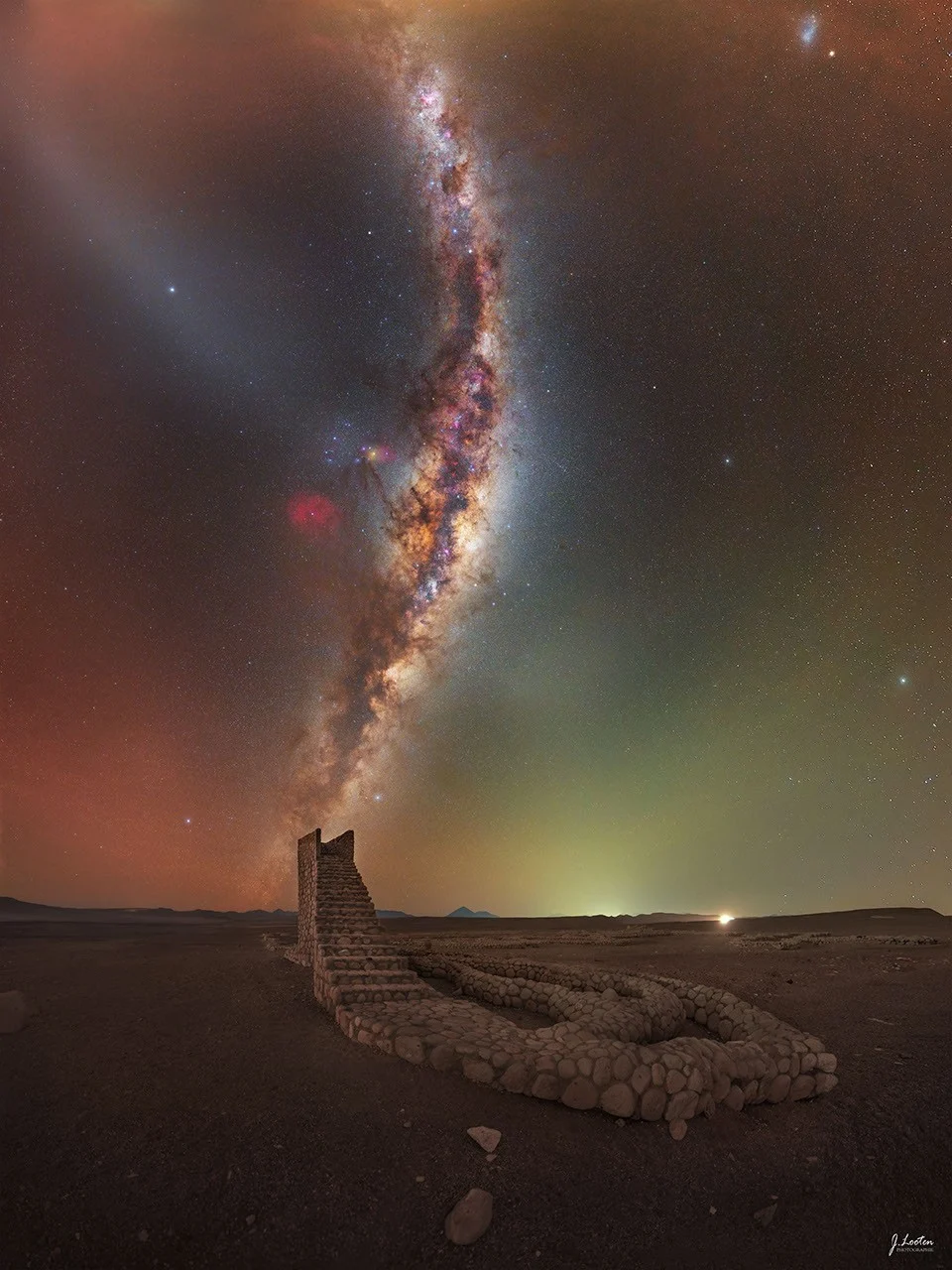
The vast, star-dusted canvas of the night sky offers countless moments of awe, but rarely does the terrestrial landscape so perfectly frame the cosmic panorama as in a recent breathtaking image captured in the Atacama Desert of Chile. A striking art installation, known as the "Desert Staircase," has become an unexpected focal point for astronomical observation, aligning with the majestic band of our own Milky Way galaxy to create a scene that appears to lead directly into the heavens. This remarkable photograph, a wide-angle composite taken in July 2025, invites viewers to ponder the immensity of the universe and the serendipitous beauty that can arise from the intersection of human artistry and natural wonder.
A Celestial Alignment in the Atacama
The image showcases a dramatic ascent of the Milky Way, rising from the horizon and arcing gracefully across the inky blackness of the night sky. In the foreground, the "Desert Staircase" sculpture, a series of stone steps, appears to culminate abruptly, its final rise mirroring the apparent trajectory of the galactic band above. This striking visual resonance transforms the earthly structure into a metaphorical gateway to the cosmos, prompting a sense of wonder and contemplation about humanity’s place within the universe.
The photograph, credited to photographer Julien Looten, is not merely a snapshot of a beautiful night but a meticulously timed capture that exploits the specific conditions of the Atacama Desert. The clarity of the air, renowned for its exceptionally low light pollution and stable atmospheric conditions, provides an unparalleled viewing platform for celestial phenomena. This region is a favored location for astronomers, housing some of the world’s most advanced telescopes, including the Atacama Large Millimeter/submillimeter Array (ALMA) and the Very Large Telescope (VLT) at the European Southern Observatory (ESO). The unique environmental factors that make the Atacama a hub for scientific discovery also contribute to its suitability for astrophotography of this caliber.
Unpacking the Celestial Elements
Beyond the prominent Milky Way, the photograph reveals a rich tapestry of astronomical objects, each contributing to the scene’s profound beauty and scientific interest.
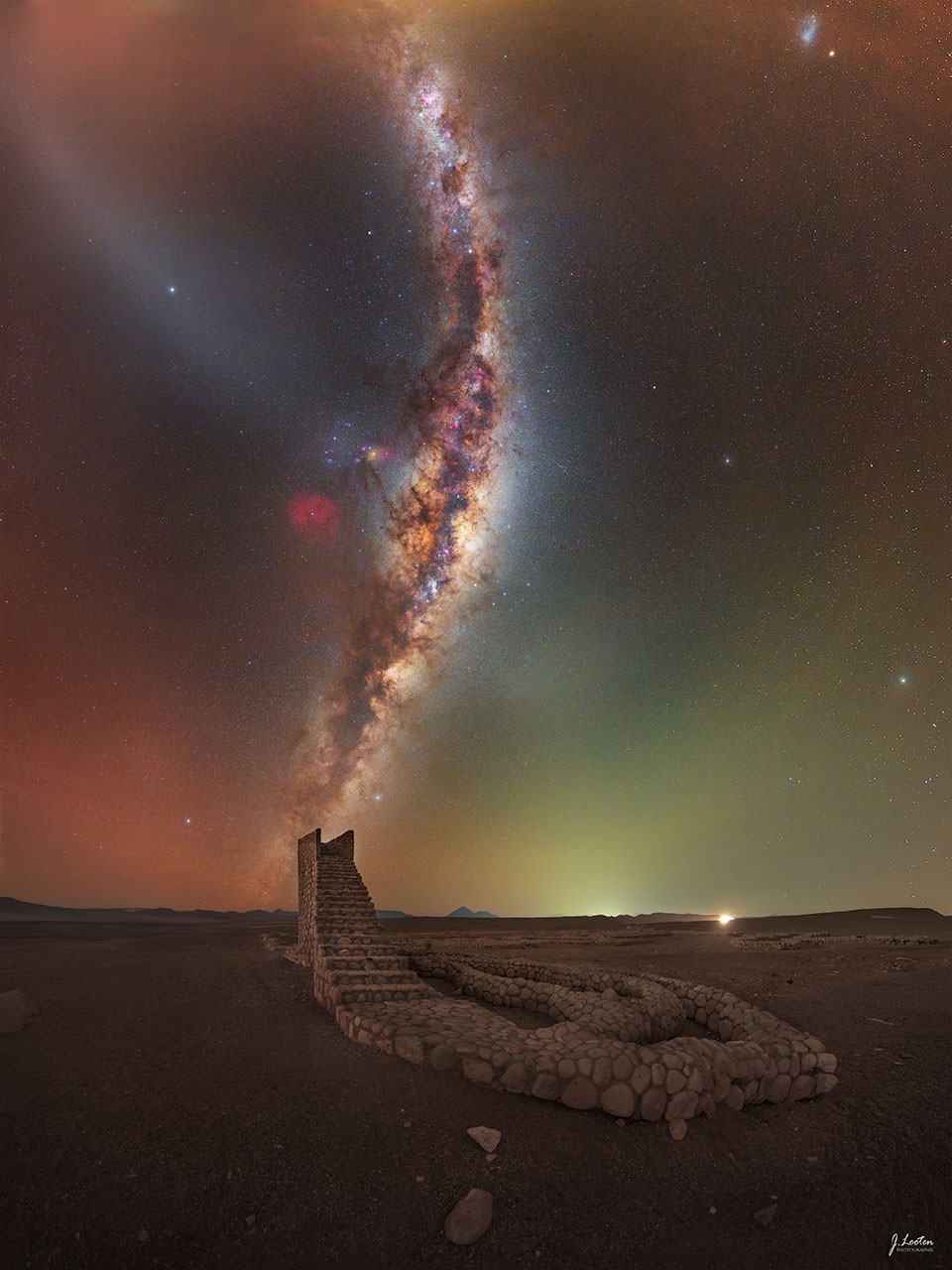
- The Milky Way: Our home galaxy, a spiral structure containing billions of stars, gas, and dust, appears as a luminous band stretching across the sky. The "dark lane" within the Milky Way, often referred to as the Great Rift, is a prominent feature, caused by interstellar dust clouds obscuring the light from stars behind them. The near-vertical orientation of the Milky Way band in this particular shot is a result of the Earth’s rotation and the observer’s latitude and the time of year.
- Zodiacal Light: Visible in the upper left quadrant of the image, the zodiacal light is a faint, diffuse glow caused by sunlight scattering off dust particles in the inner solar system. It often appears as a cone-shaped illumination extending from the horizon, most prominently seen after sunset or before sunrise in dark skies.
- Airglow: The subtle green and red hues just above the horizon are attributed to airglow, a natural emission of light by a planetary atmosphere. This phenomenon is caused by various chemical reactions, including the recombination of atoms and molecules that have been excited by solar ultraviolet radiation.
- Stars and Galaxies: The bright star Spica, the brightest star in the constellation Virgo, is discernible within the zodiacal light stripe. Further adding to the cosmic depth, the Small Magellanic Cloud, a dwarf galaxy that orbits the Milky Way, is visible at the very top right of the frame. Its presence highlights the interconnectedness of galactic structures within our local group.
The Art and the Landscape: Contextualizing the Sculpture
The "Desert Staircase" sculpture itself plays a crucial role in the photograph’s narrative. Located in Chile, a nation increasingly recognized for its significant contributions to astronomy and its commitment to preserving dark skies, the art piece serves as a poignant reminder of humanity’s enduring fascination with the heavens. While the exact artist and specific intent behind the "Desert Staircase" are not detailed in the initial information, sculptures placed in remote, natural landscapes often aim to evoke a sense of scale, perspective, and contemplation, inviting viewers to consider their relationship with the environment and the universe. The juxtaposition of a man-made structure with the grandeur of the cosmos amplifies this effect, suggesting a dialogue between earthly aspirations and celestial realities.
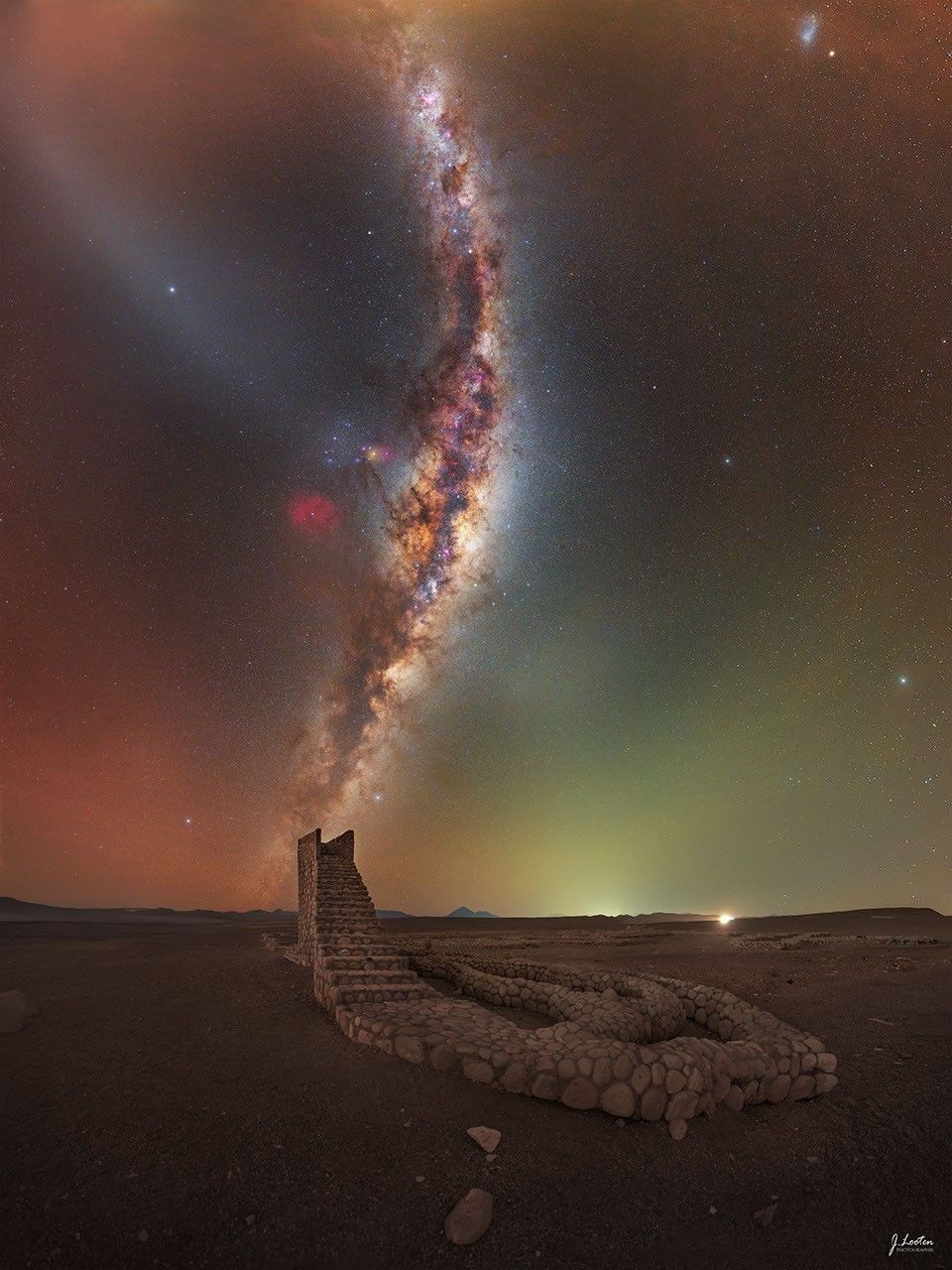
The Atacama Desert, where this photograph was taken, is not just a barren expanse; it is a unique ecosystem and a significant geological region. Its extreme aridity has led to the preservation of ancient geological formations and a remarkable lack of biological interference, making it an ideal location for both astronomical observation and artistic installations that seek to engage with the raw beauty of nature. The presence of the Andes Mountains, the Licancabur volcano, and the distant lights of San Pedro de Atacama on the horizon further ground the celestial spectacle in a tangible geographical context, illustrating the diverse elements that contribute to this extraordinary scene.
A Chronology of Celestial Appreciation
The appreciation of the night sky has been a constant thread throughout human history, from ancient civilizations charting constellations for navigation and ritual to modern-day astronomers unraveling the universe’s deepest mysteries. This photograph represents a contemporary facet of that long-standing engagement, merging artistic expression with scientific observation.
- Ancient Times: Early humans observed the predictable movements of celestial bodies, developing calendars and mythologies tied to the stars.
- The Age of Exploration: Astronomers like Copernicus, Galileo, and Kepler revolutionized our understanding of the solar system, shifting the Earth from the center of the universe.
- The Telescope Era: The invention of the telescope opened up new vistas, revealing nebulae, galaxies, and the moons of other planets.
- The Space Age: Rocketry and space exploration allowed humanity to venture beyond Earth, providing unprecedented views and data about the cosmos.
- Modern Astrophotography: Advances in digital imaging technology and accessible equipment have empowered individuals to capture stunning celestial images, often from terrestrial vantage points.
This photograph, captured in July 2025, is a testament to the current era of astrophotography, where sophisticated techniques and prime locations converge to produce images of remarkable detail and artistic merit. The photographer’s choice to time the shot specifically to align the sculpture with the "near-vertical Milky Way band" underscores a deliberate effort to create a narrative that bridges the earthly and the cosmic.
Supporting Data and Implications
The Atacama Desert’s status as a premier astronomical observation site is supported by robust scientific data. Light pollution levels in many parts of the world have increased dramatically over the past century, impacting not only astronomical research but also the human experience of the night sky. The International Dark-Sky Association estimates that over 80% of the world’s population lives with light-polluted skies, making places like the Atacama increasingly precious for their pristine darkness.
The implications of images like this extend beyond mere aesthetic appreciation. They can:
- Inspire Public Interest in Science: Visually compelling images of space can ignite curiosity in astronomy and related scientific fields, potentially encouraging future generations of scientists and engineers.
- Promote Conservation Efforts: By highlighting the beauty of dark skies, such photographs can advocate for policies and practices that reduce light pollution, preserving this natural resource for both scientific and cultural purposes.
- Foster a Sense of Global Connection: The Milky Way is a shared heritage for all of humanity. Images that showcase its grandeur can foster a sense of unity and shared wonder.
- Encourage Artistic Innovation: The intersection of art and science, as demonstrated by the "Desert Staircase" and its celestial backdrop, can lead to new forms of creative expression and interdisciplinary collaboration.
Official Responses and Broader Impact
While there are no specific official statements directly tied to this particular photograph, organizations like NASA and ESO routinely feature stunning astrophotography on their platforms, recognizing its power to engage the public. NASA’s Astronomy Picture of the Day (APOD) program, which highlights a different astronomical image daily with explanations from professional astronomers, serves as a prime example of this commitment. The inclusion of this image within such a program would underscore its significance as a blend of natural beauty and human artistic endeavor.
The broader impact of such imagery on tourism and local economies in regions like the Atacama Desert cannot be overstated. The allure of pristine night skies and unique landscapes draws visitors from around the globe, contributing to the sustainable development of communities that actively work to protect their dark sky heritage. Initiatives such as the establishment of Dark Sky Reserves, like the one in the Atacama, demonstrate a growing global recognition of the value of dark skies and the need for their preservation.
In conclusion, the "Stairway to Heaven" photograph from Chile’s Atacama Desert is more than just a visually stunning image; it is a powerful symbol of humanity’s enduring quest to understand its place in the universe. By aligning a terrestrial art installation with the celestial majesty of the Milky Way, it offers a profound perspective on the interconnectedness of art, science, and the natural world, inviting us all to look up and wonder.
Tomorrow’s picture: open space.