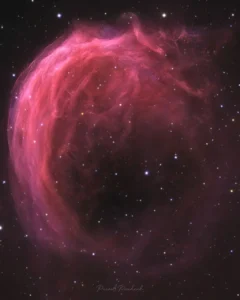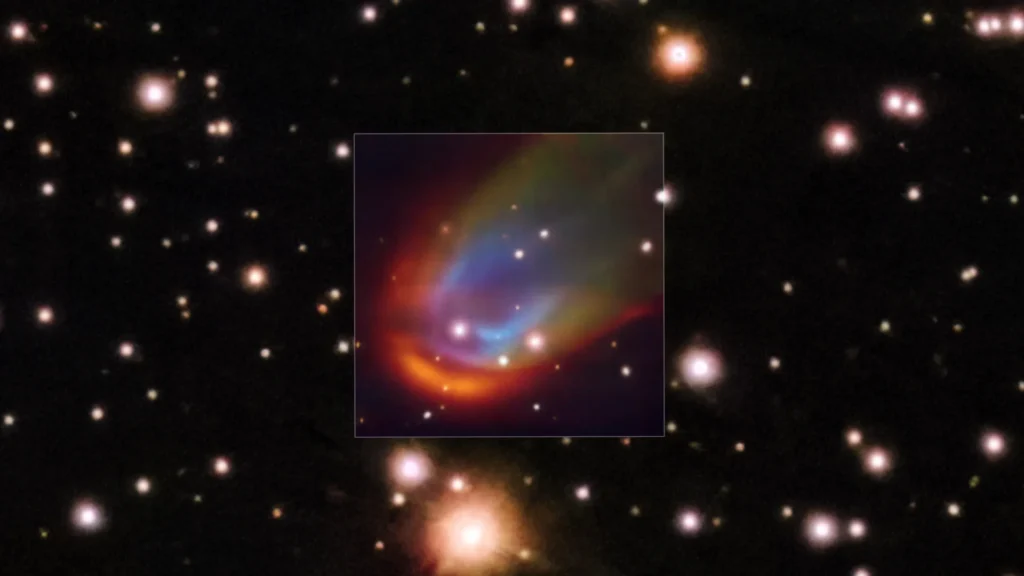
Stars, in their incandescent brilliance, often command our attention. Yet, it is in their dying embers that some of the most profound cosmic mysteries lie. Astronomers, employing the formidable capabilities of the European Southern Observatory’s Very Large Telescope (ESO’s VLT), have captured an unprecedented and perplexing phenomenon surrounding RXJ0528+2838, a stellar remnant approximately 730 light-years from Earth. This discovery centers on a powerful shock wave, a cosmic ripple effect, generated by material streaming away from the dead star and colliding with the interstellar medium. The enigma deepens because, according to our current astrophysical models, such a compact stellar remnant should not possess the capacity to produce the spectacular structure observed. This unexpected finding directly challenges long-held theories about how deceased stars interact with their cosmic environment, particularly concerning the exchange of matter and energy.
The Unexpected Cosmic Outburst
The observation of RXJ0528+2838 has sent ripples of intrigue through the astronomical community. "We found something never seen before and, more importantly, entirely unexpected," states Simone Scaringi, an associate professor at Durham University, UK, and co-lead author of the groundbreaking study published in the prestigious journal Nature Astronomy. His colleague, Krystian Ilkiewicz, a postdoctoral researcher at the Nicolaus Copernicus Astronomical Center in Warsaw, Poland, and fellow co-lead, echoes this sentiment of astonishment. "Our observations reveal a powerful outflow that, according to our current understanding, shouldn’t be there," Ilkiewicz remarks, highlighting the significant departure from established astrophysical paradigms. In astronomical parlance, an ‘outflow’ refers to any material that is expelled or ejected from an object in space.
Unraveling the Bow Shock Phenomenon
The phenomenon observed around RXJ0528+2838 is a classic example of a bow shock. This cosmic feature, often described as a curved arc of material, is analogous to the wave that forms in front of a moving ship. Noel Castro Segura, a research fellow at the University of Warwick in the UK and a collaborator on this research, eloquently likens it to "a curved arc of material, similar to the wave that builds up in front of a ship." Such bow shocks are typically formed when a star’s stellar wind – the continuous stream of charged particles it ejects – collides with the surrounding interstellar gas and dust. However, in the case of RXJ0528+2838, the intensity and morphology of the observed bow shock cannot be readily explained by the known mechanisms associated with its stellar type.
RXJ0528+2838 is a white dwarf, the dense, hot remnant of a low-mass star that has exhausted its nuclear fuel. These stellar corpses are the final evolutionary stage for stars like our Sun. The white dwarf is part of a binary system, meaning it has a companion star. In this particular system, the companion is described as Sun-like, suggesting it is likely a main-sequence star still undergoing nuclear fusion.
The Mystery of the Missing Disk
The prevailing model for material transfer and outflow in binary systems involving white dwarfs typically involves accretion disks. In such scenarios, the gravitational pull of the white dwarf can strip material from its companion star. This stolen material then often forms a swirling disk around the white dwarf, known as an accretion disk. This disk acts as a conduit, feeding matter onto the white dwarf. During this process, a fraction of the infalling material can be ejected back into space in the form of powerful outflows, often contributing to the formation of nebulae – vast clouds of gas and dust.
However, RXJ0528+2838 presents a stark deviation from this standard picture. Extensive observations have revealed no discernible evidence of an accretion disk surrounding the white dwarf. This absence is the crux of the puzzle, as it leaves astronomers without the usual explanation for the vigorous outflow and the spectacular nebula-like structure observed. "The surprise that a supposedly quiet, discless system could drive such a spectacular nebula was one of those rare ‘wow’ moments," confesses Scaringi, emphasizing the profound impact of this discovery on the researchers.
VLT Observations: Illuminating the Source
The initial hint of this celestial anomaly emerged from images captured by the Isaac Newton Telescope in Spain. The peculiar appearance of the structure around RXJ0528+2838 prompted the research team to conduct more in-depth investigations. The advanced MUSE (Multi-Unit Spectroscopic Explorer) instrument on ESO’s VLT was instrumental in this follow-up. "Observations with the ESO MUSE instrument allowed us to map the bow shock in detail and analyse its composition. This was crucial to confirm that the structure really originates from the binary system and not from an unrelated nebula or interstellar cloud," Ilkiewicz explains. The MUSE instrument’s ability to provide detailed spectral information enabled the astronomers to precisely determine the chemical makeup and physical conditions of the observed material, thereby confirming its direct association with the RXJ0528+2838 system.
The sheer scale and distinct shape of the bow shock suggest that RXJ0528+2838 has been actively producing this powerful outflow for a considerable period, estimated to be at least 1,000 years. This extended duration of outflow generation introduces another layer of complexity to the enigma. How can a dead star, especially one apparently lacking an accretion disk, sustain such a robust expulsion of material for millennia? This temporal aspect further challenges existing theoretical frameworks.
The Magnetic Field Hypothesis: A Partial Solution
A potential clue to this persistent outflow lies in the known properties of RXJ0528+2838: its strong magnetic field. The MUSE observations not only confirmed the presence of this magnetic field but also provided crucial data about its strength and configuration. Astronomers theorize that in systems like RXJ0528+2838, where an accretion disk is absent, the powerful magnetic field might play a pivotal role in channeling material. Instead of accreting onto the white dwarf via a disk, the magnetic field could be acting like a cosmic funnel, guiding the stellar wind from the companion star directly onto the surface of the white dwarf.
"Our finding shows that even without a disc, these systems can drive powerful outflows, revealing a mechanism we do not yet understand. This discovery challenges the standard picture of how matter moves and interacts in these extreme binary systems," Ilkiewicz elaborates, underscoring the paradigm-shifting implications of this research. The researchers are exploring the possibility that this magnetic field is not merely a passive conduit but is somehow linked to a hidden energy source, which Scaringi has alluded to as a ‘mystery engine.’
However, even with the magnetic field hypothesis, a full explanation remains elusive. The current strength of RXJ0528+2838’s magnetic field, as measured, appears insufficient to sustain the observed bow shock for the estimated 1,000-year duration. Calculations suggest that the present-day magnetic field could only power such an outflow for a few hundred years at most. This discrepancy points to a missing piece of the puzzle, a more potent or perhaps intermittent energy source that has been active for a longer period.
The Quest for the "Mystery Engine"
The discovery around RXJ0528+2838 opens up a new frontier in stellar astrophysics. The immediate implication is the need for a re-evaluation of how binary systems, particularly those involving white dwarfs, exchange matter and energy. The absence of a disk, coupled with sustained powerful outflows, suggests that magnetic fields might be far more significant drivers of these phenomena than previously understood, or that other, yet undiscovered, mechanisms are at play.
To unravel this cosmic riddle, astronomers must broaden their observational scope. Studying a wider range of binary systems, especially those exhibiting similar characteristics to RXJ0528+2838, will be crucial in identifying common patterns and formulating robust theoretical models. Future observations will likely focus on characterizing the magnetic fields of other discless white dwarf binary systems and searching for evidence of similar outflows.
The next generation of astronomical instruments promises to shed further light on these complex processes. The European Southern Observatory’s upcoming Extremely Large Telescope (ELT), with its unprecedented light-gathering power and resolution, is poised to play a pivotal role. The ELT will enable scientists to study not only known systems like RXJ0528+2838 in exquisite detail but also to detect and analyze much fainter and more distant examples. "The ELT is expected to map more of these systems as well as fainter ones and detect similar systems in detail, ultimately helping in understanding the mysterious energy source that remains unexplained," Scaringi anticipates, expressing optimism about the future of this research.
Broader Implications for Stellar Evolution
The implications of this discovery extend beyond understanding individual stellar systems. It could fundamentally alter our comprehension of the late stages of stellar evolution and the processes that shape the interstellar medium. The material ejected by stars, even in their death throes, contributes to the cosmic cycle of matter, providing the raw ingredients for future generations of stars and planets. Understanding the mechanisms driving these outflows is therefore essential for a complete picture of galactic evolution.
Furthermore, the study of extreme astrophysical phenomena like the one observed around RXJ0528+2838 can serve as a crucial testbed for fundamental physics. The intense gravitational fields, strong magnetic forces, and high-energy particle interactions occurring in these environments can reveal deviations from established physical laws, potentially leading to new discoveries in areas such as plasma physics and general relativity.
The scientific community is now eagerly awaiting further data and theoretical developments that will help to demystify the ‘mystery engine’ powering the spectacular bow shock around RXJ0528+2838. This dead star, once a vibrant celestial body, continues to teach us about the universe’s intricate and often surprising workings, pushing the boundaries of our knowledge and inspiring new avenues of cosmic exploration. The journey to fully comprehend this stellar enigma has just begun.