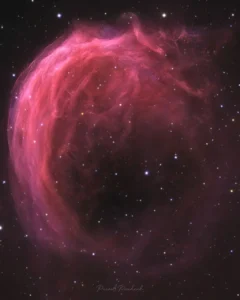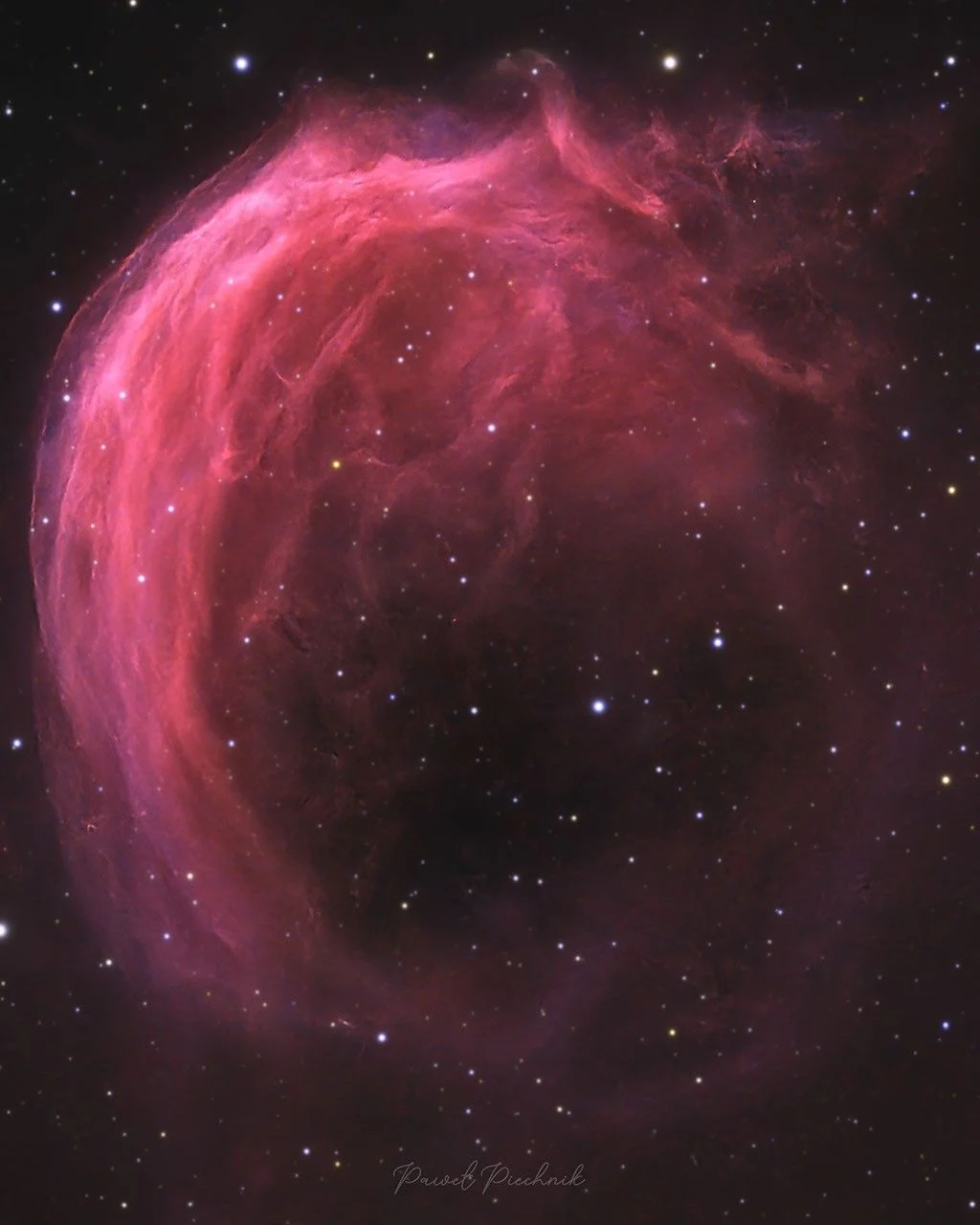
The vast expanse of the cosmos continues to unveil its breathtaking spectacles, and the latest offering from NASA’s Astronomy Picture of the Day (APOD) is no exception. A stunning image captures the intricate beauty of the Shrimp Nebula, officially cataloged as Sh2-188, showcasing a vibrant pink swirling nebula against a backdrop of a star-filled sky. This celestial marvel, featured on September 29, 2026, offers a glimpse into the dramatic final stages of a Sun-like star’s life and the energetic processes that shape interstellar gas.
Unveiling the Shrimp Nebula: A Planetary Nebula Like No Other
The Shrimp Nebula, Sh2-188, is a particularly captivating example of a planetary nebula, a phase in the life cycle of low-to-intermediate mass stars, like our own Sun. These nebulae are formed when a star exhausts its nuclear fuel and expels its outer layers into space, creating a glowing shell of gas and dust. What sets the Shrimp Nebula apart is its impressive angular size, spanning approximately half the diameter of the full Moon. This makes it one of the largest planetary nebulae visible in the night sky, offering astronomers a significant canvas for study.
The featured image, captured by amateur astrophotographer Pawel Piechnik from Krakow, Poland, highlights the nebula’s characteristic pink hue. This color is a direct result of the light emitted by hydrogen atoms that have been energized by the nebula’s central star. The image was further processed using data from sulfur and oxygen emissions, allowing for a more comprehensive representation of the nebula’s chemical composition and true colors. The digital adjustments made by Piechnik aim to approximate the nebula’s actual appearance, providing viewers with an almost lifelike view of this distant cosmic structure.
The Mystery of the Swirl: A Stellar Wake
The most striking feature of the Shrimp Nebula is its dynamic swirling pattern. The top portion of the nebula, in particular, displays intricate details and a pronounced spiral structure, while the lower part appears more diffuse and open. Astronomers attribute this energetic swirl to the exceptionally high speed at which the nebula’s central white-dwarf core is moving through interstellar space.
A white dwarf is the dense remnant of a star that has shed its outer atmosphere. In the case of Sh2-188, this white dwarf is moving at an unusually rapid pace. This high velocity is creating a phenomenon known as a "bow shock" – a shock wave that forms ahead of an object moving through a fluid medium at supersonic speeds. In the context of space, this "fluid" is the interstellar medium, the diffuse gas and dust that permeates galaxies.
The bow shock in the Shrimp Nebula is most prominently visible on the upper left side of the image, exhibiting a distinct arc-like structure. This shock wave is akin to the bow wave created by a boat plowing through water, pushing and compressing the surrounding interstellar gas. As the white dwarf surges forward, it compresses and heats the gas on its leading edge, causing it to brighten and become more visible. This process is what gives the nebula its ethereal glow and its distinctive shape.
Background Context: The Life and Death of Stars
Understanding the Shrimp Nebula requires an appreciation for stellar evolution. Stars like our Sun spend the majority of their lives in a stable phase, fusing hydrogen into helium in their cores. This process generates outward pressure that balances the inward pull of gravity. However, as a star ages, it eventually exhausts its hydrogen fuel.
For Sun-like stars, this leads to a series of dramatic transformations. The star’s core contracts and heats up, causing its outer layers to expand and cool, turning it into a red giant. During this phase, the star may undergo further fusion processes, creating heavier elements. Eventually, the star’s outer layers are ejected into space, forming a planetary nebula. The remaining core collapses into a dense, hot white dwarf.
Planetary nebulae, despite their name, have nothing to do with planets. The term originated in the 18th century when early astronomers, observing these round, gaseous objects through their telescopes, were reminded of the appearance of planets. While the central star eventually cools and fades over billions of years, the expelled material can persist for tens of thousands of years, enriching the interstellar medium with heavier elements, which are crucial for the formation of new stars and planetary systems.
Timeline of Celestial Events (Inferred)
While a precise timeline for the formation of the Shrimp Nebula is difficult to ascertain without detailed spectroscopic analysis and precise distance measurements, a general chronology can be inferred based on our understanding of stellar evolution:
- Billions of Years Ago: The parent star of the Shrimp Nebula begins its life, likely as a main-sequence star similar to our Sun.
- Millions of Years Ago: The star exhausts its core hydrogen fuel and enters the red giant phase. Its outer layers begin to expand significantly.
- Tens of Thousands of Years Ago (estimated): The star sheds its outer envelope, initiating the formation of the planetary nebula. The central core collapses to form a white dwarf.
- Thousands of Years Ago to Present: The white dwarf moves at high velocity through the interstellar medium, creating the bow shock and shaping the nebula’s structure. The expelled gas continues to expand and interact with the surrounding interstellar environment.
- Present Day (September 29, 2026): Pawel Piechnik captures the detailed image of the Shrimp Nebula, providing astronomers and the public with a remarkable view of this dynamic cosmic event.
Supporting Data and Astronomical Significance
The study of planetary nebulae like Sh2-188 provides invaluable data for astronomers. By analyzing the light emitted from these nebulae, scientists can determine their chemical composition, temperature, density, and velocity. This information helps us to:
- Understand Stellar Evolution: Planetary nebulae are direct observational evidence of the final stages of stellar life for a significant fraction of stars in the universe. Studying their diversity and characteristics helps refine our models of how stars evolve.
- Investigate Galactic Chemical Enrichment: The heavy elements synthesized by stars and expelled into the interstellar medium are the building blocks for future generations of stars, planets, and even life. Planetary nebulae are significant contributors to this galactic chemical enrichment.
- Probe the Interstellar Medium: The interaction of nebulae with the surrounding interstellar gas provides insights into the properties of this diffuse medium, including its density, temperature, and turbulence.
- Measure Distances: While not explicitly stated for Sh2-188 in the provided text, planetary nebulae are sometimes used as "standard candles" or for other distance measurement techniques, helping to map the structure of our galaxy.
The angular size of Sh2-188, being roughly half the diameter of the Moon, suggests it is either relatively nearby or intrinsically very large. Further distance measurements would be crucial for a complete understanding of its physical dimensions and luminosity. The velocity of the central white dwarf, which is inferred to be high, could be on the order of tens to hundreds of kilometers per second, a significant speed in astronomical terms.
Official Responses and Broader Implications
The Astronomy Picture of the Day (APOD) program, a collaborative effort involving NASA’s Goddard Space Flight Center, NASA Science Activation, and Michigan Technological University, plays a vital role in disseminating astronomical knowledge to the public. The selection of the Shrimp Nebula for APOD highlights the ongoing scientific interest in such phenomena and the public’s fascination with the wonders of the universe.
Robert Nemiroff and Jerry Bonnell, along with Cecilia Chirenti and Keighley Rockcliffe, are credited as authors and editors for this APOD feature. Their work in curating and explaining these images ensures that complex astronomical concepts are made accessible to a global audience. The continuous updates on APOD’s website, including the notification of a change in the image submission email address and the relocation of APOD’s main NASA site to science.nasa.gov/apod, demonstrate the program’s commitment to its outreach mission and its adaptation to evolving digital platforms.
The broader implications of studying objects like the Shrimp Nebula extend beyond pure scientific curiosity. Understanding the processes of stellar death and the formation of nebulae contributes to our understanding of the cosmic origins of the elements that make up our planet and ourselves. This knowledge fosters a deeper appreciation for our place in the universe and the interconnectedness of all matter.
Furthermore, the contributions of amateur astronomers like Pawel Piechnik are increasingly vital to astronomical research. With increasingly sophisticated equipment available to the public, amateur astrophotographers are capturing images of celestial objects with remarkable detail and scientific value. Their work not only inspires awe but also provides valuable observational data that can complement professional astronomical studies.
Future Investigations
The Shrimp Nebula, with its unique characteristics, is likely to remain a subject of scientific interest. Future research could focus on:
- Precise Distance Measurements: Determining the exact distance to Sh2-188 would allow for more accurate calculations of its physical size, luminosity, and the velocity of its central star.
- Detailed Spectroscopic Analysis: Further analysis of the nebula’s spectrum could reveal more about its chemical composition, temperature gradients, and the physical conditions within the shock wave.
- High-Resolution Imaging: Observations with more powerful telescopes, such as the Hubble Space Telescope or the James Webb Space Telescope, could provide even greater detail of the intricate structures within the nebula.
- Modeling the Bow Shock: Advanced computational models could be used to simulate the interaction between the white dwarf and the interstellar medium, helping to explain the precise dynamics of the bow shock formation.
The image of the Shrimp Nebula serves as a powerful reminder of the dynamic and ever-evolving nature of our universe. It is a testament to the beauty that can arise from the end of a star’s life and a window into the processes that continuously shape the cosmos. As APOD continues to showcase these celestial wonders, it fuels our collective imagination and inspires a deeper exploration of the mysteries that lie beyond our planet.