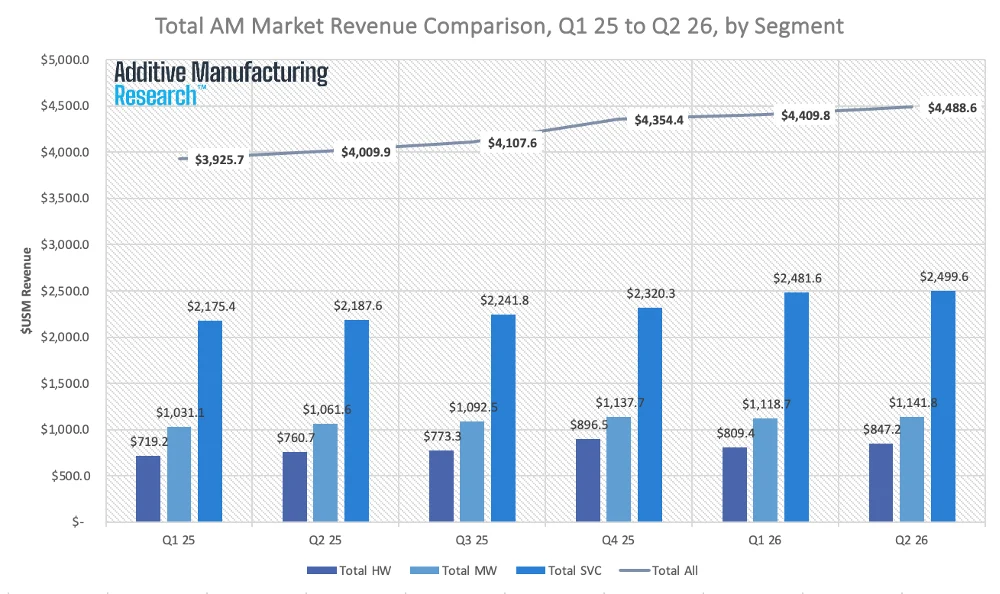
The additive manufacturing (AM) industry has demonstrated sustained expansion, achieving its sixth consecutive quarter of growth in the second quarter of 2026. This consistent upward trajectory signifies a maturing market that is increasingly solidifying its position as a viable and growing segment within the broader manufacturing landscape. Worldwide revenue for metal, polymer, and ceramic 3D printing systems, materials, and services collectively reached $4.48 billion during Q2 2026, according to newly released data from Additive Manufacturing Research (AM Research). This figure represents a significant 12% increase compared to the same period in the previous year and a modest uptick from the approximately $4.4 billion generated in the first quarter of 2026.
The comprehensive insights are derived from AM Research’s latest publications: the Q2 2026 3DP/AM Market Data and Forecast, which meticulously examines the metal and polymer AM markets, and its accompanying Q2 2026 Market Insights report. These reports provide granular data, tracking market performance by individual companies, specific printing technologies, geographical regions, and diverse application areas.
A Trend of Consistent Expansion
The current growth streak marks a notable shift for the additive manufacturing sector, which has experienced periods of volatility and consolidation in recent years. The latest data from AM Research paints a picture of steady progress: the total market revenue has climbed from an estimated $3.93 billion in the first quarter of 2025 to $4.01 billion in Q2 2025, followed by $4.11 billion in Q3, and $4.35 billion in Q4 of that year. This momentum carried into 2026, with revenue reaching approximately $4.41 billion in Q1 before its subsequent increase in the most recent quarter. This sustained expansion indicates a growing adoption and integration of AM technologies across various industries.
Segment Performance: Metal and Polymer Leading the Charge
Breaking down the revenue by material type, the metal additive manufacturing sector generated an impressive $1.81 billion in Q2 2026, a substantial increase from the $1.59 billion recorded a year prior. The polymer AM market also demonstrated robust growth, reaching $2.68 billion, up from $2.42 billion in Q2 2025. These figures underscore the continued investment and innovation within both the high-value metal sector, critical for aerospace and automotive applications, and the more broadly applicable polymer segment, vital for prototyping, tooling, and end-use parts across numerous industries.
The Growing Significance of AM Services
Crucially, the data highlights the escalating importance of additive manufacturing services. Combined revenue from AM services reached nearly $2.50 billion in Q2 2026, a significant increase from $2.19 billion in the same quarter of 2025. This growth indicates that services alone now account for more than half of the overall AM market revenue during the quarter. This trend suggests a maturing ecosystem where companies are not solely focused on selling hardware but are also actively providing part production, design optimization, and consulting services. This shift implies that the value proposition of AM is increasingly being realized through its application in actual manufacturing processes, rather than solely through the acquisition of equipment.
Expert Perspectives and Market Dynamics
Scott Dunham, Executive Vice President at AM Research, described the first half of 2026 as a "welcome time in the AM industry, with robust growth for many as forecasted." He further commented on the positive market sentiment, noting that "This has attracted some capital back to the markets, which may help further catalyze growth." However, Dunham also voiced a note of caution, acknowledging the potential for future headwinds. "It remains to be seen if we may have a stall out again as capex is pressured due to interest rates – which we have seen before – or if AM will continue to flourish as a manufacturing tool to weather rapidly changing market conditions."
Dunham’s remarks point to a critical juncture for the industry. While the current growth is encouraging, the broader economic climate presents potential challenges. The Federal Reserve’s recent decision to raise its benchmark interest rate by a quarter point, bringing the target range to 3.75% to 4%, underscores the ongoing effort to combat inflation. This marks the first rate increase in over three years, signaling a more restrictive monetary policy. For AM companies, higher interest rates can translate into increased financing costs for potential customers, particularly for large capital expenditures such as industrial 3D printers. This could lead to a more cautious approach to investment among manufacturers, potentially impacting the adoption rate of new AM technologies.
Broader Economic Context and AM’s Resilience
The resilience of the additive manufacturing market is noteworthy when considered against the backdrop of the broader manufacturing sector. The U.S. manufacturing sector, for instance, experienced its eighth consecutive month of expansion in August 2026, according to the Institute for Supply Management (ISM). Manufacturers surveyed earlier in the year had also expressed optimism regarding capital spending increases for 2026. This general economic uplift provides a favorable environment for industrial technologies.
However, the concern regarding interest rates remains a pertinent factor. Historically, periods of rising interest rates have led to increased caution in capital expenditure, especially for high-ticket industrial equipment. The substantial upfront investment required for many industrial-grade 3D printers could make some businesses re-evaluate their purchasing decisions in an environment of higher borrowing costs. This dynamic could influence the pace of adoption for advanced AM solutions, potentially favoring service-based models or incremental technology upgrades over outright equipment purchases.
Key Players and Market Coverage
AM Research’s comprehensive datasets track a wide array of companies operating within both the metal and polymer additive manufacturing markets. Prominent players included in their analysis, among many others, are Stratasys, 3D Systems, EOS, Nikon SLM Solutions, HP, Formlabs, Carbon, Bambu Lab, Creality, Farsoon, BLT, Renishaw, and Velo3D. This broad coverage ensures that the market data reflects the diverse landscape of AM technology providers and their respective market shares.
The "Core Metals" and "Core Polymers" datasets from AM Research offer nearly a decade of historical quarterly market data, complemented by forecasts extending for the next ten years. The accompanying "Market Insights" report provides crucial qualitative analysis, charts, and contextual information that enriches the quantitative data.
A Shift from Volatility to Stability
The sustained growth over the past six quarters signifies a clear departure from the more turbulent periods experienced by the AM industry in recent years. Previously, the sector was often characterized by significant layoffs, extensive restructuring, and consolidation among companies. The current trend of consistent, albeit moderate, growth suggests a move towards greater market stability and maturity. This period of expansion is not marked by a sudden, unsustainable boom but rather by a more consistent and integrated adoption of additive manufacturing as a valuable tool within the industrial ecosystem.
The data implies that additive manufacturing is steadily proving its worth as a solution for a variety of manufacturing challenges. Its ability to produce complex geometries, enable on-demand production, and facilitate customization makes it an attractive option for industries seeking to enhance supply chain resilience, reduce lead times, and innovate product designs. The growing reliance on AM services further indicates that the technology’s benefits are being realized in practical, production-oriented applications.
Future Outlook and Navigating Economic Currents
While the current growth trajectory is positive, the industry’s ability to sustain this momentum will likely depend on several factors. The ongoing economic landscape, including inflation rates and interest rate policies, will play a significant role. Furthermore, continued innovation in AM materials, processes, and software will be crucial in expanding the range of applications and further solidifying its position as a mainstream manufacturing technology.
The industry’s capacity to adapt to evolving economic conditions, while continuing to deliver tangible value and cost efficiencies to its customers, will be key. As Scott Dunham’s insights suggest, the question remains whether AM will continue to be a flexible and responsive manufacturing solution that helps businesses navigate market uncertainties, or if the broader economic pressures will temper its impressive growth. The coming quarters will offer further clarity on the additive manufacturing market’s long-term trajectory and its ability to thrive amidst a dynamic global economic environment.
For those seeking more in-depth market analysis and data, AM Research offers a comprehensive suite of reports and datasets, accessible through their website, detailing specific market segments and future projections for the additive manufacturing industry.