A suite of recent innovations is poised to redefine standards in electric vehicle infrastructure, automotive manufacturing, and industrial automation. These developments, spanning advanced diagnostic tools, novel material science, high-performance robotics, and specialized adhesives, underscore a concerted industry effort to address complex operational challenges, improve safety protocols, and accelerate technological adoption. From ensuring the reliability of burgeoning EV charging networks to streamlining the production of next-generation vehicles and empowering more flexible factory floors, these products represent a significant leap forward in engineering and manufacturing capabilities.
Revolutionizing EV Charger Testing with Fluke’s FEV500 Virtual EV
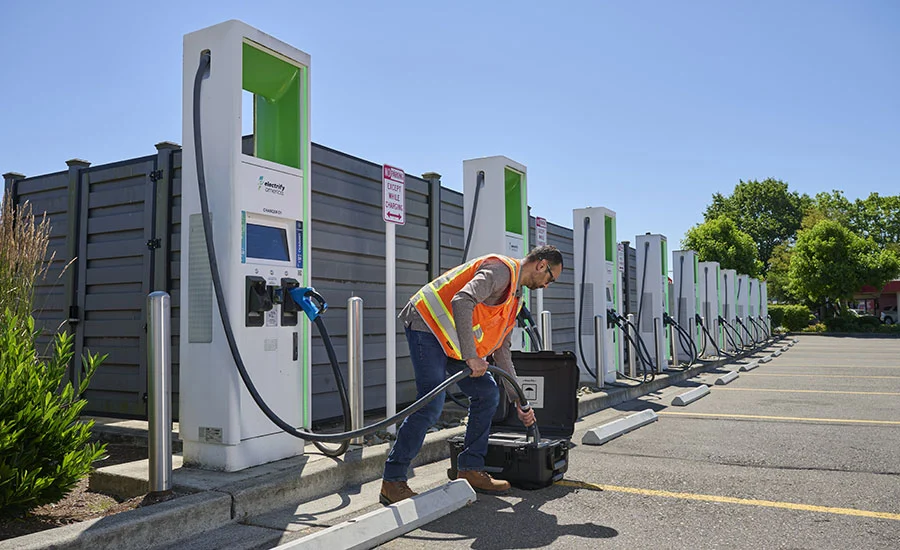
The rapid expansion of the electric vehicle (EV) market has placed unprecedented demands on charging infrastructure, necessitating robust, reliable, and interoperable charging stations. Addressing this critical need, Fluke Corporation has introduced the FEV500, a groundbreaking device designed to test DC Level 3 electric vehicle chargers. This innovative tool functions as a "virtual EV," consolidating safety, communication, and interoperability checks into a single, easily transportable unit. By integrating the functionalities typically requiring multiple tools such as digital multimeters, insulation testers, and oscilloscopes, the FEV500 significantly enhances testing efficiency and accuracy.
The FEV500 is engineered to provide actionable data crucial for regulatory compliance, proactive maintenance planning, and precise performance forecasting. Its design adheres to international standards ISO 15118 and DIN SPEC 70121, which govern the digital communication protocols between EVs and charging equipment. These standards are pivotal for ensuring seamless and secure charging experiences, making the FEV500 an indispensable asset for charger manufacturers, installation technicians, and service providers. The device delivers rapid pass-fail results through guided workflows, simplifying complex diagnostic procedures. Furthermore, its capacity to simulate real-world charging and communication scenarios allows for comprehensive validation of both interoperability and performance under diverse conditions, mitigating potential issues before they impact consumers.
Background and Market Context: The global electric vehicle market is experiencing exponential growth, with projections indicating tens of millions of units sold annually within the next decade. This surge demands a corresponding, massive expansion of charging infrastructure. However, the reliability and interoperability of charging stations have historically presented challenges, leading to consumer frustration and operational inefficiencies. Issues such as communication errors between vehicles and chargers, safety concerns related to high-voltage DC charging, and the sheer complexity of testing myriad charging protocols have highlighted a significant market gap for advanced diagnostic tools. Fluke’s FEV500 arrives at a critical juncture, offering a streamlined solution to these pervasive problems. Its emphasis on compliance with evolving international standards ensures that newly deployed and existing charging stations can meet the stringent demands of modern EVs.

Implications: The introduction of the FEV500 is expected to have far-reaching implications. For charger manufacturers, it means faster validation cycles and reduced time-to-market for new products. For charging network operators, it translates to improved uptime, enhanced customer satisfaction, and optimized maintenance schedules. Regulatory bodies will benefit from more consistent compliance across the industry. Ultimately, for the end-user, the FEV500 contributes to a more reliable, safer, and seamless EV charging experience, which is vital for accelerating mainstream EV adoption. Fluke’s commitment to delivering precision and reliability in measurement tools is clearly extended to the burgeoning EV ecosystem, reinforcing its position as a leader in industrial testing solutions.
Henkel’s Teroson EP 52 Series: Structural Adhesive with Integrated Vibration Damping
In the competitive automotive industry, the pursuit of lightweighting, enhanced structural integrity, and superior noise, vibration, and harshness (NVH) characteristics remains paramount. Henkel Corporation has unveiled its Teroson EP 52 Series structural adhesive, an innovative material that uniquely combines robust structural integrity with effective vibration damping in a single, production-ready solution. This advanced adhesive is specifically designed for automated body-in-white assembly applications, seamlessly integrating with existing dispensing systems on automotive production lines. Its development directly supports critical industry goals related to durability, passenger comfort, and vehicle lightweighting.
The Teroson EP 52 Series is a heat-curing, solvent-free, one-component adhesive fully compatible with standard pump dispensing systems commonly used for structural and hem flange bonding. This compatibility ensures a smooth transition for manufacturers looking to adopt the new material without significant overhauls to their current production infrastructure. Its formulation makes it ideal for use in weld-bonded structures, where it provides exceptional adhesion and contributes to overall vehicle rigidity. A key advantage of this adhesive is its ability to support vehicle lightweighting initiatives by eliminating the need for traditional bitumen sheets, which are typically used for acoustic damping. By replacing these heavy sheets with a single, lighter adhesive, manufacturers can achieve significant weight reduction without compromising acoustic performance, thereby contributing to improved fuel efficiency for internal combustion engine vehicles and extended range for electric vehicles. The adhesive features a unique chemical cross-linking mechanism that ensures robust bonding and structural integrity, even in demanding high-temperature applications, making it suitable for modern multi-material vehicle architectures.
Background and Market Context: The automotive sector is constantly striving for innovations that reduce vehicle weight, improve safety, and enhance the driving experience. Lightweighting directly impacts fuel economy and emissions for traditional vehicles and extends range for EVs, making it a critical design parameter. Simultaneously, consumer expectations for quieter, more comfortable rides have driven advancements in NVH reduction technologies. Traditionally, these goals often required separate materials and processes—structural adhesives for bonding and bitumen sheets or other damping materials for acoustics—adding complexity, cost, and weight. Henkel’s solution directly addresses this inefficiency by combining these functionalities. The global automotive adhesives market is a multi-billion-dollar industry, driven by the increasing use of advanced materials and the need for high-performance bonding solutions.
Implications: The Teroson EP 52 Series offers significant operational and performance benefits. From a manufacturing perspective, it simplifies the assembly process by reducing the number of materials and steps required, potentially leading to faster production cycles and lower costs. For vehicle designers, it opens up new possibilities for further weight optimization without compromising structural integrity or acoustic comfort. This innovation is particularly relevant for the electric vehicle segment, where every kilogram saved directly translates to increased battery range, a key competitive differentiator. Henkel’s long-standing expertise in material science and its deep understanding of automotive manufacturing challenges are evident in this product, which promises to contribute to more efficient, quieter, and structurally sound vehicles. The solvent-free nature also aligns with growing industry demands for more sustainable and environmentally friendly manufacturing processes.

ABB Robotics’ PoWa Family: High-Speed Collaborative Robots for Heavy Payloads
The landscape of industrial automation is continually evolving, with collaborative robots (cobots) emerging as a transformative technology designed to work alongside humans with enhanced safety and flexibility. ABB Robotics has introduced its PoWa family of high-speed collaborative robots, a series engineered to handle payloads ranging from 7 to an impressive 30 kilograms. This development addresses a significant gap in the market, bridging the performance chasm between traditional cobots, which often lack the speed and payload capacity for rigorous industrial applications, and conventional industrial robots, which are typically designed for highly specialized, large-scale automation environments requiring extensive safety caging.
The PoWa family of cobots empowers manufacturers to automate heavier and faster processes while retaining the inherent flexibility, ease of use, and compact footprint that define collaborative robotics. This capability is crucial for industries seeking to enhance productivity and quality in tasks that were previously too demanding for cobots or too complex and costly for traditional industrial robots. Typical assembly applications for the PoWa series include arc welding, machine tending, and screwdriving – tasks that often involve considerable forces or require handling heavier components. A hallmark of these new robots is their user-friendliness; they are designed to be unboxed and operational in less than an hour, significantly reducing deployment time and technical barriers for businesses looking to integrate automation. Their intuitive programming interfaces further democratize access to advanced robotics, making them suitable for small and medium-sized enterprises (SMEs) as well as larger manufacturing operations.
Background and Market Context: Collaborative robots have seen explosive growth since their inception, driven by the need for more adaptable automation solutions that can work safely in shared human workspaces. Early cobots, while revolutionary in their safety features and ease of programming, were often limited by their payload and speed, confining them to lighter assembly tasks. This limitation prevented many industrial applications, such as handling heavy components or performing high-speed welding, from benefiting from collaborative automation. The global cobot market is projected to continue its rapid expansion, fueled by increasing labor costs, the demand for flexible manufacturing, and advancements in AI and sensor technology that enhance cobot capabilities. The PoWa family represents a maturation of cobot technology, extending its reach into more demanding industrial processes without sacrificing the core benefits of collaboration.
Implications: The introduction of the PoWa family is set to transform manufacturing by making advanced automation accessible and practical for a wider range of applications and businesses. For manufacturers, it means increased productivity, improved consistency, and the ability to reallocate human workers to higher-value, less repetitive tasks. The ability to handle heavier payloads at higher speeds expands the scope of tasks that can be automated collaboratively, from complex assembly to material handling. This innovation also plays a critical role in fostering manufacturing resilience and flexibility, allowing companies to quickly reconfigure production lines in response to changing market demands. ABB Robotics, a long-standing leader in industrial automation, continues to drive innovation in the field, making advanced robotic solutions more versatile and easier to integrate into diverse manufacturing ecosystems, thereby contributing to the broader Industry 4.0 movement.
Avery Dennison’s Pressure-Sensitive Adhesive Tapes for EV Battery Assembly
The electric vehicle revolution hinges on the performance, safety, and longevity of its battery systems. To meet the stringent demands of modern EV battery manufacturing, Avery Dennison Corporation has launched a new line of pressure-sensitive tapes specifically engineered for EV battery cell connection systems. This comprehensive range of functional bonding and protection adhesives is designed to make EV batteries safer, more efficient, and easier to design and assemble, addressing critical challenges within the rapidly evolving battery ecosystem.

These specialized tapes play a vital role in ensuring the reliable performance and extended longevity of EV batteries by providing high-voltage connectivity and robust protection. Key features of the new adhesive tapes include advanced flame-retardant properties, which are paramount for mitigating the risk of thermal events within battery packs. They also offer superior vibration absorption, crucial for minimizing mechanical stress on delicate battery components and connections during vehicle operation, thereby extending the battery’s lifespan and maintaining consistent performance. Furthermore, the tapes exhibit high-temperature resistance, allowing them to securely bond materials to thermal and flame barriers, an essential aspect of battery thermal management. The product line includes both single-coated tapes for dielectric protection – ensuring electrical insulation between components – and double-coated tapes for bonding thermal barriers, which are critical for managing heat dissipation and preventing thermal runaway.
Background and Market Context: Electric vehicle batteries are complex, high-energy systems that require meticulous design and assembly to ensure safety and optimal performance. Challenges in battery manufacturing include effective thermal management, robust vibration dampening, electrical insulation, and ensuring long-term durability under harsh operating conditions. The demand for higher energy density, faster charging capabilities, and extended battery life continues to drive innovation in battery design and material science. The global EV battery market is expanding rapidly, with billions of dollars being invested in giga-factories and advanced battery research. Adhesive solutions are increasingly critical in this sector for their ability to provide precise bonding, electrical insulation, thermal management, and vibration damping in compact, high-performance battery packs.
Implications: Avery Dennison’s new line of pressure-sensitive tapes is poised to significantly impact EV battery manufacturing and vehicle safety. By offering enhanced flame retardancy and thermal management capabilities, these tapes contribute directly to reducing the risk of catastrophic battery failures, a primary concern for both consumers and manufacturers. The vibration absorption properties help safeguard the structural integrity of battery packs, leading to longer battery life and consistent performance over the vehicle’s lifespan. Moreover, by simplifying bonding and protection processes, these tapes can streamline assembly lines, leading to more efficient production and potentially lower manufacturing costs. As a leader in adhesive technologies, Avery Dennison is strategically positioned to support the continued growth and innovation within the electric vehicle industry, providing critical components that underpin the reliability and safety of the next generation of transportation.
A Unified Push for Industrial Advancement
The collective introduction of these innovative products from Fluke, Henkel, ABB Robotics, and Avery Dennison underscores a significant trend in modern industry: a unified push towards greater efficiency, enhanced safety, and superior performance. These advancements are not isolated but interconnected, particularly in their collective impact on the rapidly expanding electric vehicle ecosystem and the broader landscape of advanced manufacturing. From the precision diagnostics ensuring the reliability of EV charging infrastructure to the sophisticated materials enhancing vehicle construction, the flexible automation transforming factory floors, and the specialized adhesives securing critical battery components, each innovation contributes to a future where industrial processes are smarter, safer, and more sustainable. As industries continue to navigate technological shifts and evolving market demands, such targeted and impactful innovations will be crucial drivers of progress and competitiveness on a global scale.