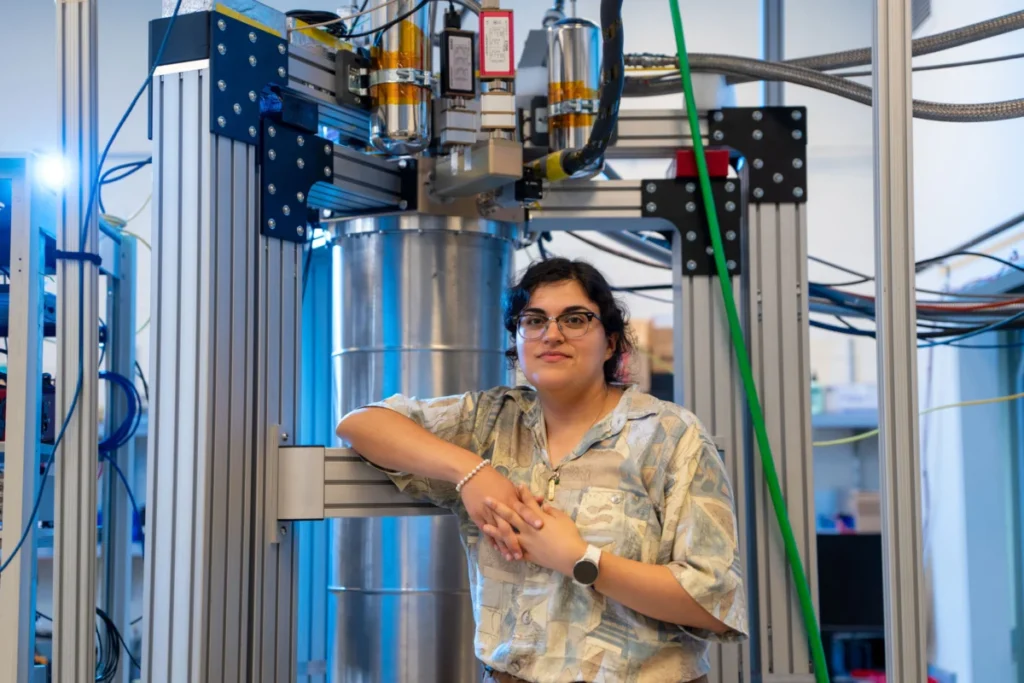
In the high-stakes world of experimental particle physics, where the fundamental building blocks of the universe are scrutinized at the subatomic level, researchers are often tasked with reconciling the theoretical elegance of mathematical models with the messy, unpredictable reality of laboratory data. For Reyes, a sixth-year PhD candidate at the Massachusetts Institute of Technology (MIT), this pursuit has defined over half a decade of academic rigor. Working within the Formaggio Group at MIT’s Laboratory for Nuclear Science (LNS), Reyes has dedicated her doctoral career to the study of neutrinos—particles so elusive they are frequently referred to as "ghost particles." Her journey, which transitioned from the laboratories of Cambridge, Massachusetts, to the nuclear research facilities of Grenoble, France, exemplifies the collaborative and adaptive nature of modern high-energy physics.
The Enigma of the Neutrino and the Standard Model
To understand the significance of Reyes’ work, one must first look at the framework of the Standard Model of particle physics. Developed in the mid-20th century, the Standard Model is the most robust theory scientists have to describe the three of the four fundamental forces—electromagnetism, the weak nuclear force, and the strong nuclear force—while classifying all known elementary particles. While the model has successfully predicted the existence of particles like the Higgs boson, it remains an incomplete "map" of the universe. It notably excludes gravity and fails to account for dark matter or dark energy, which comprise the vast majority of the cosmos.
Neutrinos occupy a unique and somewhat problematic position within this framework. They are the most abundant particles in the universe that possess mass, yet their mass is so infinitesimally small that for decades they were thought to be massless. They are produced in astronomical quantities by the sun, as well as by terrestrial sources such as nuclear reactors and radioactive decay. Despite trillions of neutrinos passing through a human body every second, they rarely interact with normal matter, making them nearly impossible to detect without specialized, highly sensitive equipment.
Reyes’ research focuses on these particles because their behavior offers a potential "trapdoor" to new physics. If neutrinos behave in ways not predicted by the Standard Model, they could lead to a more comprehensive theory of the universe. Specifically, Reyes is involved in the Ricochet neutrino experiment, an international collaboration aimed at observing a rare phenomenon known as coherent elastic neutrino-nucleus scattering (CEvNS).
The Ricochet Experiment: Precision at the Nuclear Level
The Ricochet experiment is situated at the Institut Laue-Langevin (ILL) in Grenoble, France, home to one of the world’s most intense sources of low-energy neutrinos: a high-flux nuclear research reactor. The experiment seeks to measure CEvNS, a process where a neutrino interacts with an entire atomic nucleus rather than a single constituent proton or neutron. This interaction results in a tiny, measurable "recoil" of the nucleus.
Because the energy deposited by this recoil is exceptionally low, detecting it requires cryogenic detectors cooled to temperatures near absolute zero. These detectors, known as bolometers, measure the minute increase in temperature caused by a single neutrino interaction. The Ricochet collaboration utilizes these state-of-the-art technologies to probe the "neutrino floor," a boundary where neutrino interactions could potentially interfere with searches for dark matter. By mastering the detection of CEvNS, Reyes and her colleagues are providing a new tool to test the limits of the Standard Model with unprecedented precision.
Chronology of a Research Pivot: From MIT to Grenoble
The trajectory of a PhD is rarely a straight line, and Reyes’ experience is a testament to the necessity of scientific flexibility. Upon joining the Formaggio Group, her initial focus was directed toward a localized project based at MIT. However, experimental physics is often subject to the timelines of hardware development and funding cycles. A few years into her residency, it became evident that the MIT-based project would not be operational in time for her to complete her dissertation research.
Faced with a potential delay, Reyes pivoted her focus to the Ricochet experiment in France. This transition required her to move from theoretical preparation to the "hands-on" reality of an international collaboration. Her first foray into the French research landscape was a three-month visit to Grenoble, where she was tasked with understanding the fundamental operations of the experiment’s initial two detectors.
As the experiment scaled up, so did the complexity of the data management. The project grew from two detectors to nine, and eventually to an array of 18. In the early stages, monitoring the health of the detectors and performing low-level data analysis was a manual, time-consuming process. Recognizing that the increasing volume of data would soon outpace human capacity, Reyes and a colleague took the initiative to modernize the experiment’s infrastructure.
Innovation Through Automation
The development of a custom software framework became a turning point in Reyes’ doctoral work. By automating the routine monitoring and analysis tasks that she had previously performed manually, she not only streamlined the experiment’s operations but also created a legacy tool for the collaboration.
"It’s sort of like you’re building your own stuff to replace yourself," Reyes noted, reflecting on the process. This automation allowed the team to maintain a 24/7 watch on the detectors’ performance, ensuring that any fluctuations in the cryogenic systems or background noise were identified in real-time. For a graduate student, the act of "replacing oneself" with code is a significant milestone; it shifts the researcher’s role from a technician to an architect of the scientific process.
This contribution earned her the trust of senior collaborators. In the hierarchical world of large-scale physics experiments, moving from a student who follows instructions to a leader who proposes and implements system-wide solutions is a rare and difficult transition. Her work on the software framework demonstrated a level of "physicist prowess" that solidified her standing within the international team.
The Chateaubriand Fellowship and International Cooperation
The depth of Reyes’ involvement in the French scientific community was furthered by the Chateaubriand Fellowship, a prestigious grant offered by the Embassy of France in the United States. This fellowship allowed her to spend nine months living and working in Grenoble, following two shorter three-month stints.
Being physically present at the Institut Laue-Langevin was crucial for the success of the Ricochet experiment. In an era of remote work, the nuances of experimental physics—such as the physical calibration of detectors and the immediate troubleshooting of hardware—still require "boots on the ground." Furthermore, working in the same time zone as her European collaborators facilitated a level of synergy that is often lost in trans-Atlantic Zoom calls.
Beyond the laboratory, the experience provided Reyes with a broader perspective on the global scientific culture. She observed a distinct difference in the French approach to work-life balance compared to the often grueling pace of American academia. This exposure to a different cultural philosophy, combined with her newfound hobby of crocheting—a tactile contrast to the abstract world of subatomic particles—contributed to her growth as a well-rounded scientist.
Leadership and the Human Element of Science
One of the most significant, yet least discussed, aspects of a PhD in physics is the development of "soft skills." Reyes’ journey from a self-described student who preferred being told what to do to a researcher who "wrangles" people and leads projects highlights the human infrastructure required to run a multi-million-dollar experiment.
Experimental physics at the scale of Ricochet is a communal effort. It requires the coordination of dozens of scientists across different countries, institutions, and languages. Reyes found that as her technical expertise grew, so did her responsibility to guide others. This transition required a boost in confidence and the ability to defend her scientific judgment in the face of scrutiny. Her evolution suggests that the "Standard Model" of a successful physicist includes not just mathematical brilliance, but the ability to manage teams and navigate the politics of international collaborations.
Broader Implications and the Future of Particle Research
The data being collected by Reyes and the Ricochet team has implications that reach far beyond the walls of the reactor building in Grenoble. If the experiment succeeds in measuring CEvNS with high precision, it will provide a sensitive probe for "non-standard interactions"—forces or particles that do not fit into our current understanding of the universe.
For example, precise measurements of neutrino scattering can help constrain the properties of "sterile neutrinos," a hypothetical fourth type of neutrino that does not interact via the weak force at all. If discovered, sterile neutrinos could be a candidate for dark matter, solving one of the greatest mysteries in modern science. Additionally, the technology developed for Ricochet—ultra-sensitive cryogenic bolometers—has applications in other fields, including quantum computing and nuclear non-proliferation monitoring.
As Reyes prepares to defend her thesis and seeks a postdoctoral position, her work stands as a bridge between current knowledge and the unknown. She plans to continue her career in research, potentially remaining within the European scientific circuit, where she found a professional and personal resonance.
Conclusion: The Tangible and the Elusive
The duality of Reyes’ life—spending her days investigating particles that can barely be said to exist while spending her evenings crocheting tangible objects—serves as a metaphor for the life of an experimentalist. Science is an attempt to make the invisible visible and the abstract concrete.
Through her work at MIT and in France, Reyes has contributed to a project that seeks to answer the most fundamental questions about the nature of reality. Her journey underscores a vital truth in the scientific community: while the particles being studied may be "vanishingly small," the effort, collaboration, and personal growth required to understand them are immense. As she moves toward the next stage of her career, the lessons learned in the laboratories of Grenoble—about automation, leadership, and the value of a well-timed pivot—will undoubtedly shape the next generation of discoveries in the field of nuclear science.