Artificial intelligence is rapidly becoming an indispensable tool for cosmologists seeking to unravel the universe’s deepest mysteries. New research highlights how a machine learning technique known as transfer learning promises to dramatically expedite and reduce the cost of the search for novel physics beyond the prevailing standard cosmological model. However, the same study also uncovers a paradoxical hurdle: AI, when excessively reliant on prior knowledge, can struggle to discern genuinely new phenomena, a challenge termed "negative transfer." This dual-edged discovery, published in the Journal of Cosmology and Astroparticle Physics (JCAP), underscores both the immense potential and inherent limitations of integrating advanced AI into fundamental scientific inquiry.
The Enduring Mysteries Beyond the Standard Model
For decades, the Lambda-cold dark matter ($Lambda$CDM) model has served as the bedrock of modern cosmology. This highly successful framework elegantly explains a vast array of cosmic observations, from the universe’s accelerated expansion to the large-scale distribution of galaxies and the cosmic microwave background (CMB) anisotropies. It posits a universe composed of approximately 5% ordinary matter, 27% mysterious cold dark matter (which provides gravitational scaffolding for structure formation), and 68% equally enigmatic dark energy (responsible for the accelerating expansion). Developed through a confluence of theoretical insights and groundbreaking observational data gathered over the last half-century, including measurements from missions like COBE, WMAP, and Planck, $Lambda$CDM has provided an unprecedentedly precise description of cosmic evolution.
Despite its triumphs, $Lambda$CDM is not without its fissures. It necessitates the existence of components—dark matter and dark energy—whose fundamental nature remains unknown. Furthermore, recent high-precision measurements have unveiled several persistent tensions, such as the "Hubble tension," a significant discrepancy between the expansion rate of the local universe and that inferred from the early universe’s CMB. Other anomalies, like the distribution of matter in the universe (quantified by the parameter $sigma_8$) and the clustering of galaxies, occasionally present subtle deviations from $Lambda$CDM predictions. These growing discrepancies, coupled with the inherent incompleteness of the model (it does not account for quantum gravity or the masses of neutrinos), strongly suggest that $Lambda$CDM is merely an approximation of a more profound underlying physics.
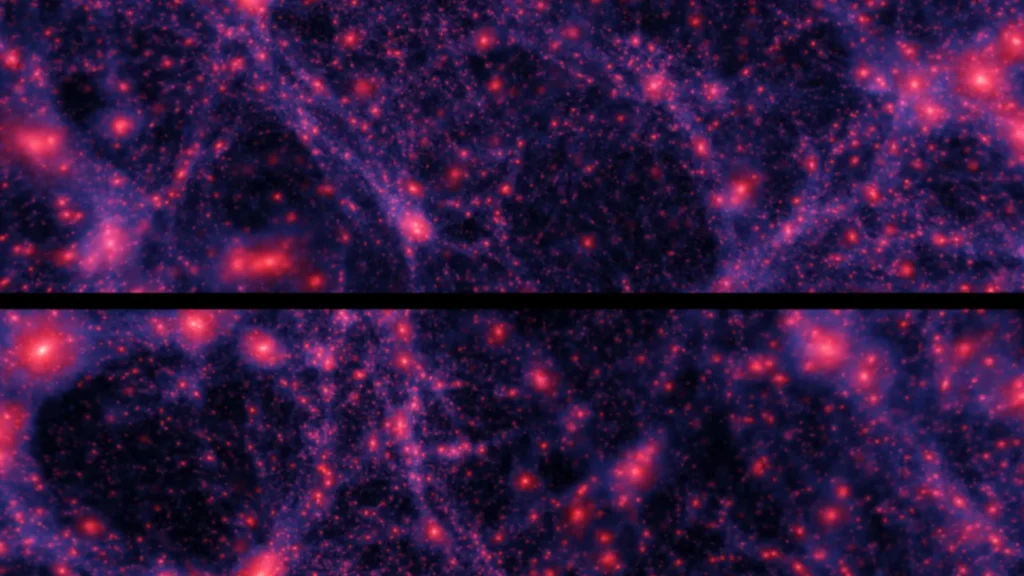
Investigating these tantalizing hints of "new physics" often involves exploring alternative theories: modified gravity models that tweak Einstein’s general relativity, evolving dark energy models where its density changes over cosmic time, or the inclusion of massive neutrinos. Neutrinos, though tiny, are incredibly abundant and their masses, while minuscule, can subtly influence the formation of large-scale structures by "free-streaming" out of gravitational potential wells, thereby smoothing out matter distributions. Each of these theoretical avenues requires extensive computational modeling. Researchers must generate vast ensembles of detailed computer simulations, each representing a virtual universe constructed under different physical assumptions. These cosmological simulations, which track the gravitational evolution of billions of particles over billions of years, are notoriously computationally expensive, demanding prodigious computing power from supercomputers and consuming considerable time and energy.
Transfer Learning: A Shortcut to Cosmic Understanding
Recognizing the escalating computational demands, researchers have turned to artificial intelligence, specifically machine learning, to accelerate the discovery process. The study led by Veena Krishnaraj and Adrian Bayer investigated whether transfer learning could dramatically enhance the efficiency of probing these beyond-$Lambda$CDM theories.
Transfer learning is a powerful paradigm in machine learning where a model, pre-trained on a vast dataset for a specific task, is then adapted or fine-tuned for a different, but related, task. This approach leverages the knowledge acquired during the initial training phase, rather than starting the learning process from scratch. In many real-world applications, from image recognition to natural language processing (e.g., the foundation models behind large language models like GPT), transfer learning has revolutionized efficiency and performance.
In the context of cosmology, the team’s innovative strategy involved initially training a neural network on simpler, less computationally intensive simulations based purely on the well-understood $Lambda$CDM model. This "pretraining" phase allowed the AI to develop a robust understanding of the fundamental gravitational dynamics and statistical properties of the universe as described by the standard model. Following this, the network was subjected to additional training, but this time using more sophisticated simulations that incorporated the potential signatures of new physics—such as massive neutrinos, modified gravity, or evolving dark energy.
Adrian Bayer, a cosmologist at the Flatiron Institute and Princeton University and co-author of the study, likens this methodology to an educational shortcut. "Usually, people train the AI directly on the most computationally expensive simulations," Bayer explains. "What we do instead is first use simpler and less expensive $Lambda$CDM simulations to give the AI an idea of what’s happening, and only afterward move to the more complex models." He further draws an analogy to academic learning: "You first read a basic book to get an idea of the knowledge, and then move to the really complicated book."
Veena Krishnaraj, the first author and an undergraduate student at Princeton University, emphasizes that this strategic pretraining prevents the AI from being overwhelmed: "This strategy prevents the AI from having to ‘digest everything at once.’" The practical implications were profound: in certain scenarios, transfer learning reduced the number of computationally expensive simulations required by more than a factor of ten, representing a significant saving in time, energy, and financial resources. This efficiency gain could translate into the ability to explore a much broader parameter space for new physics, accelerating the pace of discovery.
The Unexpected Pitfall: Negative Transfer
While the efficiency gains were impressive, the study also uncovered a subtle yet critical challenge: negative transfer. This phenomenon occurs when prior knowledge, instead of facilitating new learning, actually impedes it. Using Bayer’s textbook analogy, imagine a medical student thoroughly versed in common ailments. When presented with a rare disease whose symptoms closely mimic those of a prevalent condition, the student’s existing knowledge, usually helpful, might lead them to misdiagnose, pushing them towards the more familiar conclusion.
The same issue can manifest in AI systems. The researchers observed that in certain instances, the subtle signatures of new physics bore a resemblance to patterns already associated with parameters within the standard cosmological model. When faced with such ambiguous data, the pre-trained neural network, leaning on its extensive $Lambda$CDM knowledge, tended to interpret the unfamiliar information through the lens of what it already knew, thereby struggling to correctly identify genuinely novel effects.
A striking example arose during the study of simulations incorporating massive neutrinos. The observational signatures linked to neutrino mass — primarily their impact on the growth of large-scale structure — can closely resemble changes associated with an existing $Lambda$CDM parameter known as $sigma_8$. The parameter $sigma_8$ quantifies how strongly matter clusters throughout the universe; a higher $sigma_8$ indicates more clumpy structures. Because both massive neutrinos and variations in $sigma_8$ can lead to similar patterns of structure formation, the pre-trained neural network initially found it challenging to distinguish between the two effects.
"The negative transfer is not random. It is driven by underlying physical degeneracies in the model," Krishnaraj explains. This means that different physical processes can, in fact, produce very similar observable outcomes, creating an inherent ambiguity that even advanced AI struggles to disentangle. The challenge for both human and artificial intelligence lies in identifying which underlying parameter or physical mechanism is truly responsible for an observed effect when multiple explanations could fit the data. "So this is something we need to be aware of and try to mitigate," she concludes, emphasizing the need for strategies to address this bias.
Implications for Future Cosmological Surveys and the Human-AI Partnership
The findings of Krishnaraj, Bayer, and their colleagues (Christian Kragh Jespersen and Peter Melchior) in their paper, "Transfer Learning Beyond the Standard Model," published in JSTAT, illuminate both the profound potential and critical limitations of applying foundation model concepts to fundamental physics. These AI approaches, broadly similar in spirit to the techniques underpinning modern generative AI systems and large language models, promise unprecedented efficiency but also introduce new complexities in interpretation and validation.
The immediate next step for this research involves moving beyond simulations to apply these transfer learning techniques to real astronomical observations. This transition is crucial, as the universe’s data is inherently messier and more complex than even the most sophisticated simulations. The scientific community is on the cusp of an era of "big data cosmology." Upcoming cosmological surveys are poised to collect unprecedented volumes of high-precision data about the universe in the years ahead. Missions like the Vera C. Rubin Observatory’s Legacy Survey of Space and Time (LSST), the European Space Agency’s Euclid mission, the Dark Energy Spectroscopic Instrument (DESI), and NASA’s Roman Space Telescope will map billions of galaxies and probe the cosmic web with exquisite detail. The data streams from these observatories will be so immense—petabytes to exabytes—that human analysis alone will be impossible. AI and machine learning are not merely helpful; they are essential for processing, classifying, and extracting scientific insights from these colossal datasets.
The team believes that transfer learning could become an indispensable tool for these upcoming surveys, allowing cosmologists to rapidly test various new physics models against real-world data without the prohibitive computational cost of training models from scratch for every new hypothesis. This could significantly accelerate the pace of discovery, enabling faster identification of subtle deviations from $Lambda$CDM that might point towards new fundamental laws.
However, the discovery of negative transfer also underscores a vital lesson: AI, while powerful, is a tool that requires careful oversight and continuous validation. Scientists cannot blindly accept AI-driven conclusions, especially when searching for truly novel phenomena. The human element—critical thinking, domain expertise, and an awareness of potential biases—remains paramount. Mitigating negative transfer might involve developing more sophisticated AI architectures, incorporating uncertainty quantification into AI predictions, or designing training regimens that specifically guard against over-reliance on standard model patterns. It could also involve combining AI insights with other analytical methods, such as Bayesian inference, to provide more robust conclusions.
Ultimately, the future of cosmology will likely involve a symbiotic partnership between human scientists and advanced AI. AI will act as an incredibly efficient assistant, sifting through vast amounts of data and simulations, identifying patterns, and accelerating the testing of hypotheses. But the critical interpretation, the formulation of truly new questions, and the recognition of genuinely revolutionary discoveries will continue to rely on the human mind’s unique capacity for intuition, skepticism, and creative leaps. The promise of AI to accelerate our understanding of the cosmos is immense, but so too is the responsibility to wield it wisely, recognizing its strengths and understanding its inherent limitations.