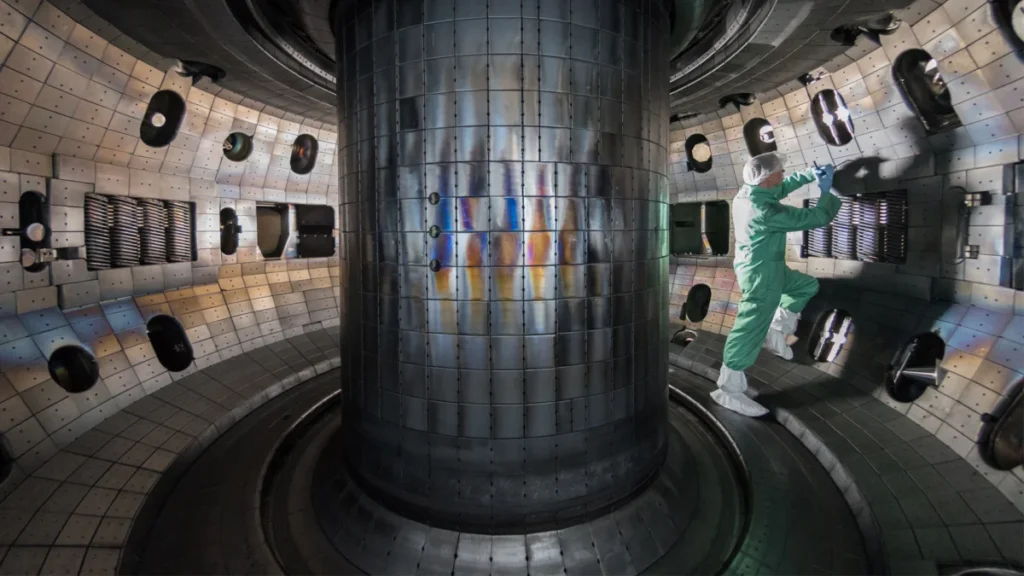
Inside the heart of a nuclear fusion machine, conditions are engineered to be extraordinarily extreme. Plasma, a superheated state of matter, can reach temperatures exceeding those found in the Sun’s core, demanding powerful magnetic fields to compress and confine it within an infinitesimally small, inherently unstable volume. These formidable conditions, while indispensable for initiating and sustaining the fusion reaction that promises clean, abundant energy, also introduce subtle yet critical challenges to the very machinery designed to harness it. At the DIII-D National Fusion Facility in San Diego, a leading experimental tokamak, even minute displacements in the massive magnetic coils encircling the plasma can profoundly influence the outcome and safety of an experiment. In a significant leap forward, researchers have now unveiled an innovative machine learning system capable of dynamically learning from these real-time shifts, accurately predicting the behavior of the machine’s hardware in subsequent experiments. This breakthrough represents a pivotal step towards integrating artificial intelligence as an operational tool in the demanding field of fusion research, echoing parallel endeavors to leverage AI for real-time plasma control and stability.
The newly developed methodology has demonstrated remarkable efficacy, reducing prediction errors by an impressive 80 percent when benchmarked against conventional static machine learning models. This substantial improvement brings AI considerably closer to becoming an indispensable, proactive element in the fusion control room. Kishan Rajput, a data scientist at Jefferson Lab and one of the lead researchers on the project, underscored the practical implications of this advance, stating, "The technique that we have developed would help fusion researchers find issues before they actually happen on the physical machine." This proactive capability is critical for mitigating risks and optimizing experimental efficiency in facilities like DIII-D.
The Intricate Dance of Fusion: Unpredictability in Extreme Environments
The DIII-D facility is a tokamak, a toroidal (donut-shaped) device specifically engineered to use intense magnetic fields to confine superheated plasma. Its distinctive D-shaped cross-section is enveloped by a sophisticated arrangement of large magnets, collectively known as toroidal field (TF) coils. These coils are masterpieces of precision engineering, constructed and secured to extraordinarily tight tolerances. However, despite their robust design, they are not entirely immune to movement. The extreme thermal and electromagnetic forces at play, coupled with the inherent variability in plasma stability from one experimental "shot" to the next, can induce subtle, yet significant, shifts in these coils.
Each experimental shot at DIII-D is an attempt to sustain plasma under specific conditions, often lasting only a few seconds. The dynamic interaction between the superheated plasma, which can reach temperatures of hundreds of millions of degrees Celsius (far exceeding the Sun’s 15 million-degree core), and the surrounding magnetic fields, generates immense pressures and forces. These forces, acting on the massive TF coils, can cause minute deformations or movements. Rajput elaborates on the necessity of understanding these dynamics: "You want to predict the movement of these coils during experiments to get a sense of how stable a particular shot would be and whether a problem may arise." The integrity of the magnetic confinement system is paramount; even slight deviations can compromise plasma stability, leading to disruptions or, in worst-case scenarios, damage to the reactor components.
The fundamental challenge for conventional machine learning models in this context lies in the non-stationary nature of the data. The data describing the TF coil movement is not static; it evolves over time, reflecting the changing behavior of the plasma and the cumulative effects on the machine’s hardware. A traditional machine learning model, trained solely on historical data, operates under the implicit assumption that future data will largely conform to past patterns. This assumption quickly breaks down in the dynamic environment of a fusion reactor. As Rajput highlights, "There’s a lot of drift in the TF coil data shot to shot because the behavior of the plasma is always changing. So if you only train a model on historical data and try to use it without any updates, it would likely not be reliable." This inherent unpredictability necessitates a more adaptive and resilient approach to data analysis and prediction.
A New Paradigm: Online Learning and Adaptive AI
Recognizing the limitations of static models, the DIII-D team sought a more flexible solution: a virtual representation of the TF coil system that could continuously update itself between experimental shots and accurately forecast the behavior during the subsequent one. This vision led to the development of an approach rooted in deep neural networks trained through online learning. Unlike batch learning, where a model is trained once on a fixed dataset and then deployed, online learning continuously feeds new information into the system. This allows the model to adjust and refine its understanding as conditions evolve, making it particularly well-suited for highly dynamic environments like fusion reactors.
The researchers further augmented this concept by implementing an online ensemble method. Instead of relying on a single model, their system integrates several models, each trained using different historical time horizons. This multi-model approach addresses the varying timescales over which changes can occur within the fusion machine. For instance, some models are optimized to respond effectively to sudden, rapid shifts in machine behavior, while others are better equipped to capture slower, more gradual drifts. Models covering intermediate time periods fill the gaps, providing a comprehensive and nuanced understanding of the system’s evolution. This layered approach ensures that the AI system is robust to diverse forms of temporal variability, enhancing its predictive accuracy across a spectrum of operational scenarios.
A critical innovation in their methodology was the incorporation of uncertainty estimates into every prediction. During the prediction phase, the system naturally cannot definitively know if its forecast is correct. To address this, each prediction is accompanied by a measure of the model’s confidence. The ensemble then strategically prioritizes models that produce narrower, and thus more reliable, uncertainty ranges. This means the system not only provides a forecast of what is likely to happen but also quantifies the trustworthiness of that prediction. This dual output—prediction plus confidence—is invaluable for operators, allowing them to make more informed decisions and to understand the level of risk associated with proceeding with an experiment.
The practical impact of this online learning, uncertainty-guided ensemble approach has been substantial. Compared to static machine learning models, online learning alone reduced prediction error by an impressive 80 percent. The subsequent integration of the uncertainty-guided ensemble further reduced errors by an additional 10 percent, relative to standard single-model online learning. Crucially, this ensemble method also furnished the vital uncertainty estimates necessary to support real-time operational decisions, elevating the system from a mere predictive tool to a sophisticated decision-support mechanism.
From Digital Twin to Fusion Control Room: Operationalizing AI
The researchers aptly describe their innovative system as a "digital twin" of DIII-D’s toroidal-field coil system. A digital twin is a virtual replica of a physical asset, process, or system that can be supplied with real-time data to simulate its behavior, predict outcomes, and optimize performance. In this context, the digital twin serves as a virtual sandbox where operators can feed various parameters they intend to run on the physical machine, anticipating how the actual hardware might respond before committing to an experiment. "We created a virtual replica, more or less. You can feed all sorts of different parameters to this virtual replica that you may want to run on the physical machine," Rajput explains.
This capability is particularly transformative for facilities like DIII-D, where experimental shots occur approximately every 10 minutes. This tight turnaround leaves operators with minimal time to diagnose and address unexpected hardware behavior that might emerge between experiments. The ability to predict coil movement before the next shot is initiated offers a critical window for intervention. Operators can proactively modify plasma parameters, adjust experimental protocols, or even carry out necessary maintenance, preventing a minor issue from escalating into a significant problem that could delay research or, worse, damage expensive equipment. DIII-D has consistently been at the forefront of research aimed at controlling complex and potentially dangerous behaviors within fusion plasmas, and this new AI system represents a powerful addition to their arsenal.
Looking ahead, the research team plans to rigorously test the system on years of accumulated data. This extensive validation will expose the AI to a broader spectrum of operational conditions, including rarer events, further refining its uncertainty estimates and enhancing its overall robustness. Another key area of focus is to gain a deeper understanding of how the models themselves evolve as the physical machine undergoes changes over time. This push towards "explainable AI" (XAI) is paramount in high-stakes scientific domains. As Rajput notes, "People want to know what’s going on inside an AI model as opposed to it being a so-called ‘black box.’ That’s a top priority because it builds trust." Transparency in AI decision-making is essential for gaining the confidence of human operators and ensuring its seamless integration into critical control systems.
The framework developed by Rajput and his colleagues is currently deemed ready for deployment at DIII-D. Its adaptability suggests that it could potentially be tailored for use in other fusion machines worldwide, offering a standardized approach to predictive maintenance and operational optimization. Should this broader adoption occur, AI’s role in fusion research will extend far beyond merely analyzing experimental results after the fact. It will become an integral part of the real-time decision-making process, influencing whether the next experiment is deemed safe and ready to proceed. This development aligns with a growing trend across the fusion community to harness AI’s power, including initiatives to accelerate complex fusion simulations and enhance precise plasma control in next-generation tokamaks like ITER.
Broader Implications for the Future of Fusion Energy
The promise of nuclear fusion as a virtually limitless, clean energy source remains one of humanity’s grand scientific challenges. While significant progress has been made, the journey to commercially viable fusion power is fraught with engineering complexities, material science hurdles, and the inherent difficulty of containing matter at stellar temperatures. Advances like the DIII-D AI-powered digital twin are not merely incremental; they represent foundational steps towards making fusion reactors more reliable, safer, and ultimately, more economically viable.
By enabling proactive identification and mitigation of hardware issues, this system directly contributes to several key objectives in fusion research:
- Accelerated Research Cycles: Reduced downtime due to unforeseen hardware issues means more experimental shots can be conducted, accelerating the pace of discovery and optimization.
- Enhanced Safety and Reliability: Predicting potential problems before they manifest prevents costly damage to reactor components and improves the overall safety profile of fusion facilities.
- Improved Experimental Reproducibility: A better understanding and prediction of machine behavior lead to more consistent experimental conditions, which is vital for validating scientific theories and engineering designs.
- Path to Commercialization: As fusion moves from experimental facilities to pilot plants and eventually commercial reactors, the ability to monitor and predict the behavior of complex systems in real-time will be absolutely critical for continuous operation and maintenance.
This work published in the journal Machine Learning with Applications underscores the transformative potential of artificial intelligence when applied to the most demanding scientific and engineering frontiers. As fusion researchers continue their quest to harness the power of the stars, adaptive AI systems like the digital twin for DIII-D’s TF coils will undoubtedly play an increasingly central role, pushing the boundaries of what is possible and bringing the dream of clean fusion energy closer to reality.






