Arrow Electronics has officially incorporated NXP Semiconductors’ Ara240 discrete neural processing unit (DNPU) into its innovative Digital Test Drive platform, marking a significant advancement in democratizing access to cutting-edge artificial intelligence hardware for engineers worldwide. This strategic integration empowers developers with remote access to the powerful AI accelerator, enabling comprehensive evaluation and testing of complex AI workloads before necessitating a substantial investment in physical hardware. The move is poised to accelerate innovation in edge AI, offering a practical solution to the inherent challenges of hardware procurement and setup that often hinder the initial phases of AI product development.
A New Paradigm for AI Hardware Evaluation
The Digital Test Drive platform, a pioneering initiative by Arrow Electronics, transforms the traditional hardware evaluation process. Instead of the cumbersome and time-consuming practice of ordering physical evaluation kits, waiting for delivery, and then setting up complex development environments locally, engineers can now connect to and manipulate real physical systems over the web. This cloud-based remote hardware testing and development environment provides an unparalleled level of convenience and efficiency. For the Ara240, this means developers can now evaluate its capabilities by connecting to systems powered by NXP i.MX applications processors, effectively running real-world AI scenarios. This direct engagement with live hardware offers a crucial advantage, moving beyond mere specifications sheets or theoretical benchmark data to provide tangible performance insights. Developers can rigorously test demanding AI workloads, including sophisticated computer vision algorithms, large language model (LLM) inference, and advanced vision language AI applications, gaining confidence in their hardware selection and architectural decisions.
NXP Ara240: Powering Intelligent Edge Applications
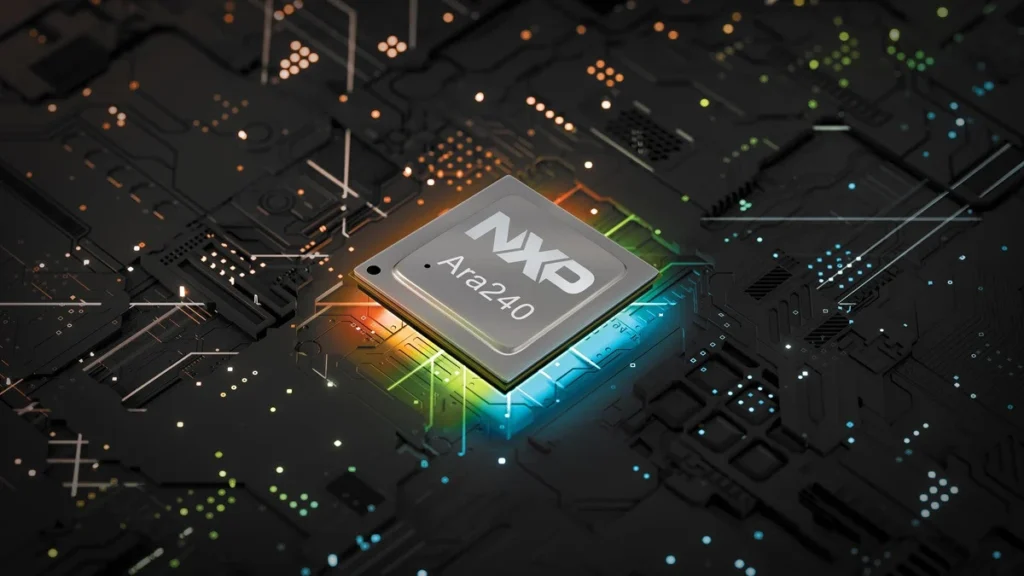
At the heart of this integration is the NXP Ara240, a discrete neural processing unit meticulously engineered to address the escalating demands of AI workloads at the very edge of the network. The imperative for edge processing stems from several critical factors: the need to reduce latency, minimize dependence on often-congested cloud infrastructure, and enhance data privacy and security by retaining more data within the local system. The Ara240 is a testament to NXP’s commitment to enabling robust, high-performance AI inference directly on devices, where immediate decision-making and low-power operation are paramount.
The accelerator boasts an impressive performance capability of up to 40 equivalent tera operations per second (eTOPS). To put this into perspective, eTOPS is a metric designed to provide a comparable measure of AI performance across different architectures, accounting for the efficiency with which various operations are executed. A figure of 40 eTOPS signifies substantial processing power, enabling the Ara240 to handle complex neural networks with efficiency. This power is critical for supporting a diverse range of modern AI models, including the increasingly prevalent large language models (LLMs) that drive natural language processing, vision language models (VLMs) which integrate visual and textual understanding, as well as transformer networks and traditional convolutional neural networks (CNNs) that form the backbone of many computer vision applications.
Furthermore, the Ara240 is designed with scalability in mind, supporting up to 16 GB of LPDDR4 memory. This generous memory allocation is crucial for running larger and more sophisticated AI models directly within embedded and edge systems. The ability to load and execute substantial models locally significantly reduces the need for constant communication with cloud servers, thereby cutting down on data transfer costs, improving response times, and bolstering system reliability, especially in environments with intermittent connectivity. Potential applications for the Ara240 are vast and varied, spanning critical sectors such as industrial automation, advanced robotics, precision machine vision systems, and a wide array of other intelligent edge platforms where real-time processing and autonomy are essential.
The Evolution of Remote Development and Arrow’s Strategic Vision
Arrow Electronics has long been a pivotal player in the electronics distribution landscape, providing comprehensive supply chain services and technical expertise to engineers and manufacturers globally. The Digital Test Drive platform represents a natural evolution of their commitment to empowering innovation. Launched to address the growing complexities of hardware evaluation in an increasingly digital world, the platform offers a streamlined, cost-effective, and rapid path to assessing new technologies.
The initial scope of the Digital Test Drive covered various microcontrollers, FPGAs, and other embedded platforms, allowing engineers to experiment with different architectures and functionalities without the logistical overhead. The addition of a specialized AI accelerator like the NXP Ara240 underscores Arrow’s strategic focus on supporting the burgeoning field of artificial intelligence, particularly at the edge. By offering this capability, Arrow is not merely distributing components; it is enabling an ecosystem where developers can prototype, test, and iterate with unprecedented speed and flexibility. This is especially vital in the fast-paced AI sector, where new models and algorithms emerge rapidly, demanding equally rapid hardware adaptation and validation.
For development teams, the implications are profound. The ability to assess the Ara240’s performance with their specific workloads, using real hardware and realistic data, mitigates significant risks associated with hardware selection. This pre-investment evaluation can prevent costly design mistakes, reduce development cycles, and ensure that the chosen hardware perfectly aligns with application requirements, thereby optimizing performance, power consumption, and overall system cost.
Industry Context: The Ascent of Edge AI and its Challenges
The global market for edge AI is experiencing explosive growth, driven by the proliferation of IoT devices, the demand for real-time analytics, and the increasing concerns over data privacy and network bandwidth. According to various market research reports, the edge AI market is projected to reach tens of billions of dollars within the next few years, with a compound annual growth rate (CAGR) exceeding 20-30%. This growth is fueled by diverse applications ranging from smart cities and smart homes to healthcare, automotive, and industrial IoT.

However, developing for edge AI presents a unique set of challenges. Edge devices often operate under strict constraints concerning power consumption, physical size, and thermal management. Furthermore, deploying complex AI models on these resource-limited devices requires highly optimized hardware and software solutions. The selection of appropriate AI acceleration hardware is a critical decision, as it directly impacts performance, efficiency, and the overall success of an edge AI product. The landscape of AI accelerators is also complex, with various architectures like GPUs, FPGAs, ASICs, and dedicated NPUs each offering distinct advantages and trade-offs. Discrete neural processing units like the Ara240 are specifically designed to offload AI inference tasks from general-purpose CPUs, providing significant performance gains and power efficiency for dedicated AI workloads.
Historically, hardware evaluation has been a bottleneck. Engineers would spend weeks or even months acquiring evaluation boards, configuring toolchains, and debugging initial setups before they could even begin testing their AI models. This lengthy process often meant that by the time an evaluation was complete, newer, more powerful hardware might already be on the horizon, or market windows could have been missed. Remote access platforms like Arrow’s Digital Test Drive directly address these inefficiencies, aligning development timelines with the rapid pace of AI innovation.
Official Responses and Strategic Implications
The sentiment from NXP underscores the strategic importance of this collaboration. Justin Mortimer, Senior Director, Product Marketing, Secure Connected Edge at NXP Semiconductors, articulated the core benefit: "Developers need practical ways to understand how advanced AI technologies will perform in real applications. By providing access to NXP’s Ara240 DNPUs through Digital Test Drive, Arrow enables engineering teams to evaluate real-world edge AI performance faster and make informed design decisions." This statement highlights NXP’s recognition of the practical challenges faced by developers and their commitment to facilitating easier adoption of their cutting-edge silicon. For NXP, the partnership with Arrow’s Digital Test Drive expands the reach of the Ara240, ensuring that their innovative hardware can be easily accessed and thoroughly vetted by a broader spectrum of potential customers, ultimately driving greater market penetration and adoption.
While an explicit statement from Arrow Electronics regarding this specific integration was not provided in the original content, the overarching strategy is clear. By enriching its Digital Test Drive platform with leading-edge components like the NXP Ara240, Arrow reinforces its position as a critical enabler in the technology ecosystem. An inferred statement from an Arrow executive might emphasize their dedication to providing comprehensive solutions that streamline the entire product development lifecycle, from concept to production. Such a statement would likely highlight how this addition empowers their customer base to innovate faster, reduce development costs, and bring intelligent products to market more efficiently, further solidifying Arrow’s role as a value-added distributor and technology partner.
From an industry analyst’s perspective, this collaboration represents a positive trend towards the "democratization" of advanced hardware. Platforms that abstract away the logistical complexities of hardware access allow smaller teams and startups to compete more effectively with larger enterprises, fostering a more dynamic and innovative landscape for AI development. It also signifies the increasing importance of software-defined hardware evaluation, where the physical components are managed remotely, but the user experience is seamless and immediate.
Broader Impact and Future Outlook
The integration of the NXP Ara240 into Arrow’s Digital Test Drive carries significant broader implications for the future of AI development and deployment.
Firstly, it significantly lowers the barrier to entry for developing sophisticated edge AI applications. Small and medium-sized enterprises (SMEs) and individual developers, who might lack the budget or infrastructure to acquire multiple evaluation kits, can now experiment with powerful DNPUs, fostering a more inclusive innovation environment. This "try before you buy" model is particularly attractive for emerging technologies where the optimal hardware solution might not be immediately apparent.
Secondly, it accelerates the time-to-market for new intelligent products. By compressing the hardware evaluation phase, companies can dedicate more resources and time to application development and optimization, leading to faster product launches and quicker realization of market opportunities. In competitive sectors like autonomous systems or industrial IoT, where speed is paramount, this efficiency gain is invaluable.
Thirdly, it promotes better design decisions. With the ability to perform rigorous, real-world testing early in the design cycle, engineers can make more informed choices about their hardware architecture, leading to more robust, efficient, and cost-effective final products. This can reduce the likelihood of costly redesigns or performance compromises down the line.
Finally, this collaboration underscores a growing trend in the electronics industry: the convergence of distribution, design enablement, and cloud services. Distributors like Arrow are evolving beyond mere logistics providers to become integral partners in the innovation process, offering tools and platforms that directly address the pain points of their engineering customers. This trend is likely to continue, with more complex and specialized hardware components becoming accessible through similar remote evaluation frameworks.
The NXP Ara240 evaluation environment is available now through Arrow Digital Test Drive, providing an immediate opportunity for engineers to engage with this powerful edge AI accelerator. This initiative stands as a testament to the ongoing efforts within the technology sector to simplify and accelerate the development of intelligent systems, paving the way for a new generation of innovative, high-performance edge AI applications that will redefine industries and daily life.