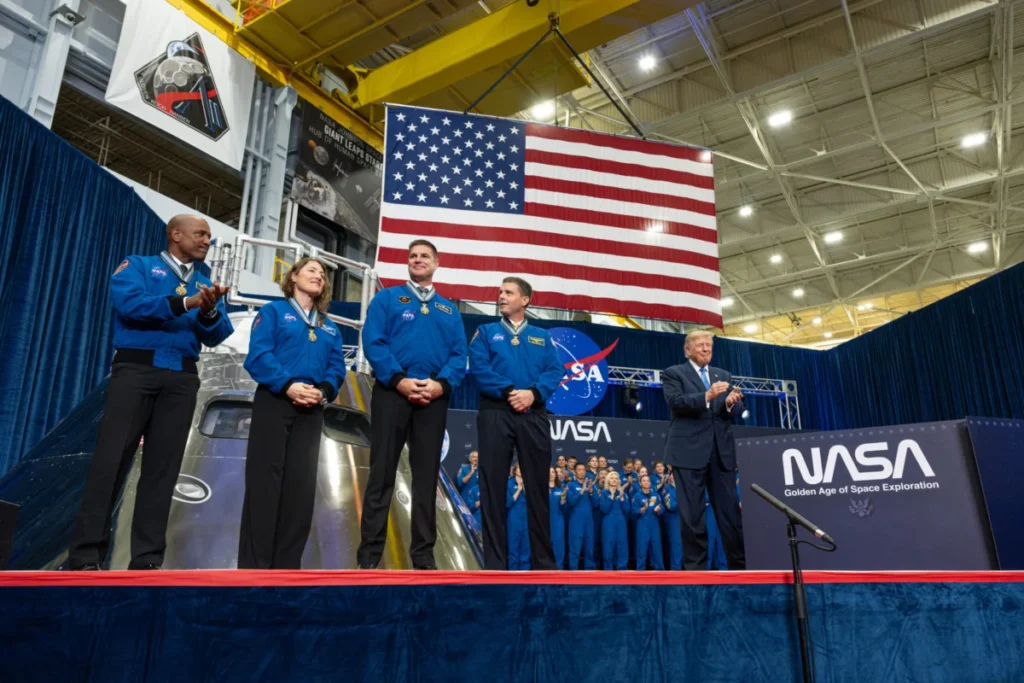
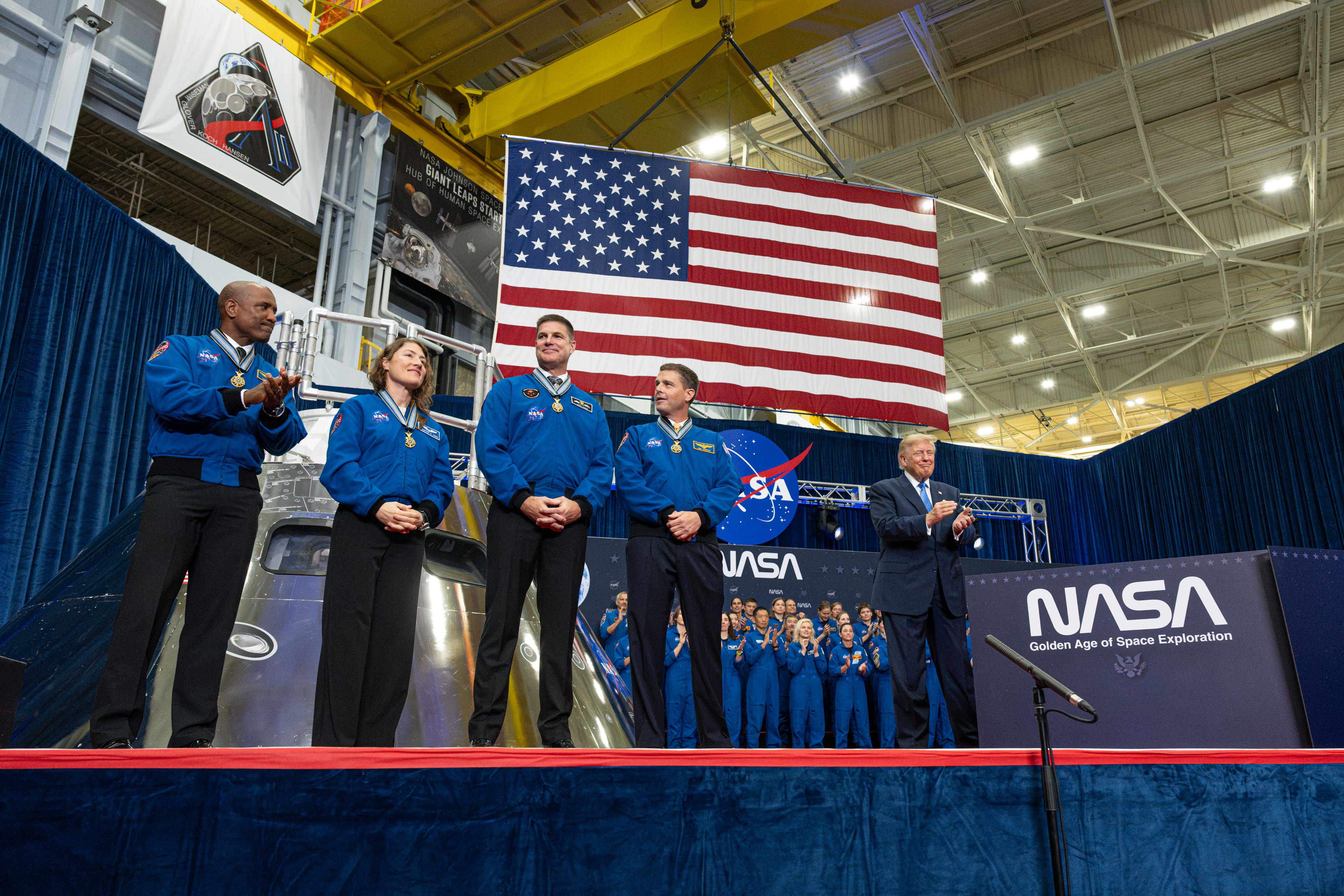
On August 28, 2026, a significant moment in space exploration history unfolded as President Donald J. Trump bestowed the prestigious Congressional Space Medal of Honor upon the four-person crew of NASA’s Artemis II mission. The distinguished astronauts, NASA’s Victor Glover and Christina Koch, Canadian Space Agency’s Jeremy Hansen, and NASA’s Reid Wiseman, were recognized for their exceptional bravery and meritorious service during the groundbreaking lunar flyby. The ceremony, held on this historic date, underscored the profound impact of their mission on the nation’s space program and humanity’s ongoing journey to explore the cosmos.
A Legacy of Courage and Contribution
The Congressional Space Medal of Honor, established by Congress in 1969, stands as the United States’ highest civilian award for space exploration. It is bestowed upon individuals who, in the performance of their duties, exhibit extraordinarily brave and exceptionally meritorious efforts, making significant contributions to the welfare of the nation and humanity. This esteemed award has a rich history, with 34 recipients to date, including the crews of Apollo 1, Challenger, and Columbia, who received the honor posthumously, a testament to the inherent risks and profound sacrifices associated with pushing the boundaries of human exploration. The inclusion of the Artemis II crew among these distinguished individuals marks a pivotal chapter in the evolution of spaceflight, celebrating a new era of lunar exploration and international collaboration.
The Artemis II Mission: A Giant Leap for Humanity
The Artemis II mission, which concluded prior to this recognition, represented a critical step in NASA’s ambitious Artemis program. Launched on November 16, 2024, the mission carried four astronauts – Commander Reid Wiseman, Pilot Victor Glover, Mission Specialist Christina Koch, and Mission Specialist Jeremy Hansen – on a historic 10-day journey around the Moon. This mission was not intended to land on the lunar surface but rather to serve as a vital test of the Orion spacecraft’s capabilities and the crew’s ability to operate in deep space. The astronauts successfully traversed the far side of the Moon, a significant achievement that pushed the boundaries of human spaceflight beyond low Earth orbit for the first time since the Apollo era.
The primary objectives of Artemis II were multifaceted, focusing on validating critical life support systems, navigation, communication, and the overall performance of the Orion spacecraft in the challenging environment of translunar space. The mission provided invaluable data that would be essential for future, more complex lunar missions, including the eventual landing of humans on the Moon and the establishment of a sustainable lunar presence. The crew’s successful execution of these objectives, despite the inherent risks of deep space travel, demonstrated remarkable skill, dedication, and resilience.
A Chronology of Courage and Achievement
The journey culminating in the Congressional Space Medal of Honor began years before the Artemis II launch. The selection of the crew was a rigorous process, drawing from experienced astronauts with diverse skill sets.
- 2019-2023: Extensive training and mission preparation for the Artemis II crew. This period involved simulations, survival training, and familiarization with the Orion spacecraft and its systems. International collaboration between NASA and the CSA was further solidified during this phase, with Jeremy Hansen becoming the first Canadian to venture beyond Earth orbit.
- November 16, 2024: Launch of the Artemis II mission from Kennedy Space Center, Florida, aboard the Space Launch System (SLS) rocket. The thunderous roar of the SLS marked the beginning of a new chapter in human lunar exploration.
- November 18, 2024: Orion spacecraft successfully performs a propulsive burn to depart Earth orbit and begin its journey around the Moon.
- November 21, 2024: The crew reaches the vicinity of the Moon, embarking on a trajectory that would take them around the lunar surface.
- November 23, 2024: Artemis II spacecraft successfully travels around the far side of the Moon, a critical milestone that had not been achieved by humans in over fifty years. This marked a significant psychological and technical barrier overcome.
- November 24, 2024: The Orion spacecraft completes its lunar flyby and begins its journey back to Earth.
- November 26, 2024: The Artemis II mission successfully concludes with the splashdown of the Orion capsule in the Pacific Ocean, marking the safe return of the crew.
The data collected and the experiences gained during this mission were immediately analyzed, providing crucial insights for the subsequent Artemis III mission, which aims to land astronauts on the lunar South Pole.
Supporting Data and Technical Advancements
The Artemis II mission represented a significant technological leap. The Orion spacecraft, designed for deep space human exploration, underwent rigorous testing. Its European Service Module (ESM), provided by the European Space Agency (ESA) in partnership with NASA, is crucial for propulsion, power, and life support. The SLS rocket, the most powerful rocket ever built, provided the necessary thrust to propel Orion on its lunar trajectory.
- Orion Spacecraft: Capable of supporting a crew of up to four astronauts for up to 21 days. Features advanced life support systems, navigation, and communication capabilities. Its heat shield is designed to withstand the extreme temperatures of re-entry from lunar velocities.
- Space Launch System (SLS): The foundational element of the Artemis program. The Block 1 configuration of SLS used for Artemis II generated 8.8 million pounds of thrust at liftoff, more than any rocket in history.
- Mission Duration: Artemis II’s 10-day flight provided valuable data on crew performance, spacecraft systems, and radiation exposure in deep space.
- Radiation Environment: Understanding and mitigating radiation exposure is a primary concern for long-duration space missions. Data from Artemis II will inform the development of improved shielding and operational strategies for future missions.
The successful completion of Artemis II, demonstrating the reliability of these complex systems and the crew’s ability to adapt to the challenges of deep space, was a testament to decades of research, development, and international collaboration.
Official Responses and Broader Implications
The awarding of the Congressional Space Medal of Honor to the Artemis II crew has been met with widespread acclaim from government officials, space agencies, and the scientific community.
NASA Administrator, in a statement following the ceremony, remarked, "The Artemis II crew embodied the spirit of exploration and dedication that defines NASA. Their courage and professionalism have paved the way for humanity’s return to the Moon and beyond. This medal is a fitting tribute to their extraordinary achievements."
The Canadian Space Agency also issued a congratulatory message, highlighting the significance of Jeremy Hansen’s participation. "We are immensely proud of Colonel Hansen and his role in this historic mission. His presence aboard Artemis II underscores the strength of international partnership in space exploration and inspires a new generation of Canadians to dream big."
The implications of the Artemis II mission and the subsequent recognition of its crew extend far beyond the immediate scientific and technical achievements.
- Renewed Public Interest in Space: The mission reignited public enthusiasm for human spaceflight, capturing imaginations worldwide and demonstrating the tangible progress being made in returning humans to the Moon.
- International Collaboration: The mission served as a powerful example of successful international cooperation in space. The involvement of the CSA highlighted the growing trend of global partnerships in ambitious space endeavors.
- Foundation for Future Exploration: Artemis II’s success is a critical stepping stone for the Artemis program’s ultimate goal of establishing a sustainable human presence on the Moon and eventually venturing to Mars. The lessons learned will be invaluable for future missions.
- Economic and Technological Spin-offs: Investments in space exploration consistently lead to technological advancements with broad applications in various industries, from materials science and medicine to computing and telecommunications. The Artemis program is expected to yield significant economic and societal benefits.
The Congressional Space Medal of Honor, in its highest form, recognizes not just individual acts of bravery but also the collective endeavor of pushing humanity’s frontiers. The Artemis II crew, through their daring voyage and successful execution of mission objectives, have etched their names into the annals of space exploration, inspiring a future where the stars are within closer reach. Their achievement, celebrated with this prestigious award, signifies a bold affirmation of humanity’s enduring drive to explore, discover, and reach for the unknown. The mission, and the honor bestowed upon its crew, serve as a powerful reminder of what can be accomplished when nations unite with a shared vision for the future of space exploration.