Water, the most abundant liquid on Earth and essential for all known life, presents a paradox to scientists. Despite its omnipresence, it exhibits a suite of properties that defy conventional liquid behavior, setting it apart from nearly every other known substance. Foremost among these anomalies is its peculiar expansion upon freezing, rather than the expected contraction, a characteristic that allows ice to float and insulate aquatic life. Scientists have long theorized that these counterintuitive behaviors are intrinsically linked to dynamic shifts in water’s microscopic structure, which vary with changes in temperature and pressure. However, a consistent, universally accepted methodology to precisely describe and quantitatively compare these intricate structural transformations has remained elusive, posing a significant hurdle to a complete understanding of this fundamental molecule.
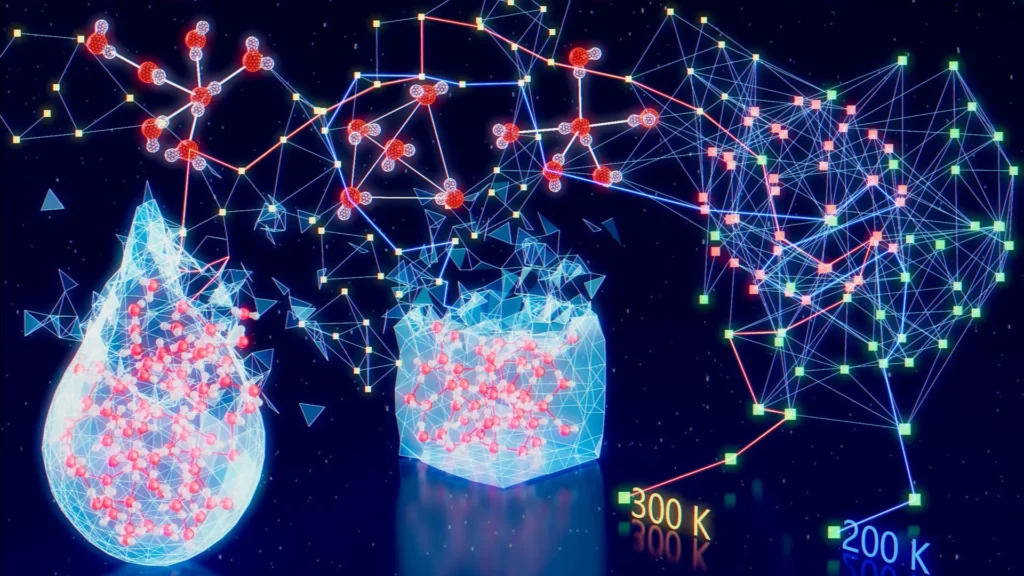
Now, a pioneering research team at the University of Osaka has harnessed the power of artificial intelligence (AI) to address this long-standing scientific challenge. Their newly developed AI system offers a unified and robust framework for evaluating and comparing diverse methods used to describe the complex microscopic architecture of supercooled water. This innovative approach is proving instrumental in identifying which structural descriptors most effectively capture the critical features that dictate water’s unusual properties. The groundbreaking findings from this research were recently published in the prestigious journal Communications Chemistry, marking a significant stride in the quest to unravel the enduring mysteries of H₂O.
The Enduring Enigma of Water’s Anomalies
Water’s peculiar characteristics are not limited to its expansion upon freezing. It boasts an unusually high specific heat capacity, meaning it absorbs and releases significant amounts of heat with minimal temperature change, thereby moderating Earth’s climate. Its high surface tension allows insects to walk on its surface and facilitates capillary action in plants. It has an exceptionally high dielectric constant, making it an excellent solvent for a vast array of substances, earning it the moniker "universal solvent." Most notably, liquid water reaches its maximum density at approximately 4 degrees Celsius (39.2 degrees Fahrenheit), rather than at its freezing point. This anomaly ensures that the coldest water in a lake sinks, allowing warmer, less dense water to remain above, preventing entire bodies of water from freezing solid from the bottom up—a critical factor for the survival of aquatic ecosystems.
For centuries, these deviations from typical liquid behavior have puzzled physicists and chemists. Early theories often focused on the hydrogen bonds that form between water molecules, a relatively strong intermolecular force that dictates many of water’s properties. Each water molecule (H₂O) can form up to four hydrogen bonds with neighboring molecules, creating a dynamic, constantly forming and breaking network. It is this intricate, fluctuating network that is believed to underpin water’s macroscopic oddities. However, visualizing and quantifying these microscopic arrangements, especially under extreme conditions, has been a monumental task, historically relying on indirect measurements and theoretical models.
Supercooling: Exaggerating Water’s Peculiarities
The journey for liquid water to transition into its solid, crystalline form—ice—typically commences at a specific nucleation site. These sites provide a surface where water molecules can begin to align themselves into the ordered, hexagonal crystal lattice characteristic of ice. Such nucleation points can be minute impurities suspended within the water, microscopic imperfections on the interior surface of a container, or even airborne dust particles.
However, in the pristine absence of these nucleation sites, water can defy its conventional freezing point of 0°C (32°F) and persist in a liquid state even when cooled significantly below this threshold. This extraordinary condition is known as supercooled water. While seemingly exotic, supercooled water plays a crucial role in natural phenomena, such as the formation of ice in clouds (where water droplets can remain liquid down to about -40°C), and is a significant area of study in cryopreservation and atmospheric science.
It is under these supercooled conditions that water’s already unusual properties become even more dramatically pronounced and complex. Scientists hypothesize that these intensified behaviors are a direct consequence of a delicate and dynamic balance between two distinct, competing structural forms of liquid water: a high-density liquid (HDL) and a low-density liquid (LDL). At the molecular level, water molecules are perpetually engaging in the formation and dissolution of their characteristic hydrogen bond networks. The LDL structure is characterized by a more open, tetrahedral arrangement, akin to the structure of ice but disordered, with molecules linked by strong hydrogen bonds forming cage-like arrangements. Conversely, the HDL structure is more compact and disordered, with a higher proportion of broken or distorted hydrogen bonds, allowing molecules to pack more closely together. As the temperature rises, the more compact HDL structures gain increasing dominance over the more open, ice-like LDL arrangements, driving the shifts in density and other properties observed. Understanding this delicate interplay is central to unlocking the secrets of water.
The Historical Challenge of Structural Descriptors
Over many decades, researchers have developed a plethora of conceptual tools and metrics—known as structural descriptors—to characterize the local arrangement of water molecules. These descriptors aim to translate the complex, three-dimensional dance of molecules into quantifiable data points. Examples include "tetrahedral bond order parameter," which measures how closely the local arrangement of molecules resembles an ideal tetrahedron (characteristic of LDL), and "local density," which quantifies the number of molecules within a certain radius around a central molecule (higher in HDL). Other descriptors might analyze hydrogen bond angles, coordination numbers, or various radial distribution functions.
The fundamental issue has been that these structural descriptors were developed independently by different research groups, often with specific theoretical models or experimental techniques in mind. Consequently, they often operate on divergent scales, utilize different units or dimensions, and focus on disparate types of information. This lack of standardization has created a significant hurdle, making it exceedingly difficult to directly compare the efficacy and relevance of these descriptors. Scientists have struggled to definitively determine which descriptors most accurately and efficiently capture the truly essential structural information required to explain water’s macroscopic behavior, especially under supercooled conditions. This fragmentation of descriptive tools has hindered the development of a unified, comprehensive theory of water.
Osaka University’s AI-Driven Breakthrough: A Unified Framework
Recognizing this critical bottleneck, researchers at the University of Osaka sought a novel approach, turning to the rapidly evolving field of artificial intelligence. Their solution centered on integrating a neural network model to provide a standardized, objective evaluation platform for these disparate structural descriptors.
"Past studies have shown that using machine learning to classify and understand structural data is effective," explains Kang Kim, a corresponding author on the study. "We specifically wanted to incorporate a neural network model into this study to evaluate how accurate the descriptors were at capturing key structural information, in a way that is like human cognition." This statement highlights the core idea: to train an AI to "learn" the nuances of water’s molecular structures in a way that can then be used to validate human-designed metrics.
The methodology involved training the AI system using vast datasets generated from molecular dynamics (MD) simulations of supercooled water. Molecular dynamics is a computational simulation technique that models the physical movements of atoms and molecules. By applying Newton’s laws of motion to a system of particles (in this case, water molecules), MD simulations can track the trajectories of each atom over time, providing a detailed, time-resolved picture of their collective behavior and structural arrangements. These simulations can operate on timescales ranging from picoseconds to microseconds, involving thousands to millions of atoms, and are critical for understanding the dynamic nature of liquids.
The Osaka team fed the neural network a wealth of structural data derived from these sophisticated MD simulations, encompassing various temperatures and pressures within the supercooled regime. Through an iterative process of repeated trial and error, the AI system progressively learned to discern and recognize meaningful patterns within the complex molecular structures. Essentially, the neural network developed an internal representation of what constitutes an LDL-like structure versus an HDL-like structure, without being explicitly programmed with rules for either. This unsupervised or semi-supervised learning capability is a hallmark of advanced AI systems.
Identifying the Most Efficient Descriptors
Once trained, the AI system was put to the test. "The network used what it had learned to compare how 16 descriptors differentiated between LDL and HDL structures at different temperatures," reports Nobuyuki Matubayasi, senior author of the research. "In this way, we determined the most efficient descriptors." The AI acted as an impartial judge, evaluating the performance of each of the 16 pre-existing structural descriptors. For each descriptor, the AI assessed its ability to accurately distinguish between the high-density and low-density liquid environments across a range of supercooled temperatures. Descriptors that provided clearer, more consistent differentiation were deemed more effective by the AI.
This systematic evaluation allowed the researchers to identify a subset of descriptors that were most powerful and concise in capturing the essential structural information relevant to water’s phase behavior and anomalies. This is a crucial step because it moves beyond qualitative arguments or limited comparisons, providing a quantitative, AI-backed endorsement of specific methods. The implications are profound: future research can now focus on using these validated, efficient descriptors, streamlining computational efforts and fostering more accurate theoretical models.
A New Era for Water Research: Broader Implications
The framework developed by the Osaka team represents a significant methodological advancement with far-reaching implications across multiple scientific disciplines. By providing a unified and robust means to compare and validate structural descriptors, this research fundamentally improves scientists’ ability to connect microscopic structural changes in water to its observed macroscopic thermodynamic behavior.
Fundamental Science: This work contributes directly to resolving long-standing debates regarding water’s phase diagram, particularly the existence of a "liquid-liquid critical point" and a "second critical point" in supercooled water, where the transition between HDL and LDL becomes sharper. Understanding the precise molecular mechanisms of this transition is vital for a complete theory of water. The optimized descriptors can accelerate the development of more accurate equations of state and predictive models for water under extreme conditions.
Climate Science and Atmospheric Research: Supercooled water droplets are ubiquitous in Earth’s atmosphere, playing a critical role in cloud formation, precipitation, and radiative transfer. A deeper understanding of ice nucleation mechanisms, which are heavily influenced by the local structure of supercooled water, can lead to more accurate climate models and improved predictions of weather patterns, including the formation of severe storms and ice accumulation.
Materials Science and Engineering: The insights gained from this research could guide the design of novel materials. For instance, creating surfaces that either promote or inhibit ice formation (anti-icing or pro-icing materials) is crucial for aviation, energy infrastructure, and various industrial applications. Understanding how specific molecular arrangements in water interact with different surfaces at a fundamental level, enabled by precise structural descriptors, can accelerate the development of such functional materials. Similarly, it could inform the development of advanced membranes for water purification or desalinization, where water’s interaction with pore structures is key.
Biochemistry and Pharmaceutical Sciences: Water is the solvent of life, and its interactions with biomolecules are fundamental to biological processes. Protein folding, enzyme catalysis, and drug-receptor binding are all profoundly influenced by the surrounding water molecules. The ability to precisely characterize the local water structure around proteins or drug molecules, using validated descriptors, could enhance our understanding of molecular recognition, aid in drug design, and improve methods for preserving biological samples (e.g., cryopreservation of organs or tissues).
The Future of AI in Scientific Discovery: Beyond the specific findings about water, this study serves as a powerful testament to the transformative potential of artificial intelligence in accelerating scientific discovery. By automating the evaluation of complex theoretical models and enabling the identification of the most salient features from vast datasets, AI can help researchers cut through noise, identify patterns that might elude human intuition, and rapidly advance our understanding of complex systems. This research demonstrates a clear pathway for AI to act as a crucial partner in fundamental scientific inquiry, guiding the development of even better computational tools and models for studying the intricate molecular structures of a myriad of substances.
In conclusion, the work from the University of Osaka represents a pivotal moment in the centuries-long quest to understand water. By leveraging advanced artificial intelligence, the researchers have not only provided a robust framework for comparing existing structural descriptions but have also identified the most efficient pathways to characterize water’s hidden molecular architecture. This breakthrough promises to bridge the critical gap between water’s microscopic behavior and its macroscopic anomalies, paving the way for unprecedented insights into the most essential liquid on Earth and offering a glimpse into the future of AI-driven scientific exploration.