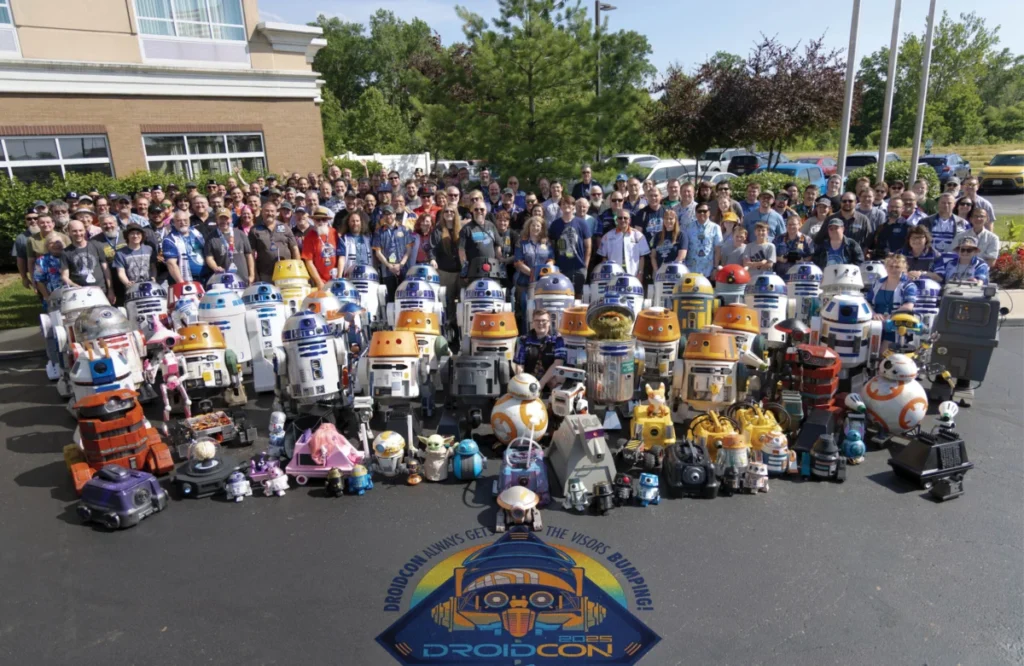
The vibrant universe of Star Wars droids has long captivated audiences, but for a dedicated community of "droidsmiths," these mechanical companions are more than just cinematic characters – they are tangible engineering challenges and cherished projects. As DroidCon 2025 in Indianapolis recently showcased, the passion for recreating and innovating within the Star Wars droid canon has exploded, evolving from the early days of R2-D2 replicas to a diverse array of highly sophisticated, fan-built automata. This phenomenon, fostered by collaborative online communities and the global maker movement, demonstrates a remarkable blend of technological ingenuity, artistic craftsmanship, and communal spirit.

The Genesis of the Droid Building Movement: The Astromech Legacy

The journey into fan-built droids traces its roots back to the venerable R2 Builders Group. Make: magazine, a long-time champion of the maker spirit, first profiled this pioneering community in its second issue in May 2005. At a time when comprehensive blueprints were scarce, these early enthusiasts meticulously reverse-engineered R2-D2 from movie footage, prop measurements, and shared observations, laying the groundwork for a global movement. Their forum, astromech.net, remains the central hub, hosting an invaluable repository of blueprints, 3D models, and collective knowledge.

The club’s ethos is built on collaboration, with members continually refining designs to accommodate various building styles. Whether utilizing traditional hand-cut styrene sheets, employing advanced CNC, waterjet, or laser cutters for wood and aluminum parts, or leveraging the burgeoning capabilities of 3D printing, the community ensures accessibility. For those without specialized tools, "parts runs" – cooperative purchasing and manufacturing initiatives – allow aspiring droidsmiths to acquire components and begin their builds. This open-source approach has not only democratized the building process but also fostered an environment of continuous innovation.

Technological Leaps: New Methods for Iconic Droids

The past decade has witnessed significant advancements in the methods and technologies employed by droid builders. Since Make: published its guide to building a life-sized R2-D2 in 2016, 3D printing has transitioned from a tool for intricate "greebles" (small, aesthetic details) to a viable method for constructing entire droid frames. The MrBaddeley Printed Droid group, led by Michael Baddeley, exemplifies this shift, offering full R2-D2 3D models and fostering a community around additive manufacturing. This approach lowers the barrier to entry, allowing more individuals to participate in complex builds.

For purists who prefer metal, club blueprints are now often converted into files compatible with online custom fabrication services like SendCutSend and OSH Cut. This enables makers to order precisely cut aluminum parts with minimal personal tooling, bridging the gap between hobbyist and professional fabrication.

Electronics have also seen a rapid evolution. Traditional brushed scooter motors are now complemented by more efficient and precise brushless motors, such as the Q85 and Rev Neo. Drive systems like the MaxDrive have adapted to support both, while popular control software like SHADOW has been updated to integrate these new options seamlessly. The advent of inexpensive, powerful hardware like the DFRobot DFPlayer for audio and the ESP32 processor has further reduced the cost and size of crucial electronic components, replacing older solutions like the MP3 Trigger and Arduino Mega while maintaining functionality.

A significant leap in realism comes from the Human-Cyborg Relations hardware and software, which generates unique, AI-driven vocalizations for R2 and other astromechs, faithfully replicating their original speech patterns and phonemes. Control systems have also become more sophisticated; the Kyber Control System, for instance, allows builders to add multiple buttons to sBus-capable RC receivers, enabling complex sound and animation sequences. It integrates seamlessly with popular hardware like Pololu Maestro servo controllers and the MarcDuino animatronic controller, offering operators unprecedented control over their droids’ expressions and movements.

The Expanded Universe of Fan-Built Droids

The growing Star Wars saga has introduced a plethora of new droids, each inspiring dedicated communities and innovative builds. These groups leverage shared knowledge, blueprints, and 3D models to bring characters from screen to reality.

BB-8: The Spherical Sensation
Introduced in 2014’s The Force Awakens, the spherical BB-8 presented a unique engineering challenge. While Lucasfilm initially relied on puppetry and "trike" versions for filming, their reveal of a truly free-rolling BB-8 at Star Wars Celebration 2015 ignited the fan community. The BB-8 Builders Club (bb8builders.club/forum and Facebook) quickly formed, creating forums for sharing plans and models.
A notable team, comprising Psy DeLacy, Chris Stroud, David Ferreira, Matt Hobbs, and Alex Coajou, embarked on a ground-up redesign of BB-8 in 2019. Their goal was to integrate new features and optimize existing ones, making the droid more robust and user-friendly. Key innovations included a keyed configuration for easy frame assembly, pogo pins for panel connections, and enhanced access to internal hardware. Optimizing for SLS printing allowed for clever hardware integration in tight spaces while maintaining structural integrity. Their customized drive system, developed after rigorous testing of various motors and actuators, incorporated custom boards and batteries. The team’s meticulous programming, particularly Chris Stroud’s work on "free animation" – subtle movements like BB-8’s head turning slightly in the direction of travel – imbues the droid with remarkable lifelike qualities, easing the operator’s burden while enhancing audience immersion. This BB-8 has since graced major events, including Celebrations in Anaheim, London, and Tokyo, consistently performing to critical acclaim.

K-2SO: The Bipedal Guardian
Rogue One (2016) introduced K-2SO, a towering, sardonic enforcer droid whose backstory was later expanded in Andor. Despite the daunting prospect of replicating a 7-foot bipedal robot, droid builders embraced the challenge. While many fan-built K-2SOs are static displays, a passionate subset is dedicated to making them mobile. Droid Division offers a full 3D printable model, and the K-2SO Builders Club (Facebook) serves as a vital knowledge-sharing platform.
Darren Moser (drscifi) stands out for his multi-year dedication to animating K-2SO. Starting in 2016 with PVC pipe and EVA foam, Darren’s initial puppet was a wearable costume. Over eight years and five iterations, his "Droid of Theseus" evolved significantly. His 2022 upgrade for Star Wars Celebration Anaheim, while visually superior, highlighted structural weaknesses, prompting a return to robust mechanisms. By spring 2025, drawing on lessons from earlier versions and mastering 3D modeling and printing, Darren achieved unprecedented realism. New 3D printed shoulder rings, movie-accurate joint covers (using mirrors for the illusion of hollow limbs), and a refined head mechanism (developed with Travis Butler from Dave Moog’s Droid Division files) allowed for expressive eye and head movements. A custom bike cable linkage system provided precise control over individual fingers, enabling gestures like pointing and fist-bumping. Dual joysticks controlled head motion and neck bob, while twin cameras offered Darren a live feed from K2’s perspective. The head’s modular design, snapping into place with a single umbilical cord, streamlined transport and setup. Darren’s V5 K-2SO debuted at the Hollywood El Capitan premiere of Andor Season 2, a testament to his perseverance. Weighing around 30 pounds and powered by a Ryobi tool battery for four hours, K2 represents a pinnacle of fan-built puppetry, with further upgrades planned for future events like Star Wars Celebration Los Angeles in 2027.

B2EMO: The Loyal Scrapper
Andor (2022) brought forth B2EMO, a loyal and endearing salvage droid realized through entirely practical effects. Its complex movements—expanding/retracting feet, segmented spinning body, articulated head, and omnidirectional strafing via omniwheels—presented a formidable, yet achievable, building goal. Michael Baddeley’s V2 files provide a popular starting point, and the B2EMO Droid Builders Group (Facebook) facilitates community innovation.
Brothers Steven Dodds and Brian Dodds undertook their B2EMO build in December 2024, aiming for a WonderCon 2025 debut. Their highly customized droid blends Michael Baddeley’s V2 files with David Ferreira’s "Pro" head mechanism and Tim Hebel’s prototype drive system. Brian, handling internal mechanics and wiring, custom-machined aluminum components, including adapter rings for brushless motors within the 6-inch Mecanum wheels, granting B2 its signature omnidirectional movement. Steven focused on the exterior and code, running his 3D printer almost continuously to produce ABS plastic shells. He meticulously glued, sanded, textured, and distressed parts to achieve B2’s screen-accurate, weathered appearance. Paul Thomson contributed his expertise to the final paint and weathering. Steven also programmed and installed lights, edited sounds, and enabled code-controlled motion. Their B2EMO faithfully replicates all on-screen movements, including "turtle mode," and speaks lines from the show, controlled by a customized RC system. Their rapid progress underscores the power of collaborative building and specialized skill sets.

D-O: The Quirky Unicycle
The Rise of Skywalker (2019) introduced D-O, a self-balancing, one-wheeled droid with a cobbled-together aesthetic that immediately resonated with makers. Disney’s reveal of a working D-O at Star Wars Celebration in April 2019 spurred intense fan activity, with many replicas completed even before the film’s December release. Michael Baddeley created the first fan replica, followed by Matt Denton, who worked on the official movie prop and documented his build process in an extensive YouTube series. The D-O Builders Club (Facebook) provides a platform for this community.
Steven Foster, encouraged by fellow builder Chris Stroud, began his D-O journey by following Denton’s tutorial. However, seeking further improvements and screen accuracy, he embarked on an ambitious redesign from scratch, despite lacking prior CAD or mechanical engineering experience. With crucial support and feedback from Psy DeLacy, Neil Hutchison, and Dave Ferreira, Steven is nearing completion of a D-O that achieves remarkable fidelity in both appearance and behavior, exemplifying the iterative nature of passion projects within the community.

RX Series Droids: From Pilot to DJ
The Star Tours attraction at Disneyland introduced RX-24 ("Rex"), the animatronic pilot of the StarSpeeder 3000. Rex was later repurposed as R-3X, the DJ at Oga’s Cantina in Galaxy’s Edge. These droids have inspired a thriving community that creates plans, 3D models, drive systems, and even speech synthesis/modulation software. The "CantinaOS" project, integrating ChatGPT, aims to allow R-3X droids to converse in character, showcasing the cutting edge of AI in fan builds. The RX Series Droid Builders Club (Facebook) is a central gathering point.
The team of David Ferreira, Chris Stroud, Matt Hobbs, Patrick Gray, and Trevor Zaharichuk debuted their RX-91L, "Gil," at Star Wars Celebration Anaheim in 2022. Gil boasts a winning personality and has contributed new tech to the wider building community. Operating a droid with a drive system, three articulated arms, and a multi-axis head is complex, so the team implemented one-player and two-player modes. They also incorporated "free animation," where subtle movements (e.g., head rotation prompting visor movement) reduce operator load and enhance realism. Gil’s voice, controlled by the operator through a headset, drives lights in his mouthpiece. Extensive research, including frequent "research trips" to Oga’s Cantina and Star Tours for photos, videos, and performance observations, was critical in developing the RX droids’ authentic look and behavior.

BDX Droids: The Lifelike Ducklings
In 2023, Disney Imagineers, in collaboration with Nvidia and Google DeepMind, unveiled the real-life BDX Droids, affectionately known as "Duckling Droids." These small, bipedal droids, often seen in packs interacting with guests at Galaxy’s Edge, represent a significant leap in animatronics, utilizing AI for incredibly lifelike motion and emotion. Their anticipated appearance in The Mandalorian and Grogu movie (2026) has further spurred fan interest. The BD-X Duckling Droid Builders club (Facebook) is actively working to reverse-engineer these complex machines.
Jaime Machuca, a robotics engineer and ArduPilot Dev Team member, began his BD-X project in August 2024 after seeing Disney’s version at GTC. Inspired by their lifelike motion, Jaime is replicating the droid using insights from Disney’s published research. His build combines PLA-CF 3D-printed parts with CNC-machined components, off-the-shelf electronics, and dual Nvidia Jetson Orin NX computers. The droid is currently undergoing reinforcement learning to mimic Disney’s version. Jaime plans to open-source the project, with versions for both ROS 2 users and those building without ROS. Collaborators like Mimir Reynisson, Jessica "Psy" DeLacy, and the Open Duck Mini community (Antoine Pirrone, Mankaran Singh, Grégoire Passault) are driving the project forward, with Mathew Collins developing the Steamdeck controller app. A more accessible, walking version, Open Duck Mini, is already available on GitHub (github.com/apirrone/Open_Duck_Mini), supported by a growing Discord community (discord.gg/krkSKZYJuT).

MSE-6 (Mouse) Droids: Imperial Messengers
As old as Star Wars itself, the MSE-6 droid debuted in Episode IV: A New Hope (1977), zipping through Imperial corridors. Today’s builders use 3D printing, styrene, wood, and aluminum to recreate these droids, even producing robust "Mousezilla" versions capable of carrying riders or towing astromechs. Often a first build for new droidsmiths due to its relative simplicity, the Mouse Droid Builders Club (mousedroidbuilders.club and Facebook) offers extensive guidance.
Romano and Connie Bassi were inspired by a Robot Chicken episode to build their MSE droid. Their screen-accurate exterior features a vacuum-formed styrene shell, sourced from the community forum. For authenticity, side "greeblies" incorporate real computer IC chips and capacitors, while top details are 3D printed and enhanced with additional components. The shell sits on a modified RC car chassis, powered by an off-the-shelf brushed motor, Sabertooth driver, and steering servo. Internally, they crafted a miniature cockpit using customized 3D files from Thingiverse, housing two needle-felted mouse figures, MSE-3827 (driver) and MSE-421 (supervisor). The driver’s head moves side-to-side, while the passenger’s has three servos for intricate head and body tilting, allowing it to lean out of a hidden, servo-operated side door. The mice’s uniforms are repurposed 1:6 scale Imperial officer action figure outfits, tailored to allow servo movement, with 3D-printed armor and helmets. LED lighting illuminates the cockpit, and a Maestro controller programs the mice’s servo movements. Sound effects, including A New Hope clips and mouse squeaks, are triggered via an RC transmitter, bringing this tiny Imperial workhorse to life.

GNK-series Power Droid (Gonk): The Walking Battery
Another original Star Wars droid from 1977, the GNK droid, or "Gonk," provides power across the galaxy. Its simple, box-like form makes it one of the easiest droids to build, often starting with two stacked plastic storage bins. Builders then personalize them with creative "greebles" like lights, vents, holoprojectors, and functional charging ports. The Gonk Droid Builders Group (Facebook) fosters this creative community.
Mike Longo‘s childhood fascination with the "funky Gonk droid" from the Jawa’s sandcrawler led him to build his own after seeing a friend’s creation. Finding an oddly shaped plastic tote resembling a Gonk body, Mike began his build. He used a 3D printer for feet and many "greeblies," designing some parts himself, like the E-shaped side panel. A silver spray-painted bungee cord served as a cable, and a food storage container became the "face." His son Nick helped wire the four LED lights on the face. PVC plastic boards, heat-bent into shape, covered the bin seams, reinforced by 3D-printed brackets. Beyond aesthetics, Mike integrated a portable charger with USB sockets, powering the droid’s LEDs and an MP3 player with a speaker, and providing external charging ports for phones. Currently finished in granite gray and midnight blue with a clear matte finish, Mike is in the process of weathering his Gonk to give it a well-used look, with plans to showcase it at future Star Wars events.

C-Series Astromech Droid (Chopper): The Grumpy Rebel
C-series droids, particularly C1-10P, or "Chopper," gained prominence in Star Wars: Rebels before making the leap to live action in Rogue One and Ahsoka. Builders embrace both animated and live-action appearances, creating a lively community on astromech.net and the Chopper Builders group (Facebook).
Jaime Acevedo and his wife, drawn to Chopper’s defiant personality, built their droid using files from MrBaddeley Printed Droid. Recognizing the complexity of animating Chopper, Jaime developed multiple custom controllers for quick access to sounds and sequences. A custom phone app and game controller wirelessly connect to an ESP32 within the droid, granting full control over all actions. For stealthier operations, a palm-sized controller offers buttons for Chopper’s most common sounds and actions, enabling seamless interaction at events.

Treadwell Droids: The Unsung Laborers
WED Treadwell droids are ubiquitous across the galaxy, performing tasks from moisture farm maintenance to starship repairs. After a minor role in A New Hope, they appeared in The Empire Strikes Back, Attack of the Clones, The Mandalorian, and The Book of Boba Fett. Paul Thompson and Ross Saggio are developing detailed build plans for these droids, and the Treadwell Builder’s Club (Facebook) serves as a community hub.
Paul Thompson‘s quest to build a Treadwell began in 2009, inspired by a childhood photo in The Star Wars Storybook. With limited information available then, his build evolved through collaborative "droid sleuthing." He discovered that Treadwell’s "eyes" were internal lenses from a Paterson Trident 35mm slide viewer, its gripper claw a repurposed pickle fork, and its tracks made from a 3-inch race car blower belt turned inside out. These discoveries allowed him to extrapolate the droid’s overall dimensions. Paul’s Treadwell is a hybrid of wood (for the head, fitted with 3D-printed details and authentic Trident lenses), aluminum (for the mast, supporting five arms crafted from printed parts, metal tubes, and found items), and plastic. The wooden base cleverly conceals the battery pack and electronics, bringing the droid to life.

Scrubber Droids: The Racing Machines
First seen in The Phantom Menace, the Scrubber droid, a simple cleaning unit, was discovered by early builders to be an inverted 8-gallon storage tote mounted on wheels. Often built on R/C car platforms, these rugged droids are frequently used in racing and "smash-up derby" competitions at droid builder gatherings. The Scrubber builders group (Facebook) and the Mouse droid forums share many ideas for these builds.
Jesse Maricelli, an electrical engineer with expertise in power engineering and embedded systems, was inspired by a local Scrubber racing competition to build his own. While designs for "greeblies" are available on the Facebook page, Jesse aimed to incorporate as many "found parts" as possible while maintaining the original style. He used power transformers from an old DLP TV for side details and built the radar from a medical squeeze bottle top and a toilet float arm bracket. A unique feature is an old iPhone repurposed as a terminal display on the rear, cycling custom animations as a status screen. His Scrubber combines 3D-printed PLA and resin, ACM (aluminum composite material), and thin aluminum sheet. Electronics include Sabertooth motor controllers, an Arduino Mega, and PS3 Move Navigation controllers. Running a modified version of SHADOW, popular with R2-D2 builders, his scrubber can strafe left and right using Mecanum wheels, in addition to normal driving.

The Broader Impact: Fostering Innovation and Community

The global Star Wars droid building community represents a unique nexus of fandom, engineering, and collaborative innovation. These "droidsmiths" are not merely replicating props; they are engaging in complex problem-solving, applying diverse technical skills—from CAD design and 3D printing to electronics, programming, and mechanical fabrication. This hands-on engagement with advanced technology provides an informal yet powerful education in STEM fields, inspiring new generations of makers.

Events like DroidCon and Maker Faires serve as crucial venues for showcasing these creations, sharing knowledge, and fostering camaraderie. The open-source nature of many projects means that designs, code, and insights are freely exchanged, accelerating collective progress. The inferred enthusiasm from Lucasfilm and Disney for these fan-made droids further validates and encourages the community, recognizing the profound emotional connection fans have with these characters.

Looking ahead, the integration of cutting-edge technologies like advanced AI for character interaction (as seen in the BDX droids and the "CantinaOS" project) suggests an exciting future where fan-built droids become even more autonomous, interactive, and lifelike. This thriving ecosystem of builders demonstrates that with passion, collaboration, and a willingness to embrace new tools, the boundaries of what’s possible in the realm of robotics and immersive fan experiences continue to expand, truly bringing a galaxy far, far away, a little closer to home.