A groundbreaking collaboration led by the University of Warwick has unveiled the first comprehensive framework designed to identify "spacetime fluctuations"—minute, random distortions in the very fabric of spacetime. These elusive phenomena, which represent a crucial intersection between quantum physics and gravity, have long remained a theoretical construct, challenging experimentalists with their subtle and varied predictions across different quantum gravity models. The new research, published in the esteemed journal Nature Communications, offers a unified guide, translating abstract theoretical concepts into concrete, measurable signals, thus propelling the quest for a unified theory of everything firmly into the realm of experimental verification.
The Enduring Challenge: Unifying Quantum Mechanics and Gravity
For over a century, one of the most profound challenges in theoretical physics has been the reconciliation of quantum mechanics, which describes the universe at its smallest scales, with Albert Einstein’s general theory of relativity, which governs gravity and the large-scale structure of the cosmos. While both theories have been monumentally successful within their respective domains, they become incompatible when attempting to describe extreme environments, such as the singularity at the heart of a black hole or the conditions immediately following the Big Bang.
The prevailing hypothesis to bridge this divide is quantum gravity, a theoretical framework that seeks to describe gravity in terms of quantum mechanics. Various quantum gravity theories—including String Theory, Loop Quantum Gravity, and others—predict that spacetime, rather than being a smooth, continuous manifold, might exhibit a "foamy" or "fluctuating" structure at unimaginably small scales, often referred to as the Planck length (approximately 1.6 x 10^-35 meters) and Planck time (approximately 5.4 x 10^-44 seconds). At these scales, quantum effects are expected to profoundly influence the geometry of spacetime itself, leading to these proposed spacetime fluctuations.
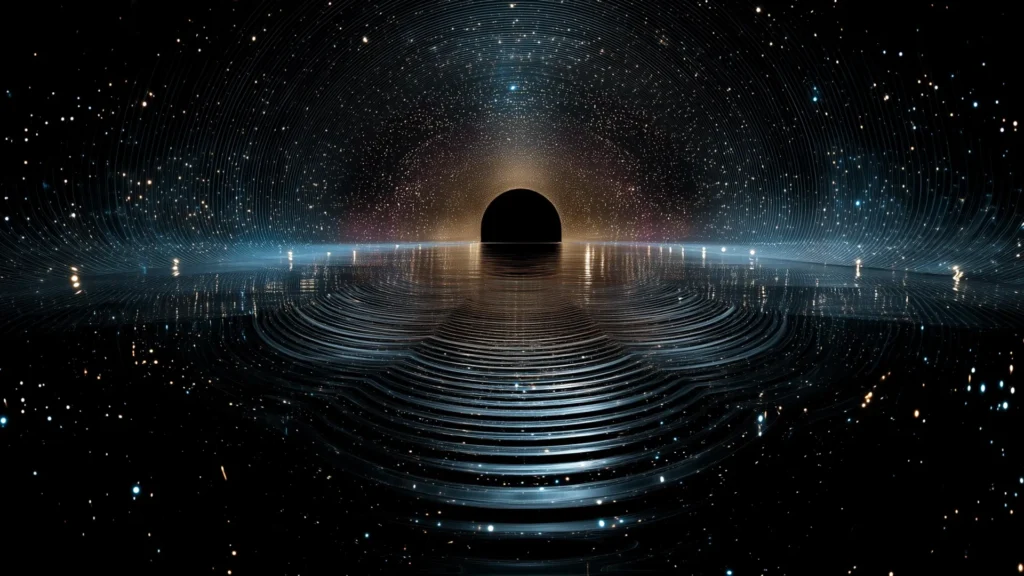
The concept of "quantum foam" was first proposed by the eminent American theoretical physicist John Wheeler in the 1950s and 1960s. Wheeler envisioned spacetime as a turbulent, bubbling sea of virtual particles and fluctuating geometries at the Planck scale, far beyond the reach of any current or foreseeable experimental apparatus. However, while the existence of such fluctuations is a common thread in many quantum gravity theories, the precise nature of these fluctuations—their statistical properties, their coherence across space and time, and their predicted magnitude—can vary significantly from one theoretical model to another. This theoretical diversity has presented a formidable hurdle for experimental physicists, leaving them without clear, unambiguous targets to search for.
Turning Abstract Theory into Concrete Observables
The breakthrough by the Warwick-led team addresses this critical experimental bottleneck. Instead of waiting for a single, universally accepted theory of quantum gravity to emerge, the researchers have developed a methodology to categorize spacetime fluctuations based on their observable characteristics. They grouped these elusive distortions into three principal categories, distinguished by how they manifest and propagate across both space and time. This categorization is not dependent on the specific underlying quantum gravity theory but rather on the mathematical description of the proposed fluctuations.
For each of these categories, the research team meticulously identified clear, measurable patterns that could be detected using highly sensitive instruments known as laser interferometers. These devices are already at the forefront of fundamental physics, renowned for their unparalleled precision in detecting minute changes in distance, most famously demonstrated by the detection of gravitational waves.
Dr. Sharmila Balamurugan, Assistant Professor at the University of Warwick and the study’s first author, articulated the significance of this development: "Different models of gravity predict very different underlying trends in the random spacetime fluctuations, and that has left experimentalists without a clear target. Our work provides the first unified guide that translates these abstract, theoretical predictions into concrete, measurable signals."
She further emphasized the immediate implications for ongoing research: "It means we can now test a whole class of quantum-gravity predictions using existing interferometers, rather than waiting for entirely new technologies. This is an important step towards bringing some of the most fundamental questions in physics firmly into the realm of experiment." This statement underscores a pivotal shift, moving quantum gravity from a predominantly theoretical pursuit to one that can be probed and constrained by empirical data.
The Power of Laser Interferometers in the Quantum Quest
Laser interferometers operate on the principle of superimposing two or more light waves to create an interference pattern. Any minute disturbance to the path length of these light waves—such as a spacetime fluctuation—can alter this pattern, which can then be precisely measured. The most famous examples of these instruments are the kilometer-scale gravitational wave observatories like LIGO (Laser Interferometer Gravitational-Wave Observatory) in the United States, Virgo in Italy, and KAGRA in Japan. These colossal detectors, with their arms stretching several kilometers, are designed to detect spacetime distortions caused by cataclysmic astrophysical events like colliding black holes and neutron stars.
While LIGO and its counterparts operate at frequencies optimized for astrophysical gravitational waves, the Warwick framework also considers smaller, laboratory-scale experimental setups. Examples include QUEST (Quantum Experiments at Space-Time) being developed at Cardiff University in the UK and GQuEST (Gravitational Quantum Experiments at Space-Time) at Caltech in the USA. These smaller interferometers, though not as vast as LIGO, are being designed with sensitivities tailored to detect different types of quantum gravitational effects or to explore higher-frequency phenomena. The flexibility of the new framework means it can be applied across this diverse range of interferometer scales and designs, maximizing the potential for detection.
Dr. Sander Vermeulen, a co-author from Caltech, highlighted the intrinsic capabilities of these instruments: "Interferometers can measure spacetime with extraordinary precision. However, to measure spacetime fluctuations with an interferometer, we need to know where—i.e., at what frequency—to look, and what the signal will look like. With our framework, we can now predict this for a wide range of theories. Our results show that interferometers are powerful and versatile tools in the quest for quantum gravity." This statement succinctly captures the essence of the research: providing the "how" and "where" for a search that previously lacked precise coordinates.
Historical Context and the Evolution of the Search
The idea that spacetime might not be perfectly smooth dates back to the early 20th century with Einstein’s general relativity, which described spacetime as a dynamic entity that can be curved by mass and energy. However, it was John Wheeler who took this concept into the quantum realm, proposing the "quantum foam" metaphor. His vision, while revolutionary, remained largely untestable due to the extreme scales involved.
The late 20th and early 21st centuries saw a burgeoning of quantum gravity theories, each attempting to quantize gravity and thus inherently predicting some form of spacetime granularity or fluctuation. String Theory, for instance, posits that fundamental particles are not point-like but rather tiny, vibrating strings, and that spacetime itself emerges from these interactions. Loop Quantum Gravity, another prominent contender, suggests that spacetime is quantized into discrete "loops" or "atoms" of space. Each of these theories, while elegant in its mathematical formulation, has struggled with a lack of empirical verification.
The development of laser interferometry, initially driven by the search for gravitational waves, inadvertently created the most promising tools for probing these quantum spacetime effects. The first direct detection of gravitational waves by LIGO in 2015, a century after Einstein’s prediction, demonstrated the incredible sensitivity achievable with these instruments. This success has fueled optimism that similar, albeit far more subtle, distortions from quantum gravity might also be within reach. The Warwick framework acts as a critical bridge, connecting the sophisticated theoretical predictions with the advanced experimental capabilities of modern interferometers.
Broader Implications and Future Directions
An important strength of this newly developed framework lies in its inherent flexibility. It is not tethered to any single explanation for the origin of spacetime fluctuations. Instead, it requires only a mathematical description of the proposed fluctuations and detailed information about the specific measurement setup. This adaptability makes it a valuable tool not only for the highly specific problem of quantum gravity but also for a broader spectrum of fundamental physics investigations.
For instance, the framework can be applied to the study of stochastic gravitational waves—a background hum of gravitational waves predicted to pervade the universe, potentially originating from a multitude of unresolved astrophysical sources or even from the early universe itself. It can also aid in the search for potential dark matter signals, as certain theoretical models propose that dark matter particles could interact with spacetime in ways that produce detectable fluctuations. Furthermore, the methodology offers a robust way to characterize and potentially mitigate certain types of experimental noise, a perpetual challenge in high-precision measurements.
Professor Animesh Datta, Professor of Theoretical Physics at Warwick and a co-author, concluded by emphasizing the transformative potential of this consistent approach: "With this methodology, we can now treat any proposed model of spacetime fluctuations in a consistent, comparable way. In the coming years, we can use this to design smarter tabletop interferometers to confirm or refute possible theories of quantum or semiclassical gravity and even test new ideas about dark matter and stochastic gravitational waves."
This research marks a significant milestone in the scientific endeavor to understand the fundamental nature of reality. By providing a unified, experimentally accessible language for spacetime fluctuations, the Warwick-led team has not only opened new avenues for testing long-standing quantum gravity theories but has also equipped the scientific community with a versatile tool for exploring some of the most profound mysteries of the universe, from the quantum structure of spacetime to the enigmatic properties of dark matter. The project received vital funding from the UK STFC "Quantum Technologies for Fundamental Physics" program and the Leverhulme Trust, highlighting the international collaborative effort and sustained investment required for such pioneering scientific advancements. The era of experimentally probing quantum gravity, once a distant dream, now appears tantalizingly close.