Astronomers have reached a major turning point in the search for life beyond Earth by detecting an atmosphere around a rocky, Earth-like planet located in another star’s habitable zone. This groundbreaking discovery offers the strongest evidence yet that planets with Earth-like temperatures and rocky compositions may not only exist beyond our solar system but also possess the essential conditions to potentially support life. The findings, published on July 16th in the prestigious journal Science, represent a significant leap forward in exoplanet research, a field that has captivated scientists and the public alike for decades.
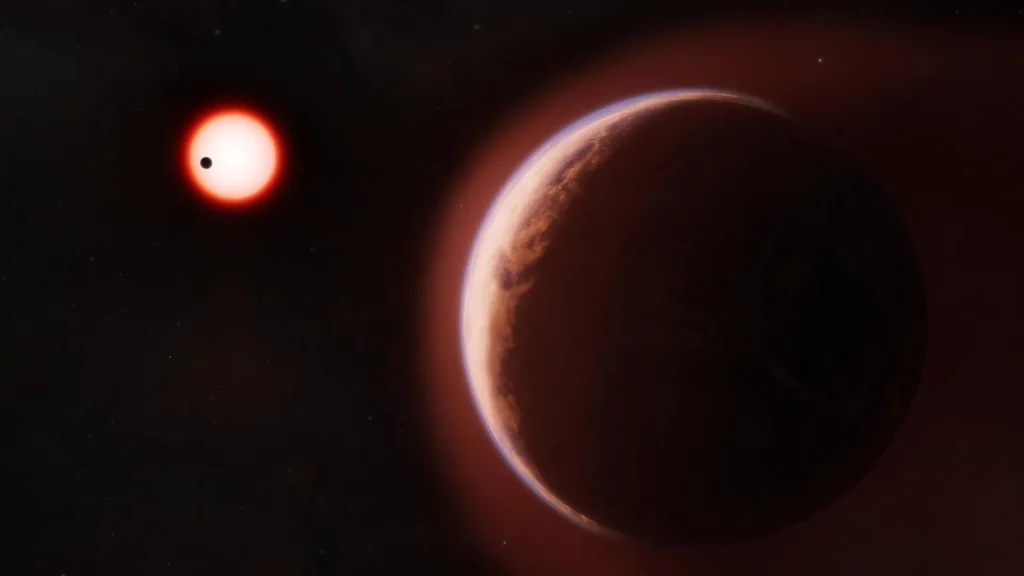
The exoplanet in question, designated LHS 1140 b, orbits a red dwarf star approximately 48 light-years away from Earth. Its location within the star’s habitable zone—the region where temperatures are conducive to the existence of liquid water on a planet’s surface—has long made it a prime candidate in the quest for extraterrestrial habitability. However, confirming the presence of an atmosphere on such distant, rocky worlds has proven to be an exceptionally challenging endeavor.
"An atmosphere is essential for a planet to support life as we know it," stated lead author Collin Cherubim, who recently completed his Ph.D. in Earth and Planetary Sciences at Harvard University. "This is the first time anyone has found an atmosphere on a rocky planet in the habitable zone of another star." Cherubim’s sentiment underscores the profound significance of this detection, moving from theoretical possibility to empirical evidence.
The Helium Signal: A Smoking Gun for an Exoplanet Atmosphere
The key to this monumental discovery lies in the detection of helium escaping from LHS 1140 b. This subtle, yet definitive, signal provided the crucial evidence supporting earlier theoretical predictions about the planet’s atmospheric composition. Red dwarf stars, like the one LHS 1140 b orbits, are the most common type of star in the Milky Way galaxy, making the potential for their planets to host atmospheres a widespread prospect. However, these stars are also known for their intense stellar flares, which can strip away planetary atmospheres. The fact that LHS 1140 b appears to have retained its atmosphere for billions of years is therefore particularly remarkable.
The study details how Cherubim and his team meticulously developed a theoretical model that predicted the upper atmosphere of LHS 1140 b would exhibit a substantial amount of helium slowly dissipating into space. This prediction was then put to the test using the Warm Infrared Echelle (WINERED) Spectrograph, an advanced instrument located at the Magellan Observatory in Chile. The researchers strategically timed their observations to coincide with an unusual celestial event: the simultaneous transit of LHS 1140 b and another planet across the face of their host star.
During a transit, an exoplanet passes in front of its star from our perspective, causing a slight dip in the star’s brightness. By analyzing the starlight that passes through the planet’s atmosphere during this event, astronomers can glean information about its composition. In this instance, while the second, unidentified planet in the transit showed no discernible atmospheric signature, LHS 1140 b produced a clear and statistically significant signal of escaping helium. This provided irrefutable evidence that the rocky exoplanet possesses an atmosphere.
A Long Road to Confirmation: From Wonder to Discovery
The journey to this discovery has been a long and arduous one, spanning decades of scientific inquiry and technological advancement. Robin Wordsworth, Gordon McKay Professor of Environmental Science and Engineering and Professor of Earth and Planetary Sciences at Harvard and one of Cherubim’s dissertation advisors, reflected on the rapid evolution of the field. "Twenty years ago we wondered whether other terrestrial-type planets even existed," Wordsworth stated. "Then we learned they’re common, and found some in the habitable zone. The next question was whether any of them had managed to keep an atmosphere. Now we know at least one has."
This sentiment is echoed by David Charbonneau, head of the Harvard Department of Astronomy and an astronomer at the Center for Astrophysics | Harvard & Smithsonian, who served as another of Cherubim’s joint advisors. Initially, Charbonneau expressed some skepticism regarding the feasibility of Cherubim’s ambitious plan. The detection method relied on a mathematical model, and observing such a specific signal—escaping helium from a rocky world—had never been accomplished before.
"Collin analyzed the planets we knew about and predicted that this one would have a helium atmosphere," Charbonneau explained. "Then he organized telescope time, got the data, and the detection was statistically rock solid." The success of Cherubim’s approach not only validated his theoretical model but also opened a new avenue for exoplanet atmosphere detection. This implies that astronomers may be able to study the atmospheres of rocky exoplanets from ground-based telescopes by focusing on the subtle signatures of gases escaping into the vastness of space.
The Enduring Atmosphere: A Billion-Year Story
The research suggests that the atmosphere of LHS 1140 b has persisted for an astonishing period, estimated to be over three billion years. This remarkable longevity is a critical factor in making LHS 1140 b an exceptionally promising target for continued and more detailed investigation. The resilience of its atmosphere, especially given its orbit around a potentially volatile red dwarf, hints at robust atmospheric processes or a fortunate planetary environment that has shielded it from complete erosion.
The implications of this discovery are far-reaching. While thousands of exoplanets have been identified, including numerous rocky worlds within habitable zones, the confirmation of an atmosphere is a fundamental prerequisite for habitability as we understand it. An atmosphere provides insulation, regulates temperature, shields the surface from harmful radiation, and can facilitate the presence of liquid water—all crucial elements for life.
Future Prospects: Unraveling the Secrets of LHS 1140 b
Cherubim’s future research plans are ambitious and directly aligned with the quest for understanding exoplanetary habitability. His immediate goal is to precisely determine the complete chemical composition of LHS 1140 b’s atmosphere. This detailed analysis will be a crucial step in assessing the planet’s potential to host life. He also hopes to ascertain whether the planet possesses surface oceans or other geological features that are intrinsically linked to habitability.
Furthermore, Cherubim and his team intend to leverage their validated model to actively search for other rocky worlds that might also harbor atmospheres. The success with LHS 1140 b serves as a powerful proof of concept, suggesting that a systematic search using this technique could yield a wealth of new atmospheric detections.
"This has been a model validation, and hopefully it’s just the first of many more observations to come," Cherubim concluded, expressing optimism for the future of exoplanet atmospheric studies. This discovery not only marks a significant milestone in astrobiology but also fuels the ongoing human fascination with the possibility of life existing beyond our own pale blue dot. The detection of an atmosphere around LHS 1140 b transforms it from merely another exoplanet into a tangible candidate for detailed study in the grand cosmic search for life.
Context and Broader Implications
The detection of an atmosphere on LHS 1140 b arrives at a time of unprecedented advancement in exoplanet science. Over the past three decades, astronomers have transitioned from speculating about the existence of planets outside our solar system to cataloging thousands of them. Instruments like the Kepler Space Telescope and the Transiting Exoplanet Survey Satellite (TESS) have been instrumental in this endeavor, revealing a diverse array of planetary systems.
However, characterizing these exoplanets, especially their atmospheres, has presented significant technical hurdles. Early successes focused on gas giants, whose large sizes and thick atmospheres made them easier targets for spectroscopic analysis during transits. Rocky, terrestrial-type planets, by contrast, have much thinner atmospheres, making the detection of atmospheric signatures considerably more challenging.
The habitable zone itself is a concept that requires careful consideration. While it defines the region where liquid water could exist, it doesn’t guarantee it. Factors such as atmospheric pressure, composition, planetary geology, and the presence of a magnetic field all play vital roles in determining a planet’s actual habitability. The detection of an atmosphere on LHS 1140 b is a crucial piece of this complex puzzle, providing the necessary foundation for further investigation into these other habitability factors.
The fact that LHS 1140 b orbits a red dwarf star adds another layer of interest and complexity. Red dwarfs are prone to intense stellar flares and coronal mass ejections, which can bombard nearby planets with high-energy particles and radiation. These events can erode planetary atmospheres over time. The survival of LHS 1140 b’s atmosphere for billions of years suggests several possibilities: perhaps the planet has a strong intrinsic magnetic field that shields it, or its orbital distance provides a degree of protection, or its atmospheric composition itself offers some resilience. Future observations will aim to shed light on these questions.
This discovery also has profound implications for the future of space telescopes and observational strategies. The success of the WINERED spectrograph in detecting escaping helium from a rocky exoplanet underscores the importance of developing and utilizing highly sensitive instruments capable of probing subtle atmospheric signals. Upcoming observatories, such as the James Webb Space Telescope (JWST), are poised to revolutionize exoplanet atmosphere characterization with their advanced capabilities, potentially allowing for the detection of a wider range of molecules, including biosignatures—gases that could indicate the presence of life.
The scientific community’s reaction to this news has been overwhelmingly positive, with many expressing excitement about the new era of exoplanet atmospheric studies it heralds. This discovery is not merely an academic triumph; it represents a significant step forward in humanity’s enduring quest to answer one of the most fundamental questions: Are we alone in the universe? The detection of an atmosphere on a rocky planet in a habitable zone brings that answer, however tentatively, a small but crucial step closer.