In a landmark discovery that pushes the boundaries of our understanding of the early universe, astronomers at the Massachusetts Institute of Technology (MIT) and several other international institutions have detected a flickering quasar dating back to the "cosmic dawn." This celestial object, located approximately 13 billion light-years from Earth, was observed as it existed a mere 850 million years after the Big Bang. The discovery, detailed in the journal Nature Astronomy, marks the earliest instance of a flickering quasar ever recorded and provides startling evidence that supermassive black holes reached a state of maturity much faster than current cosmological models predict.
The detection was made possible through the meticulous analysis of nearly a decade and a half of infrared data. By observing the "flicker" of this ancient light, researchers were able to probe the structural characteristics of the black hole’s accretion disk—the swirling vortex of gas and dust that feeds the gravitational monster. To the surprise of the scientific community, the accretion disk of this primitive quasar appeared remarkably stable and "pancake-flat," a morphology typically associated with much older, more evolved systems in the modern universe.
The Nature of the Cosmic Engine
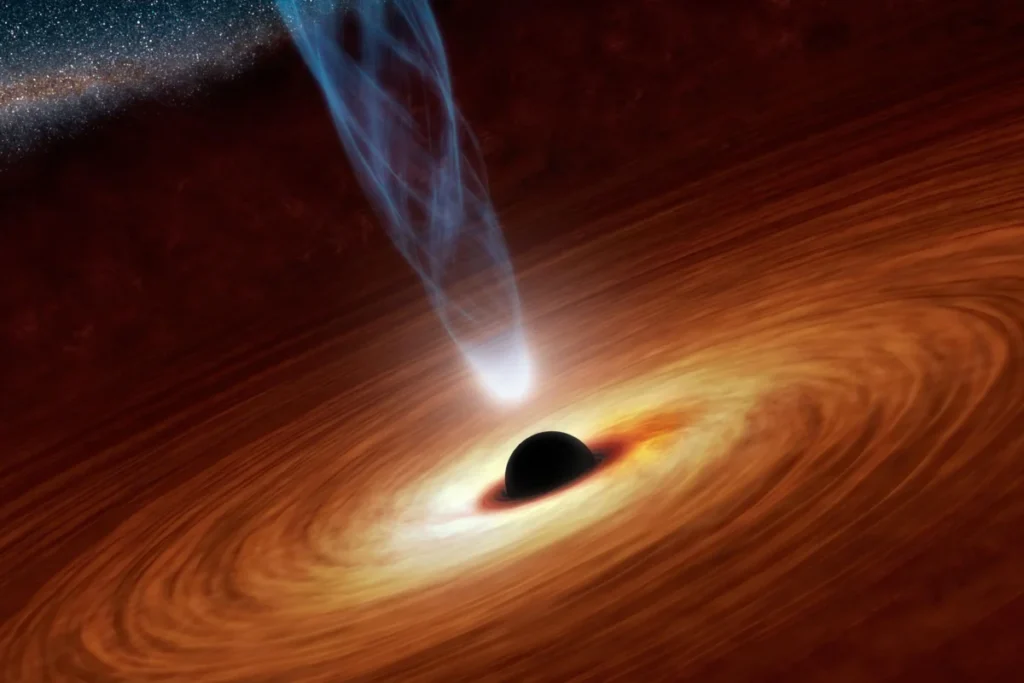
At the heart of almost every massive galaxy lies a supermassive black hole, a gravitational titan with a mass millions or even billions of times that of our Sun. While black holes are famously invisible, they become some of the most luminous objects in the cosmos when they are "active." This activity occurs as the black hole’s immense gravity pulls in surrounding material, creating a high-temperature whirlpool known as an accretion disk.
As gas and dust spiral toward the event horizon, friction and gravitational compression heat the material to millions of degrees, causing it to radiate vast amounts of energy across the electromagnetic spectrum. When this process is exceptionally energetic, the system is classified as a quasar. Quasars are so bright that they can easily outshine the combined light of all the hundreds of billions of stars in their host galaxies.
The light emitted by these systems is not constant; it fluctuates, or "flickers," based on the rate and manner in which the black hole consumes its "cosmic meal." By studying these fluctuations, astronomers can infer the physical structure of the accretion disk and the dynamics of the black hole’s growth.
Unearthing the Signal: Methodology and Technical Challenges
The search for flickering quasars in the early universe is fraught with technical hurdles. Because the universe is expanding, light from distant objects is stretched as it travels through space. This phenomenon, known as redshift, shifts visible light into the longer wavelengths of the infrared spectrum. Furthermore, the expansion of space also causes time dilation; a flicker that might take a week to occur in the quasar’s local frame of reference appears to take months or even years when observed from Earth.
To overcome these obstacles, the MIT-led team turned to NASA’s Near-Earth Object Wide-field Infrared Survey Explorer (NEOWISE). Originally designed to hunt for asteroids, the NEOWISE mission has scanned the entire sky in infrared wavelengths repeatedly over a 14-year period. This long-duration dataset provided the temporal "baseline" necessary to observe the slow, time-dilated flickering of an ancient quasar.
The breakthrough came when Kishalay De, a former MIT postdoc now at Columbia University, spearheaded a project to re-process archival NEOWISE data. This effort allowed the team to isolate a specific signal from 850 million years post-Big Bang. Gene Leung, a postdoctoral researcher at the MIT Kavli Institute for Astrophysics and Space Research, noted that while many quasars have been found in the cosmic dawn, this is the first time scientists have successfully captured one in the act of flickering.
The Pancake Paradox: A Mature Structure in a Young Universe
The primary takeaway from the flickering signal was the shape of the quasar’s accretion disk. By analyzing the flicker across different infrared wavelengths—each corresponding to different temperatures and distances from the central black hole—the researchers mapped the disk’s geometry.
In the local, "modern" universe, mature black holes typically possess flat, stable accretion disks. Conversely, theoretical models of the early universe suggested that the first supermassive black holes should be surrounded by "puffy," chaotic, and unsettled disks. These "messy" structures were expected to be the hallmark of rapid, turbulent growth phases as black holes scrambled to accumulate mass in the dense environments of the young cosmos.
However, the 850-million-year-old quasar defied these expectations. Its flicker indicated a thin, flat disk, suggesting the system had already reached a state of "calm" maturity.
"This provides direct evidence that the same feeding processes and structures observed in the nearby universe were already in place at very early times," said Anna-Christina Eilers, assistant professor of physics at MIT. "It suggests that all the messy, very rapid growth phases that we expect all black holes to go through happen very, very early on, before we see them as these very bright luminous quasars."
Data Analysis and Quantitative Findings
The scale of the energy involved in this ancient flicker is difficult to comprehend. The researchers estimate the quasar’s total luminosity to be equivalent to approximately 12 trillion suns. The observed flicker represented a fluctuation of about 20 percent in this brightness. In practical terms, this means the quasar’s energy output was surging and dipping by a margin of 2 trillion suns—a variance that occurred randomly over the 14-year observation period, much like the unpredictable dancing of a candle flame.
The consistency of this flickering pattern across a decade of data allowed the team to rule out transient events, such as a single star being torn apart by the black hole (a Tidal Disruption Event). Instead, the data pointed toward a steady, albeit fluctuating, accretion process within a stable disk.
A Timeline of Discovery and Cosmological Context
The discovery adds a significant chapter to the timeline of cosmological exploration:
- 1960s: Quasars are first identified as high-redshift, radio-bright objects, eventually understood to be active supermassive black holes.
- Early 2000s: Advancements in digital sky surveys allow astronomers to find the first quasars from the first billion years of the universe.
- 2010–2024: NASA’s NEOWISE mission provides a 14-year infrared record of the sky.
- Current Discovery: MIT researchers use the NEOWISE archive to detect the first flickering signal from the cosmic dawn, proving that mature disk structures existed 13 billion years ago.
This timeline highlights a growing "mass problem" in cosmology. If black holes were already supermassive (billions of solar masses) and structurally mature less than a billion years after the Big Bang, they must have grown at rates that challenge the Eddington limit—the theoretical maximum rate at which a black hole can consume matter before the outward pressure of radiation halts the inflow.
Broader Implications for Galactic Evolution
The role of supermassive black holes extends far beyond their own gravity. They are the "engines" of their galaxies, acting as regulatory mechanisms for star formation. As a quasar radiates energy, it can blow away the surrounding gas and dust, effectively "starving" the galaxy and preventing new stars from forming. This process, known as feedback, is essential to explaining why galaxies today have the sizes and shapes they do.
"Without supermassive black holes, no galaxy would look the way it does today," Eilers explained. "Black holes play a major role in shaping how galactic ecosystems look."
The fact that these engines were fully operational and "mature" so early suggests that the co-evolution of galaxies and black holes began almost immediately after the first stars ignited. It implies a much more synchronized and rapid development of the universe’s large-scale structures than previously thought.
Future Horizons: Peering Further Back
The MIT team’s findings have opened a new window into the study of the early universe. By proving that flickering can be detected across such vast distances, they have provided a blueprint for future observations. The next step is to use even more sensitive instruments, such as the James Webb Space Telescope (JWST), to find quasars that are still in their "puffy" and "chaotic" growth phases.
If astronomers can catch a quasar before it settles into a flat disk, they may finally solve the mystery of "seed" black holes—the original, smaller black holes from which supermassive giants grew. Whether these seeds came from the collapse of the very first stars or the direct collapse of massive gas clouds remains one of the most significant unanswered questions in astrophysics.
The discovery of the earliest flickering quasar does more than just break a record; it forces a recalibration of the cosmic clock. It reveals a universe that was capable of producing complex, stable, and incredibly powerful systems in what amounts to its chronological infancy. As researchers continue to mine the data from missions like NEOWISE and JWST, the "cosmic dawn" is beginning to look less like a slow awakening and more like a rapid, explosive emergence of complexity.