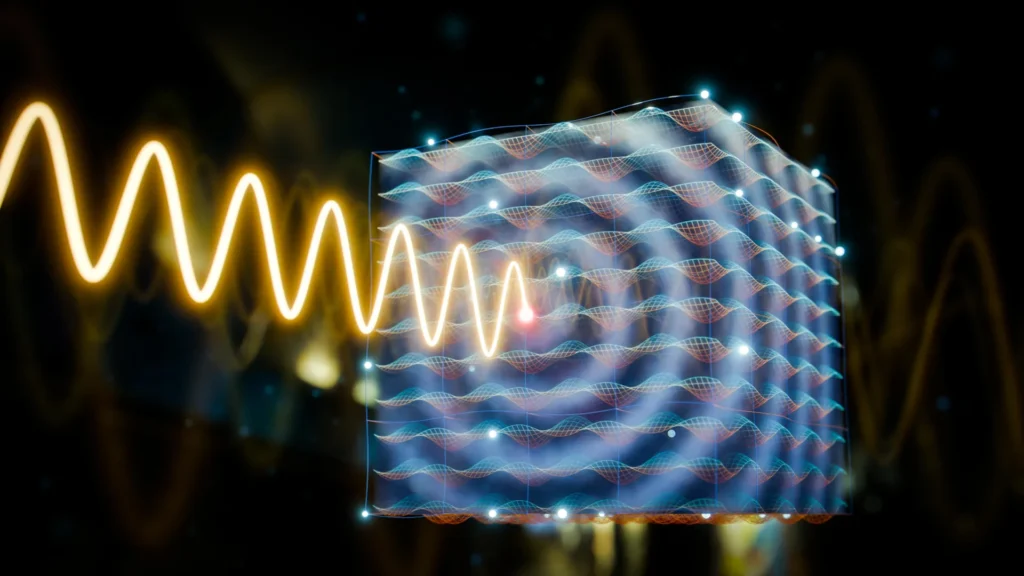
In a landmark achievement for the field of condensed matter physics and ultrafast optics, an international collaboration of scientists has successfully engineered the world’s first all-optical photonic time crystal (PTC) operating within the terahertz frequency spectrum. This experimental milestone, recently documented in the journal Nature, represents a fundamental shift in how researchers manipulate light, moving beyond traditional spatial control to a temporal dimension that allows for the dynamic alteration of optical properties on a picosecond scale. The research consortium included leading physicists from École Polytechnique, the Collège de France, and the Helmholtz-Zentrum Dresden-Rossendorf (HZDR) in Germany. By leveraging the high-intensity, superradiant terahertz pulses provided by HZDR’s TELBE facility, the team has demonstrated a method to bypass long-standing technical barriers, potentially paving the way for the next generation of ultrafast optical computers, advanced wireless communications, and highly tunable terahertz lasers.
The Evolution of Photonic Control: From Space to Time
To understand the significance of a photonic time crystal, one must first look at the history of conventional photonic crystals. First proposed in the late 1980s by Eli Yablonovitch and Sajeev John, spatial photonic crystals are materials engineered with a periodic variation in their refractive index. These structures, often found in nature—such as in the iridescent wings of a butterfly or the shimmer of an opal—function as "semiconductors for light." By creating a "photonic bandgap," these materials can block certain wavelengths while allowing others to pass, enabling the precise guiding of photons through optical fibers and laser cavities.
However, spatial photonic crystals are inherently static. Once the physical structure is fabricated, its optical properties are largely fixed. The quest for "time crystals," a concept first theorized by Nobel laureate Frank Wilczek in 2012, introduced the idea of a structure that repeats not in space, but in time. In a photonic time crystal, the material’s refractive index or conductivity is modulated rapidly and periodically throughout its entire volume. This temporal modulation creates "temporal bandgaps," where light can be amplified rather than just filtered. While theoretical models for PTCs have existed for years, the experimental realization has been hindered by the extreme difficulty of changing a material’s optical properties fast enough to keep pace with the oscillations of light itself.
Bridging the Terahertz Gap
The research team chose to focus their efforts on the terahertz (THz) range, a segment of the electromagnetic spectrum located between microwave and infrared frequencies. Often referred to as the "terahertz gap," this region has historically been difficult to exploit because it is too high-frequency for conventional electronic transistors and too low-frequency for standard optical components.
Yannis Laplace, an assistant professor at École Polytechnique and a key figure at the Laboratory of Irradiated Solids (LSI), emphasizes that the terahertz range is the final frontier of the electromagnetic spectrum. "The THz range represents the bridge between electronics and photonics," Laplace noted during the project’s unveiling. "It is a range full of opportunities for both fundamental science and practical societal applications, yet it remains technologically underdeveloped. Creating photonic crystals that function in this regime is the key to closing that gap."
The importance of the THz range lies in its ability to penetrate various materials while remaining non-ionizing, making it ideal for medical imaging, security scanning, and high-bandwidth 6G communications. However, manipulating THz waves requires materials that can respond at the scale of trillionths of a second.
Experimental Architecture: Plasmonic Metamaterials and TELBE
The successful creation of the PTC relied on a sophisticated "plasmonic metamaterial" designed at École Polytechnique with support from Thales’ Laboratoire Albert Fert and the Physics of Interfaces (PICM) laboratory. This metamaterial consists of a semiconductor substrate—a specialized mixture of indium and antimony (InSb)—overlaid with an insulating layer and a pattern of micrometer-scale gold crenelated structures.
These gold structures act as "meta-atoms," creating microscopic cavities that trap and confine light between the metal and the semiconductor. When the semiconductor is excited by an external energy source, it generates "surface plasmons"—collective oscillations of electrons that couple with the trapped photons. This interaction is what allows the material to influence light with such high precision.
The catalyst for the experiment was the TELBE facility at HZDR’s ELBE accelerator in Dresden. TELBE is one of the world’s few sources capable of generating high-power, phase-stable terahertz pulses. These pulses served as the "pump" that modulated the metamaterial’s properties. By hitting the device with these intense pulses, the researchers were able to trigger a massive and nearly instantaneous change in the material’s reflectivity.
Jan-Christoph Deinert, the coordinator of the TELBE facility, explained the technical necessity of the setup: "The unique ability of TELBE to generate high-field, phase-stable pulses was the deciding factor. To achieve the coherent, ultrafast modulation required for the photonic time crystal regime, we needed a source that could provide not just power, but extreme temporal precision. Without this infrastructure, the experiment simply would not have been possible."
Data Analysis and Theoretical Validation
The experimental results were striking. The team observed that the material’s optical properties, specifically its resonance frequency and reflectivity, could be altered on a picosecond timescale—roughly one-billionth of a billionth of a second. This speed is comparable to the period of the terahertz waves themselves, a prerequisite for a true time crystal.
The magnitude of the change was equally impressive. In traditional optics, changing the color or intensity of light usually requires passing it through multiple filters or non-linear crystals, often resulting in significant energy loss. In this experiment, the shift in reflectivity was so strong it was described as the optical equivalent of forcing an object to instantaneously change its color while maintaining its structural integrity.
To interpret these results, Marco Schiró, a Research Scientist at the Collège de France, developed a comprehensive theoretical model. His calculations not only confirmed the experimental observations but also revealed a surprising benefit: the temporal modulation reduced "photon dissipation" by half. Dissipation is a major hurdle in photonics, where energy is lost as heat or scattered as light passes through a medium. By reducing this loss, the PTC becomes much more efficient at trapping and amplifying light.
"The theory provides a roadmap for the future," Schiró stated. "We now understand that by extending the periodicity into the time domain, we can actually mitigate the inherent losses of the material. This provides a basis for guiding future discoveries and optimizing these systems for practical use."
Chronology of Development
The journey to the first all-optical PTC has been a multi-year effort:
- 2012-2015: Theoretical foundations for time crystals are laid by Wilczek and others, sparking interest in temporal photonic structures.
- 2018-2020: The team at École Polytechnique begins experimenting with static photonic crystals, discovering that magnetic fields and temperature could influence light capture, though not at the speeds required for dynamic control.
- 2021: Collaboration with HZDR begins, focusing on the use of the TELBE superradiant source to achieve picosecond modulation.
- 2022-2023: Fabrication of the gold-indium-antimony metamaterial and initial testing at the ELBE accelerator.
- 2024: Publication of the findings in Nature, marking the first successful demonstration of an all-optical PTC in the terahertz range.
Broader Impact and Industrial Implications
The implications of this breakthrough extend far beyond the laboratory. As the limits of silicon-based electronics are reached, the industry is looking toward photonics to continue the advancement of computing power—a transition often referred to as "More than Moore."
Ultrafast Optical Computing: Current computers rely on the movement of electrons, which generates heat and limits processing speeds. Optical computers, using photons, could theoretically operate at speeds thousands of times faster with minimal energy consumption. The ability of PTCs to switch optical states in picoseconds provides a viable mechanism for the high-speed "transistors" of an optical CPU.
6G and Beyond: Telecommunications networks are currently moving toward higher frequencies to accommodate more data. The terahertz range is the primary candidate for 6G technology. A photonic time crystal could act as a highly adaptable signal processor, allowing for near-instantaneous switching and routing of data-heavy terahertz signals.
Medical and Industrial Imaging: Terahertz radiation can see through clothing, plastics, and ceramics, and can even identify specific chemical signatures without the ionizing risks of X-rays. PTC-based lasers could lead to more compact, powerful, and tunable THz imaging systems for detecting early-stage cancers or inspecting pharmaceutical products.
Advanced Lasers: Lead author Tingwen Guo, a PhD student at École Polytechnique, points out that the PTC’s ability to amplify light through temporal bandgaps could lead to a new class of lasers. "By opening a new dimension for light control, we have a novel path toward amplification and lasing that doesn’t rely on traditional gain media. This could be a game-changer for optical technologies not just at terahertz frequencies, but across the entire spectrum."
Future Research Directions
Despite the success of the experiment, challenges remain. The researchers are now focused on further reducing photon dissipation. While the current model cut losses by 50%, a practical device for commercial use would require even higher efficiency. The team also aims to increase the "photon density"—the number of photons the crystal can hold and manipulate at once—to achieve stronger amplification.
The international scientific community has reacted with significant interest. Dr. Andrea Alù, a prominent figure in metamaterials research at the City University of New York (who was not involved in the study), noted that the demonstration of an all-optical PTC is a "tour de force" that validates years of theoretical speculation. "The transition from microwave experiments to all-optical terahertz experiments is a massive leap in complexity and potential utility," Alù remarked.
As the team at École Polytechnique, Collège de France, and HZDR continues to refine their device, the era of "temporal engineering" appears to have arrived. The transition from static materials to those that can change their very nature in the blink of an eye—or faster—promises to redefine the boundaries of what is possible in the world of light and matter.