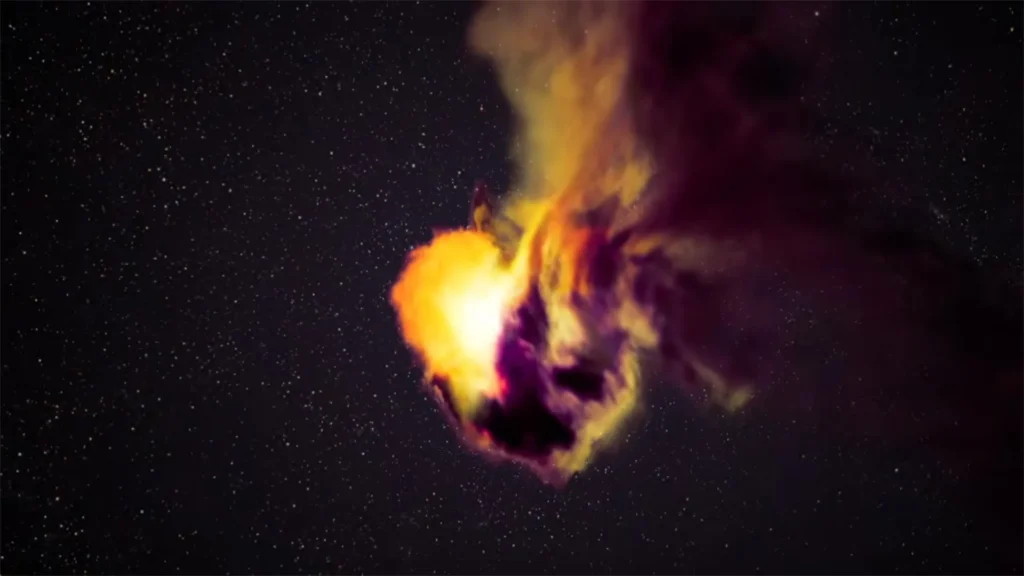
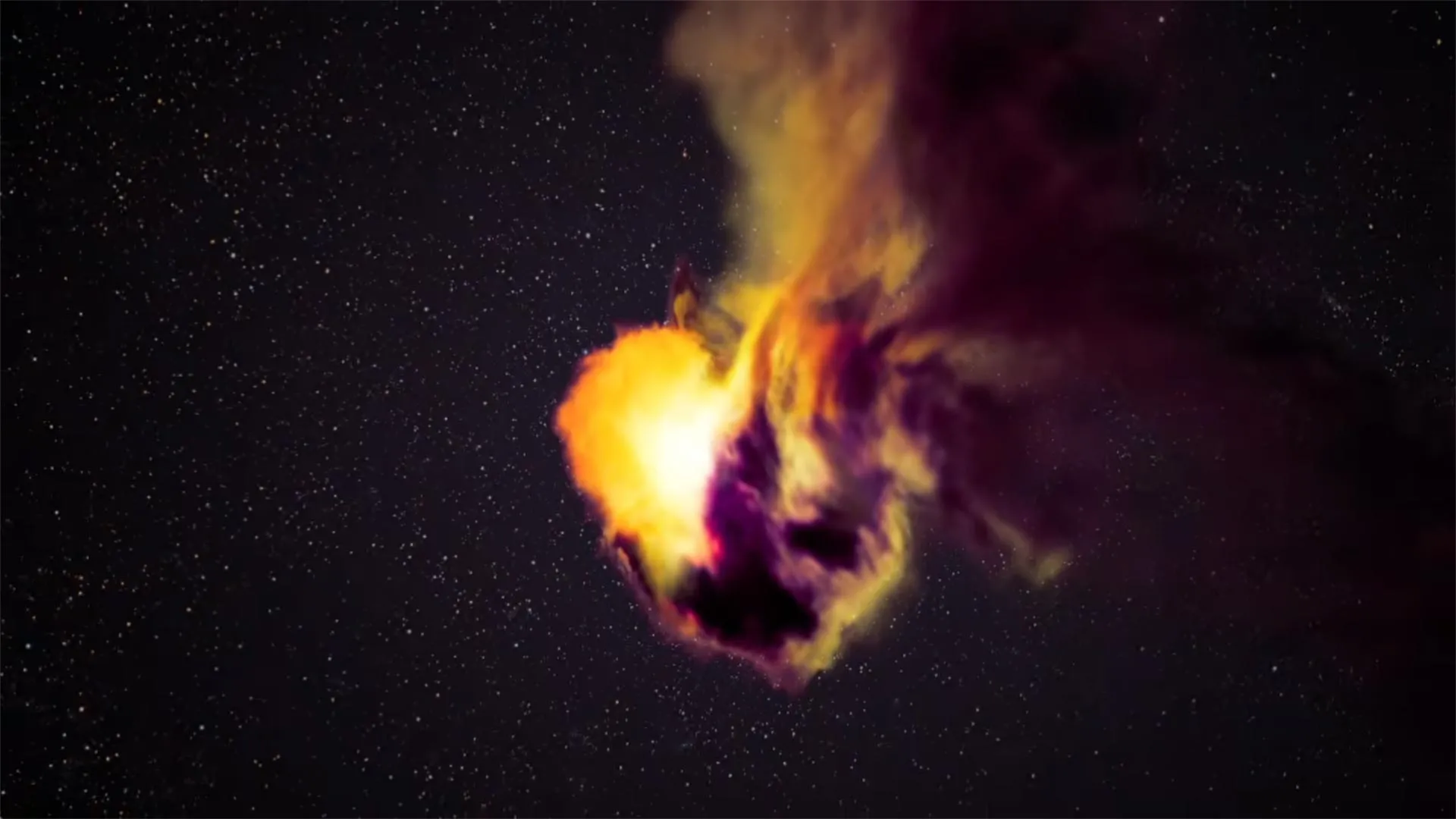
In a landmark discovery that challenges our understanding of stellar evolution, an international team of researchers has observed the interior structure of a dying star during a rare cosmic event known as an “extremely stripped supernova.” The findings, published in the prestigious journal Nature, provide a unprecedented look at the final moments of a massive star and offer empirical evidence for the complex nuclear processes that forge the chemical building blocks of the universe. Led by Steve Schulze of Northwestern University, the study details the observation of supernova SN 2021yfj, an explosion characterized by the presence of a dense shell of gas that originated from the deepest layers of the progenitor star.
The Mechanics of Stellar Nucleosynthesis and Layering
To understand the significance of SN 2021yfj, one must first look at the life cycle of massive stars. Stars are essentially giant nuclear reactors powered by fusion—the process of forcing lighter atomic nuclei together to form heavier ones. This process releases the immense energy that allows a star to resist the crushing force of its own gravity.
The fusion process occurs in distinct, chronological stages. During the vast majority of a star’s life, it fuses hydrogen into helium. As the hydrogen supply in the core is exhausted, the core contracts and heats up, allowing for the fusion of helium into carbon. For stars with sufficient mass—typically those at least eight times the mass of our Sun—the process does not stop there. The star continues to fuse heavier and heavier elements in a sequence that includes neon, oxygen, and silicon.
Each successive stage of fusion happens significantly faster than the one before it. While a massive star may spend millions of years burning hydrogen, the carbon-burning phase may last only a few thousand years. By the time the star reaches the silicon-burning stage, the countdown to destruction is nearly over; the silicon cycle is often completed in a matter of days. This rapid progression creates an "onion-skin" structure within the star. The outermost layers consist of unburned hydrogen and helium, while the inner layers represent the chronological history of the star’s fusion cycles, culminating in a core of iron.
The Phenomenon of the Extremely Stripped Supernova
In a typical core-collapse supernova, the explosion occurs while the star is still shrouded in its outer layers of hydrogen or helium. When astronomers observe these events, the light spectrum usually reveals the presence of these lighter elements. However, in "stripped-envelope" supernovae, the star has lost some or all of its outer hydrogen and helium before the explosion, often due to powerful stellar winds or the gravitational influence of a nearby companion star.
SN 2021yfj represents an extreme end of this spectrum. In this specific case, the star was so thoroughly "stripped" that the material ejected during the explosion and the gas surrounding the site were composed of silicon. This is a revolutionary observation because the silicon layer is the final stable layer produced before the star’s core turns to iron and collapses. Because the silicon-burning phase occurs so close to the time of the explosion—often within months or even days—the material does not have time to drift far from the star’s surface. Finding a shell of silicon gas around a supernova indicates that the star managed to shed almost its entire mass, right down to its innermost regions, just moments before its death.
Chronology of the SN 2021yfj Event
The timeline of SN 2021yfj provides a clear window into the terminal phase of a massive star. Based on the data collected by Schulze and his colleagues, the chronology can be reconstructed as follows:
- The Pre-Explosion Stripping Phase: Thousands of years before the explosion, the star began losing its outer hydrogen and helium envelopes. This process accelerated as the star entered its final stages of life.
- The Final Months: As the star began fusing oxygen into silicon, it underwent a violent period of mass loss. The mechanism for this is still being debated, but it resulted in the expulsion of the silicon-rich layer into the immediate vicinity of the star.
- Core Collapse: Once the core turned to iron, fusion ceased to produce energy. Within a fraction of a second, the iron core—no longer supported by radiation pressure—collapsed under gravity to form either a neutron star or a black hole.
- The Supernova Explosion: The collapse created a massive shockwave that rebounded outward, tearing the rest of the star apart. This is the core-collapse supernova.
- Interaction with the Shell: As the debris from the explosion expanded at a significant fraction of the speed of light, it slammed into the previously ejected silicon shell. This interaction "lit up" the shell, allowing Earth-based telescopes to detect the specific chemical signature of silicon.
The Mystery of the Stripping Mechanism
One of the most pressing questions raised by the study is how a star could lose its outer layers so thoroughly and so quickly. Under standard models of stellar evolution, even the most powerful stellar winds—streams of charged particles ejected from the star’s surface—are generally not strong enough to strip a star down to its silicon layer.
The research team suggests that the most plausible explanation involves a binary star system. If the progenitor of SN 2021yfj had a close binary companion, the companion’s gravity could have acted as a cosmic vacuum, siphoning off the outer layers of the dying star. This "binary interaction" is increasingly seen as a vital factor in how stars live and die. In this scenario, the companion star would have rapidly pulled the deep silicon layer away from the primary star shortly before the primary went supernova. This interaction not only explains the missing layers but also accounts for the density and proximity of the silicon shell observed by the astronomers.
Broader Scientific Implications and Data Analysis
The discovery of SN 2021yfj is more than just a rare astronomical sighting; it is a confirmation of the "Alpha Process" and the chemical evolution of the cosmos. Astronomers use spectroscopy—the study of light broken down into its constituent wavelengths—to identify elements in space. The distinct "fingerprint" of silicon in the spectrum of SN 2021yfj confirms that the theoretical models of stellar layering are accurate.
Furthermore, this event highlights the origin of the elements that make up our world. While the Big Bang produced hydrogen and helium, almost every other element was forged inside a star.
- Low-Mass Stars: Stars like our Sun are responsible for producing elements like carbon and nitrogen.
- Neutron Star Mergers: Exotic events like the collision of two neutron stars are believed to be the source of heavy metals such as gold and platinum.
- Core-Collapse Supernovae: These explosions are the primary "factories" for oxygen, neon, magnesium, and silicon.
Oxygen, the third most abundant element in the universe and a necessity for life as we know it, is primarily distributed through the death of massive stars. By studying events like SN 2021yfj, scientists can better calculate the "yield" of these elements—how much of each element a single supernova contributes to the interstellar medium. This data is crucial for understanding why the Earth has its specific chemical composition.
Official Responses and Expert Insights
While the paper in Nature provides the technical foundation, the broader astrophysical community has reacted with excitement. Experts in stellar evolution note that SN 2021yfj provides a "missing link" in supernova taxonomy.
"We have long theorized that these inner layers exist, but seeing them laid bare in the aftermath of an explosion is a rare gift," noted one researcher not involved in the study. "It tells us that our models of nuclear burning cycles are on the right track, but it also tells us we have a lot to learn about how stars interact with their neighbors in their final days."
Steve Schulze and his team emphasized that the observation was made possible by rapid-response telescopes and advanced spectroscopic analysis. The ability to catch a supernova in its earliest stages is critical, as the interaction between the explosion and the surrounding gas shell is often short-lived.
Impact on Our Understanding of the Early Universe
The findings also have implications for the study of the early universe. In the billions of years since the Big Bang, the universe has become increasingly "polluted" with heavy elements (which astronomers call "metals"). The first generation of stars, formed from pure hydrogen and helium, would have exploded in a very different way than modern stars.
By understanding how modern, "metal-rich" stars like the progenitor of SN 2021yfj explode, astronomers can create better simulations of how the very first stars influenced the formation of the first galaxies. If early supernovae were also "extremely stripped," they would have distributed elements differently, potentially affecting the rate at which later stars and planets could form.
Conclusion: A New Window into the Cosmic Forge
The observation of supernova SN 2021yfj marks a significant milestone in observational astronomy. By glimpsing the silicon layer of a dying star, researchers have effectively looked into the heart of a cosmic forge. This event confirms the rapid, final cycles of nuclear fusion and underscores the importance of binary systems in shaping the life and death of stars.
As telescopes become more powerful and surveys of the night sky become more frequent, astronomers hope to find more "extremely stripped" supernovae. Each new discovery will refine our understanding of how the universe evolved from a simple sea of hydrogen into a complex cosmos filled with the diverse elements required for planets, moons, and life itself. The story of SN 2021yfj is, in many ways, the story of our own origins, written in the light of a distant, dying star.