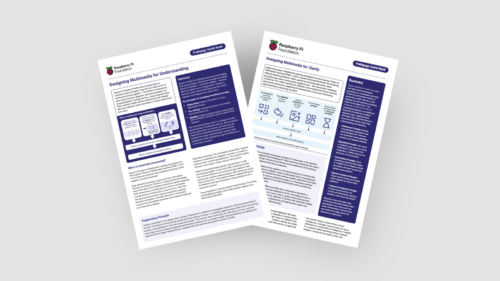
The Raspberry Pi Foundation has announced the release of two new pedagogical resources designed to optimize the delivery of computing education through the application of evidence-based psychological frameworks. These resources, categorized as "Pedagogy Quick Reads," focus specifically on Richard Mayer’s Principles of Multimedia Learning, offering educators a structured approach to reducing cognitive overload in the classroom. As the complexity of computer science curricula increases globally, these guides provide a vital bridge between cognitive science and practical classroom instruction, aiming to improve engagement and long-term knowledge retention among students.
The initiative addresses a fundamental challenge in modern education: the limited capacity of the human working memory. When students are presented with excessive or poorly structured information, they experience a "cognitive load" that can impede their ability to process new concepts. By utilizing Mayer’s research-backed strategies, the Raspberry Pi Foundation intends to help teachers design instructional materials that align with the way the human brain naturally processes visual and auditory information.
The Theoretical Foundation: Cognitive Load and Multimedia Learning
The new resources are grounded in Cognitive Load Theory (CLT), a framework developed in the 1980s by John Sweller and further refined by Richard Mayer. At its core, the theory posits that the human brain has a finite amount of processing power for new information. This load is generally divided into three categories: intrinsic load (the inherent difficulty of the topic), extraneous load (the way information is presented), and germane load (the mental effort required to create a permanent store of knowledge).
Richard Mayer’s Principles of Multimedia Learning specifically target the reduction of extraneous load. His work is based on three primary assumptions: the dual-channel hypothesis, which suggests humans have separate channels for processing visual and auditory information; the limited-capacity hypothesis, which notes that each channel can only process a small amount of data at a time; and the active-processing hypothesis, which states that learning is an active process of filtering, selecting, and organizing information.
The release of these Quick Reads—specifically "Designing multimedia for clarity" (QR32) and "Designing multimedia for understanding" (QR33)—follows a chronological progression of pedagogical support provided by the Foundation. This series began with an introductory guide to Cognitive Load Theory (QR01), establishing a baseline understanding before moving into the specific applications of multimedia design.
Strategies for Instructional Clarity: Quick Read 32
The first of the two new releases focuses on the concept of clarity, ensuring that learners can seamlessly connect visual and auditory inputs in real-time. This guide highlights several key principles that prevent the "split-attention effect," a phenomenon where a learner’s attention is divided between multiple sources of information, leading to decreased comprehension.
The Signaling and Coherence Principles
The Signaling Principle suggests that learning is more effective when cues are added that highlight the organization of the essential material. In a computing context, this might involve using arrows or highlighting to direct a student’s eye to a specific line of code while the teacher explains its function. Complementing this is the Coherence Principle, which mandates the removal of "seductive details"—interesting but irrelevant information, such as decorative graphics or background music—that can distract from the core learning objective.
Spatial and Temporal Contiguity
The principles of Spatial and Temporal Contiguity emphasize the importance of proximity. Spatial Contiguity requires that related text and images appear near each other on a screen or page, rather than being separated by large gaps or placed on different pages. Temporal Contiguity dictates that corresponding words and pictures should be presented simultaneously rather than successively. Research has consistently shown that when these principles are violated, students must use precious cognitive resources simply to mentally integrate the disparate pieces of information, leaving less room for actual learning.
The Redundancy Principle
One of the most common mistakes in modern presentations is reading text aloud that is already displayed on a screen. The Redundancy Principle warns against this, noting that learners process information more effectively from graphics and narration than from graphics, narration, and on-screen text combined. When the same information is presented both visually as text and auditorily as speech, it can overtax the visual processing channel.
Strategies for Deep Understanding: Quick Read 33
While the first guide addresses the mechanics of presentation, the second new release, "Designing multimedia for understanding," focuses on how information is structured to support the development of mental models.
Segmenting and Pre-training
The Segmenting Principle is particularly relevant to complex subjects like networking or algorithm design. It suggests that people learn better when a multimedia lesson is presented in user-paced segments rather than as a continuous stream. By breaking a lesson into manageable "chunks," educators allow students to master one concept before moving to the next.
Similarly, the Pre-training Principle posits that students learn more deeply from a multimedia message when they already know the names and characteristics of the main concepts. In a computer science setting, this involves introducing key vocabulary—such as "variable," "loop," or "protocol"—before asking students to apply these concepts in a practical coding exercise.
The Modality Principle
The Modality Principle suggests that learners retain information better when it is presented as graphics and narration rather than graphics and on-screen text. By utilizing both the auditory and visual channels simultaneously (without being redundant), the teacher can maximize the total processing capacity of the student’s working memory.
Practical Application in Computing Classrooms
The Raspberry Pi Foundation has provided specific use cases for these principles within the computing curriculum. These examples demonstrate how theoretical cognitive science can be translated into daily teaching routines.
Live Coding and Code Walkthroughs
During live coding sessions, where a teacher demonstrates the creation of a Python script or a Scratch project, the application of Mayer’s principles is critical. Educators are encouraged to avoid long, written paragraphs of commentary on slides. Instead, they should use short text annotations or "sub-goal labels" placed directly adjacent to the relevant code blocks. By using a pointer to guide focus (signalling) and explaining the logic verbally (modality) while the code is being written or highlighted, the teacher reduces the extraneous cognitive load on the student.

Networking and System Architecture
When introducing complex systems, such as how data moves across a network, the Foundation recommends a "segmenting" approach. Rather than showing a complete, complex diagram of a global network, teachers should introduce individual components—such as a local area network (LAN) or a router—separately. Once each component is understood, they can be combined into a holistic model. This prevents students from being overwhelmed by a "wall of information" at the start of the unit.
Supporting Multilingual Learners and Inclusion
A significant portion of the new resources is dedicated to the needs of multilingual learners (MLL) and students who are non-native speakers. For these students, the cognitive load is inherently higher because they must process the language of instruction alongside the subject matter.
The Foundation notes that poor lesson design can disproportionately affect these learners. By applying Mayer’s principles—specifically through the use of clear visuals, the avoidance of redundant text, and the use of pre-training—educators can lower the linguistic barriers to entry. Providing key terms in advance allows MLL students to build a foundational vocabulary, which then frees up mental space for them to focus on the computational concepts during the main lesson.
Broader Impact and Educational Implications
The release of these resources comes at a time when the demand for evidence-based teaching methods is at an all-time high. With the rapid integration of technology in classrooms, there is an increasing risk of "multimedia overkill," where the tools intended to aid learning actually hinder it due to poor design.
Data from educational research suggests that the application of Mayer’s principles can lead to significant improvements in "transfer" tests—assessments where students must apply what they have learned to new problems. In some studies, students taught with multimedia-optimized materials performed up to 50% better than those taught with traditional, non-optimized materials.
For the Raspberry Pi Foundation and the National Centre for Computing Education (NCCE), these Quick Reads represent a commitment to professionalizing the teaching of computer science. By moving away from intuitive design and toward intentional, research-based design, the organization aims to make computing more accessible to a diverse range of students.
Conclusion: The Path Toward Intentional Design
The overarching goal of the new Pedagogy Quick Reads is to foster a culture of "intentional design" in education. When lesson materials are aligned with the cognitive architecture of the human brain, students are better equipped to build lasting mental models. This, in turn, gives them the confidence to tackle independent learning activities and advanced computational challenges.
As computing continues to evolve, the methods used to teach it must also advance. The integration of Richard Mayer’s Principles of Multimedia Learning into the computing classroom is a significant step toward a more efficient, inclusive, and effective educational landscape. These free resources are now available for download, providing educators with the tools necessary to transform their instructional delivery and improve student outcomes across the globe.