A Canadian maker, known as Cass from Chaos Theory, has unveiled an innovative project that seamlessly merges iconic Star Wars lore with advanced robotics and open-source hardware principles. This ambitious endeavor has resulted in a fully autonomous, 3D-printed MSE-6 series "Mouse Droid" that transcends its original Imperial utility purpose, reimagined as a vibrant "rebel rave machine" adorned with the distinctive graffiti art style of Sabine Wren from Star Wars Rebels. The project stands as a testament to the boundless creativity within the global maker community and the increasing accessibility of sophisticated technological tools.
The Mouse Droid, colloquially recognized by Star Wars fans as the small, box-shaped service robot scurrying through Imperial installations, typically performs mundane tasks such as delivering messages or cleaning. Sabine Wren, conversely, is a celebrated Mandalorian warrior and artist known for her vibrant, defiant graffiti that often symbolizes rebellion against oppression. Cass’s project ingeniously bridges these two disparate elements of the Star Wars universe, posing the intriguing hypothetical: what if an unassuming Imperial Mouse Droid underwent a radical artistic transformation at the hands of a rebel artist? The answer materialized as a meticulously engineered robot that not only captures the aesthetic essence of this fusion but also boasts impressive autonomous capabilities.
The Genesis of a Galactic Gadget: Concept and Design Philosophy
The inspiration behind the "Rebel Rave Machine" Mouse Droid stemmed from a deep appreciation for both the original Star Wars trilogy, where the MSE-6 droid made its debut, and the animated series Star Wars Rebels, which introduced the compelling character of Sabine Wren. Cass, operating under the moniker Chaos Theory, recognized the potential for a narrative-driven design challenge. The core idea was to transform a symbol of Imperial order into an emblem of rebellion and artistic freedom. This vision went beyond merely redecorating an existing toy or remote-controlled vehicle; it demanded the creation of a fully functional, intelligent robot from the ground up.
The design process was iterative and deeply rooted in the maker ethos of building and experimenting. Cass eschewed the simpler route of adapting an off-the-shelf platform, opting instead for a custom-designed, 3D-printed chassis. This decision was driven by multiple factors, including the desire for precise control over the aesthetic and functional aspects, and a commitment to making the project open-source and easily replicable by other enthusiasts. The initial stages involved conceptualizing the mechanical structure that could house the necessary electronics while maintaining the iconic Mouse Droid silhouette, albeit with a rebellious twist. The aesthetic transformation, inspired by Sabine Wren’s vibrant, spray-painted motifs, was not merely superficial but integral to the droid’s new identity as a "rave machine," implying a playful, energetic disposition far removed from its Imperial origins.
Dissecting the Droid: Technical Specifications and Innovations
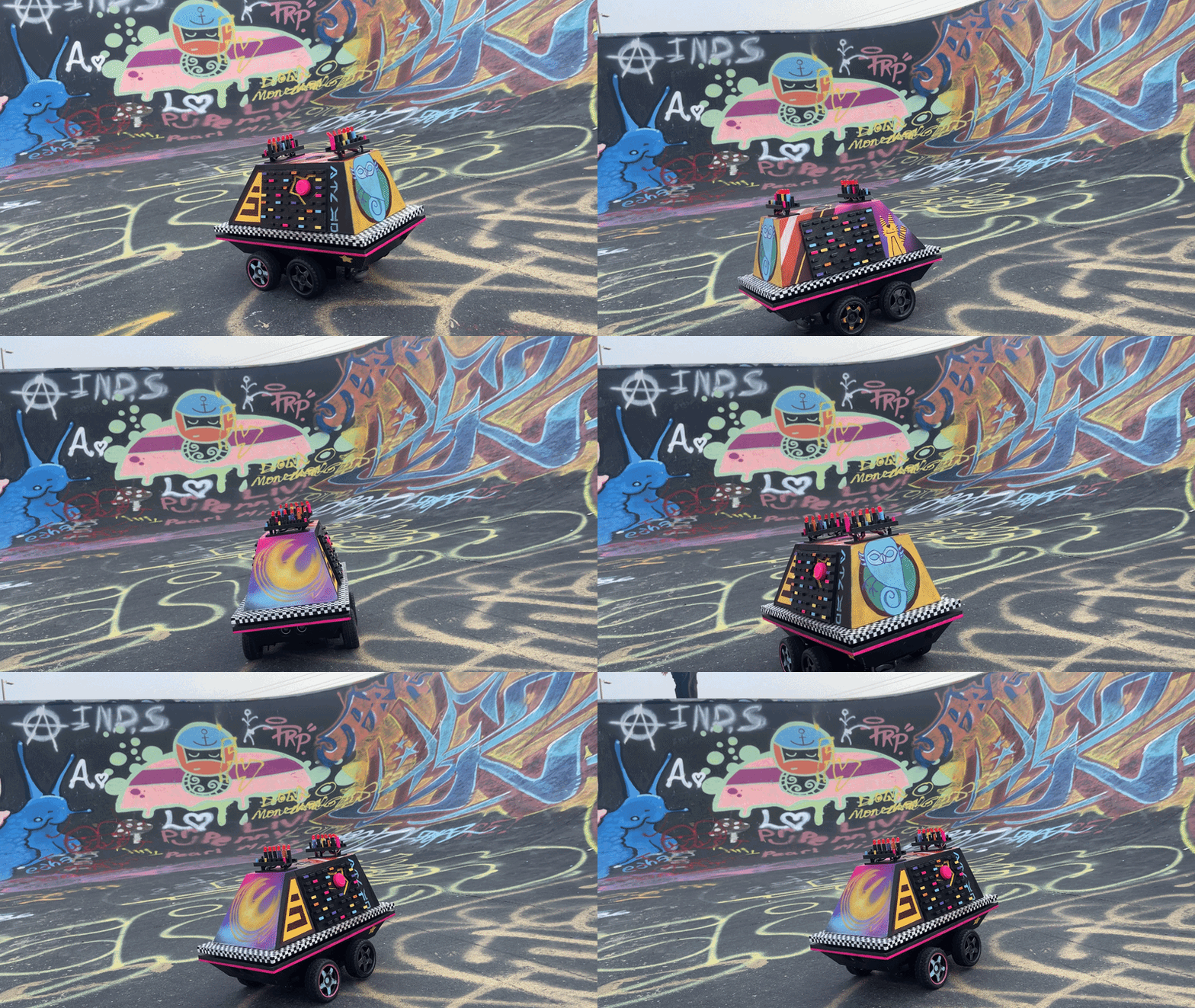
At the heart of this autonomous creation lies a sophisticated blend of accessible yet powerful components, demonstrating how hobbyist-grade electronics can achieve complex functionalities. The "brains" of the operation are powered by an Arduino UNO, a popular open-source microcontroller board widely adopted in the maker community for its versatility, ease of programming, and extensive ecosystem. The Arduino UNO serves as the central processing unit, interpreting sensor data, executing navigation algorithms, and managing the droid’s various modes, including its unique "panic mode" and "party button."
For its auditory capabilities, the droid integrates a DFPlayer Mini MP3 module. This compact and cost-effective module allows the Arduino to play pre-recorded MP3 audio files, which are crucial for the "rave machine" persona. Imagine the droid scurrying about, emitting characteristic Mouse Droid squeals, then transitioning into upbeat electronic music or playful sound effects when its "party button" is activated. This audio feedback significantly enhances the interactive experience and brings the droid’s personality to life.
Autonomous navigation, a cornerstone of the project, is facilitated by an ultrasonic distance sensor. This sensor emits ultrasonic waves and measures the time it takes for them to return after bouncing off an object, thereby calculating the distance to obstacles. The Arduino UNO processes this data, allowing the droid to detect its surroundings, avoid collisions, and navigate autonomously through an environment. This capability is fundamental to the droid’s independence from direct human control, mimicking the self-sufficient nature of its fictional counterparts. The "panic mode," a clever addition, likely triggers a rapid change in direction or a temporary halt when an obstacle is detected too close, adding a layer of reactive intelligence to its movements.
The locomotion system is built upon a custom chassis, though it initially incorporated an existing flat metal Mecanum chassis as a structural mounting point for the motors. Mecanum wheels are a specialized type of wheel that allows a vehicle to move in any direction (forward, backward, sideways, diagonally) without changing the orientation of the robot. This omnidirectional capability is achieved through rollers mounted at a 45-degree angle around the circumference of the wheel. While the Mecanum chassis provided a sturdy base during development, Cass expressed an intention to eliminate it in future iterations, designing a fully integrated, 3D-printed solution that directly mounts the motors. This evolution reflects the maker’s commitment to continuous improvement and complete control over the design. The use of heat-set inserts for attaching components to 3D prints is another testament to the attention to detail, providing robust and durable fastening points that enhance the overall structural integrity and professional finish of the build.
The Maker Ethos: Open-Source and Community Engagement
Cass’s decision to design the Mouse Droid primarily with 3D-printed components and to share the project as open-source hardware aligns perfectly with the core tenets of the global maker movement. The maker movement, a contemporary culture or subculture representing a technology-based extension of DIY (Do-It-Yourself) culture, emphasizes learning-by-doing, collaborative problem-solving, and the open sharing of knowledge and designs. Tools like 3D printers, microcontrollers such as Arduino, and readily available sensors have democratized access to prototyping and manufacturing, enabling individuals to create sophisticated projects that were once the exclusive domain of large corporations or specialized labs.
As Cass articulated, "There is also a nice practical benefit to designing everything myself: it makes the project much more replicable. Someone else with a 3D printer can take the files and build their own version without having to track down a particular RC car or adapt an existing platform to fit." This statement underscores the profound impact of open-source design. By sharing the 3D print files, schematics, and potentially the Arduino code on platforms like Instructables and Arduino Project Hub, Cass empowers countless other makers worldwide to recreate, modify, and learn from the project. This collaborative spirit accelerates innovation, fosters skill development, and builds a stronger, more knowledgeable community. The ability for others to "take the files and build their own version" transforms a singular achievement into a communal resource, embodying the true spirit of technological democratization.

Beyond the practical benefits of replicability, Cass also emphasized a deeply personal motivation: "And, honestly, there is a less-than-practical reason too: I just really enjoy building things from scratch! I enjoy pushing my skills wherever I can." This sentiment resonates with many in the maker community, where the intrinsic joy of creation, the challenge of mastering new techniques (like working with heat-set inserts), and the satisfaction of seeing an idea materialize are powerful driving forces. It highlights that the maker movement is not solely about utility or commercial viability but also about personal growth, artistic expression, and the sheer delight of bringing imagination to life.
Star Wars and the Maker Movement: A Symbiotic Relationship
The Star Wars universe has long held a special place in the hearts of makers and DIY enthusiasts. Its rich tapestry of unique vehicles, droids, weapons, and costumes provides an endless source of inspiration for prop builders, cosplayers, and model makers. From meticulously crafted R2-D2 replicas to fully functional lightsabers, the fandom has consistently pushed the boundaries of what can be created by individuals outside of professional studios. This deep engagement with the fictional world fosters a natural inclination towards hands-on creation and technical exploration.
The convergence of Star Wars fandom with the modern maker movement is a potent combination. The accessibility of tools like 3D printers has revolutionized the creation of Star Wars-inspired props and models. Complex geometries that once required advanced sculpting or casting techniques can now be designed in CAD software and printed with relative ease. Microcontrollers like Arduino allow for the integration of realistic lights, sounds, and movements, bringing these creations to life in ways previously unimaginable for the average hobbyist. Cass’s Mouse Droid project is a prime example of this synergy, demonstrating how contemporary technology can be leveraged to not only replicate elements of a beloved franchise but also to imbue them with new functionalities and narratives. It’s a creative dialogue between a fictional universe and the tangible world of engineering and art.
Broader Implications: Beyond the Rave
The "Rebel Rave Machine" Mouse Droid, while a playful and imaginative project, carries broader implications for education, creative expression, and the future of hobby robotics.
Educational Value: Projects of this nature serve as excellent educational tools. By following Cass’s open-source instructions, aspiring engineers and hobbyists can learn fundamental principles of electronics (microcontrollers, sensors, motor control), mechanical design (3D printing, chassis construction), and programming (Arduino IDE). The project provides a tangible, engaging context for learning abstract concepts, making it particularly effective for STEM education initiatives. The blend of creative art and rigorous engineering can also attract a wider demographic to technical fields.

Creative Expression: This droid is more than just a robot; it’s a piece of kinetic art. It exemplifies how technology can be a powerful medium for personal and artistic expression, allowing individuals to translate complex imaginative concepts into physical reality. The fusion of Sabine Wren’s artistic style with the utilitarian Mouse Droid challenges conventional perceptions of robotics, demonstrating that machines can be canvases for storytelling and cultural commentary.
Future of Hobby Robotics: The project highlights the increasing sophistication and accessibility of hobby robotics. As components become cheaper and more powerful, and as open-source communities continue to grow, the complexity of projects undertaken by individual makers will only increase. This democratized access to technology fosters a culture of innovation, where groundbreaking ideas can emerge from garages and workshops, not just corporate labs. The emphasis on custom 3D printing also points towards a future of highly customized and modular robotics, where designs can be easily adapted and improved.
Cultural Impact: By taking an established pop culture icon and reinterpreting it through a contemporary technological lens, Cass’s project contributes to the ongoing cultural conversation about technology’s role in society. It shows how fictional narratives can inspire real-world innovation and how individual creativity can playfully challenge established norms, even within a fictional universe. The "rebel rave machine" becomes a metaphor for breaking free from conventions and embracing new forms of expression.
In conclusion, the autonomous "Rebel Rave Machine" Mouse Droid by Cass (Chaos Theory) is a remarkable fusion of Star Wars fandom, artistic vision, and cutting-edge maker technology. It exemplifies the power of the open-source movement, the versatility of 3D printing and microcontrollers, and the boundless creativity inherent in the global maker community. More than just a robot, it is a statement—a fully functional piece of interactive art that scuttles autonomously, ready to party, and unequivocally declares its rebellious spirit, inspiring countless others to explore the intersection of imagination and engineering. The project’s availability on platforms like Instructables ensures that its legacy will continue to empower and educate, proving that with enough ingenuity and passion, even a humble Mouse Droid can become a beacon of rebellion and innovation.