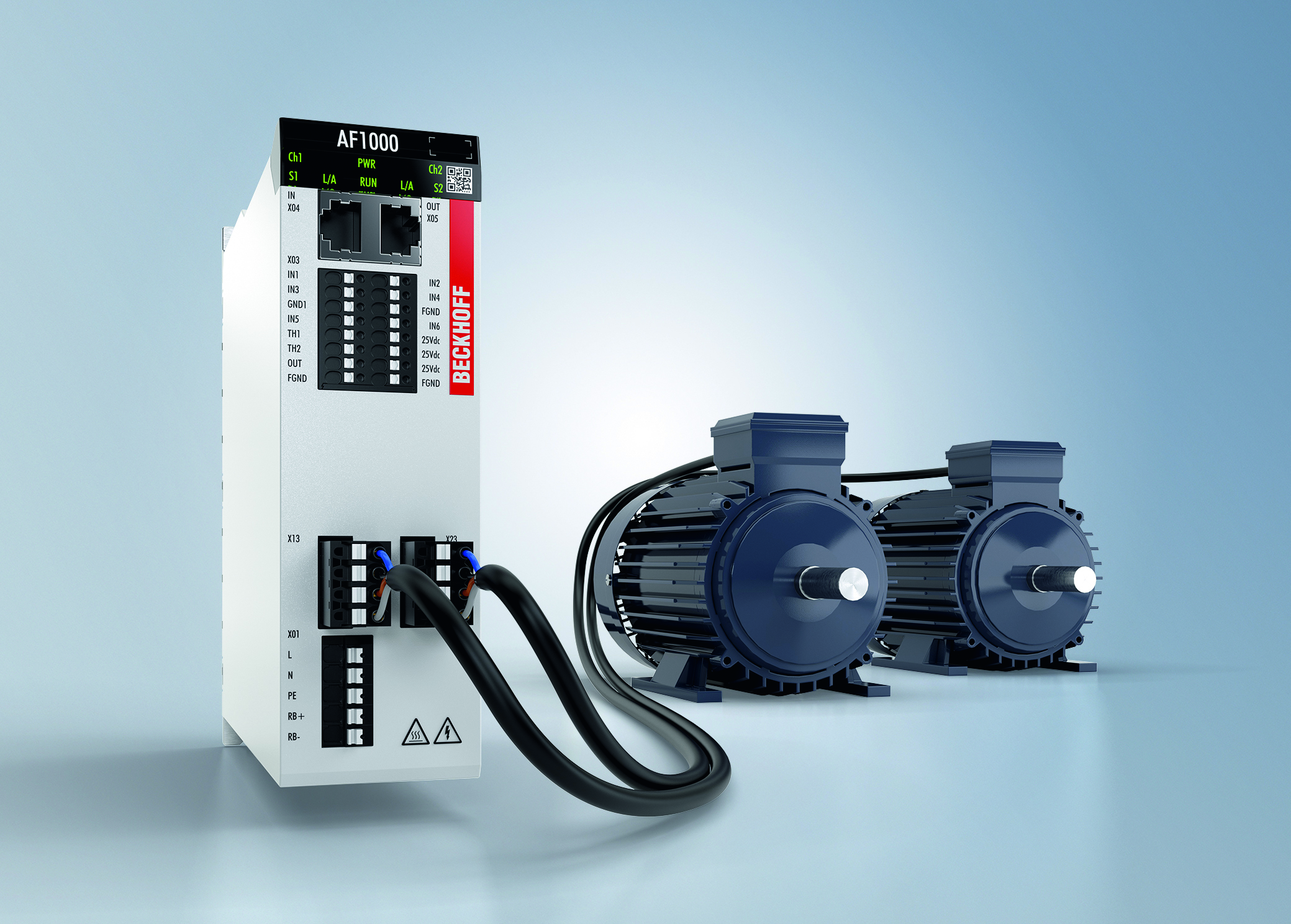
Beckhoff Automation, a leading innovator in PC-based control technology, has announced the global introduction of its new AF1000 variable frequency drive (VFD), specifically engineered to address the growing demand for efficient and integrated solutions in basic drive applications. This significant product launch expands Beckhoff’s comprehensive portfolio, offering a cost-effective and streamlined option for essential industrial functions such such as conveyor systems, various types of pumps, and industrial fans. The AF1000 is distinguished by its seamless integration with the acclaimed TwinCAT automation system through the high-performance EtherCAT communication standard, ensuring a cohesive and unified engineering environment. A key advantage for existing Beckhoff users and new adopters alike is the inclusion of advanced commissioning and diagnostic functions, features previously synonymous with Beckhoff’s premium servo drive products, now made accessible for more fundamental applications.
Understanding the Role of Variable Frequency Drives in Modern Industry
Variable Frequency Drives, often referred to as VFDs, adjustable frequency drives (AFDs), or inverters, are critical components in industrial automation. Their primary function is to control the speed and torque of AC electric motors by varying the frequency and voltage of the power supplied to the motor. This capability offers substantial benefits over traditional fixed-speed motor operation, which often relies on mechanical means like gears, pulleys, or dampers to regulate output, leading to inefficiency and increased wear.
In applications like conveyor systems, VFDs enable precise control over material flow, allowing for adjustments based on production demands, reducing bottlenecks, and preventing damage to delicate items through soft starts and stops. For pumps, VFDs are instrumental in optimizing fluid flow and pressure, preventing cavitation, and significantly reducing energy consumption, especially in applications where flow requirements fluctuate. Similarly, in fan systems, VFDs allow for demand-driven airflow, crucial for climate control, ventilation, and exhaust systems in factories, commercial buildings, and processing plants, leading to considerable energy savings and quieter operation. The introduction of the AF1000 specifically targets these widespread "basic motion tasks," acknowledging their ubiquity across diverse industrial sectors and the inherent value in optimizing their performance and efficiency.
The market for VFDs is robust and continues to grow, driven by global initiatives toward energy efficiency, industrial automation, and the integration of smart manufacturing principles. According to various market research reports, the global VFD market is projected to expand significantly over the next decade, with a compound annual growth rate (CAGR) often cited between 5% and 7%. This growth is fueled by the imperative for industries to reduce operational costs, comply with stricter environmental regulations, and enhance productivity through advanced control systems. Beckhoff’s entry into this specific segment with the AF1000 positions them to capture a portion of this expanding market, offering a solution that combines their established automation expertise with the practical requirements of basic industrial applications.
Technical Specifications and Configuration Flexibility
The AF1000 variable frequency drive is engineered with versatility and practicality in mind, catering to a range of power requirements and industrial environments. Beckhoff offers the drive in two primary versions, designed to accommodate different electrical supply standards and power demands.
One version is specifically tailored for a single-phase 240 V AC supply, making it suitable for smaller industrial setups, workshops, or applications where three-phase power may not be readily available or necessary. This variant covers a power range from 0.37 kW (approximately 0.5 horsepower) up to 1.5 kW (approximately 2 horsepower). This range is ideal for smaller pumps, compact conveyor belts, or auxiliary fan systems.
The second, more robust version, is designed for a three-phase supply up to 480 V AC, addressing the needs of larger industrial operations and machinery. This variant extends the power range from 0.37 kW up to a substantial 5.5 kW (approximately 7.5 horsepower). This capability makes it suitable for more demanding applications, including larger material handling systems, industrial-grade pumps, and powerful ventilation units. The availability of both single-phase and three-phase options underscores Beckhoff’s commitment to providing flexible solutions that can be integrated into a wide array of existing electrical infrastructures.
A notable design feature common to both versions of the AF1000 is the inclusion of several integrated components that typically require separate installations in other VFDs. These include an integrated control power supply, which eliminates the need for an external power source for the drive’s internal electronics. The unit also incorporates DC link capacitors, crucial for smoothing the rectified DC voltage and providing energy storage for dynamic operations, and a ballast circuit, which manages excess regenerative energy from the motor, protecting the drive and enhancing operational stability. Crucially, the control voltage required for the drive’s internal operations is generated directly by the integrated power supply from the DC link, further streamlining the wiring and reducing the overall footprint and complexity of the installation. This integrated design approach not only simplifies the installation process but also contributes to a more compact and reliable unit, reducing potential points of failure and simplifying maintenance.
Further enhancing its adaptability, the AF1000 is offered as either a single-axis module or a two-axis module. The single-axis module is the standard configuration for controlling one motor, while the two-axis module allows for the control of two independent motors from a single compact unit. This two-axis option is particularly beneficial in applications where space is at a premium or where synchronized control of two separate elements is required, such as dual-belt conveyors or coordinated pump systems, offering significant savings in panel space and wiring complexity.
The drive supports a variety of motor types, making it highly versatile for diverse industrial applications. These include synchronous servomotors, asynchronous motors (also known as induction motors), and reluctance motors. Importantly, the AF1000 can operate these motors without the need for external feedback devices (like encoders) in certain modes, simplifying system design and reducing costs. It supports operation in UF mode (Volts per Hertz), a common and robust control method suitable for basic speed control applications where precise position or torque control is not the primary requirement. Additionally, it offers vector control capabilities, which, even without feedback, can provide improved dynamic performance and torque control compared to simple UF mode, enhancing efficiency and responsiveness for a wider range of applications. This broad motor compatibility ensures that the AF1000 can be integrated into existing systems or utilized with newly specified motors, providing maximum flexibility for system integrators and machine builders.
Seamless Integration within the TwinCAT Ecosystem
One of the most compelling advantages of the AF1000 is its deep and inherent integration within Beckhoff’s renowned TwinCAT automation system. TwinCAT, which stands for "Twin Control Automation Technology," is a software suite that transforms a compatible PC into a real-time control system, capable of handling PLC, motion control, robotics, and HMI functions. This PC-based control philosophy has been a cornerstone of Beckhoff’s success, offering unparalleled flexibility, scalability, and computational power.
The integration of the AF1000 into this ecosystem is primarily facilitated through EtherCAT, Beckhoff’s high-performance, open real-time Ethernet fieldbus system. EtherCAT is celebrated for its exceptional speed, deterministic communication, and efficient data processing, making it ideal for motion control applications where precise timing and synchronization are paramount. By leveraging EtherCAT, the AF1000 can communicate with other Beckhoff components, such as I/O terminals, servo drives, and the central TwinCAT controller, in a highly synchronized and efficient manner. This creates a truly unified control architecture, simplifying system design, reducing wiring, and minimizing potential communication bottlenecks.
The implications of this integration are profound for users. Engineers and system integrators can manage the entire automation project, from PLC logic to motion control and HMI visualization, within a single software environment. This eliminates the need for disparate tools and programming languages for different hardware components, significantly reducing development time, complexity, and potential errors. The "one software for all tasks" philosophy inherent in TwinCAT translates directly to the AF1000, ensuring a streamlined workflow from concept to commissioning.
Furthermore, the AF1000 benefits from the sophisticated commissioning and diagnostic functions that are a hallmark of Beckhoff’s more advanced servo drive products. Specifically, the drive is commissioned using TwinCAT Drive Manager 2, the identical engineering tool employed for Beckhoff’s high-performance AX5000 and AX8000 series servo drives. This consistency is a major boon for existing Beckhoff users, as it means they can leverage their existing knowledge and familiarity with the software environment. There is no steep learning curve for a new, simplified interface; instead, the same intuitive tools and processes apply, accelerating deployment and minimizing training requirements.
These advanced diagnostic functions provide users with detailed insights into the drive’s operational status, motor performance, and potential issues. Features commonly found in such systems include real-time monitoring of parameters like current, voltage, speed, and temperature; error logging with detailed fault codes; and the ability to perform precise parameterization and tuning. By bringing these sophisticated capabilities to a drive designed for basic applications, Beckhoff empowers users to achieve higher levels of operational reliability and to perform efficient troubleshooting, thereby reducing downtime and maintenance costs. This transfer of advanced features to a more accessible product tier democratizes high-performance control and diagnostic capabilities, aligning with the broader industry trend of making automation more intelligent and user-friendly across all application levels.
Broader Market Implications and Strategic Positioning
The introduction of the AF1000 represents a strategic move by Beckhoff to strengthen its position across the entire spectrum of industrial automation, from high-end, complex motion control to more fundamental, cost-sensitive applications. For years, Beckhoff has been synonymous with cutting-edge PC-based control and advanced servo technology, often catering to industries requiring extreme precision, high dynamics, and complex multi-axis synchronization. While their existing product lines excel in these areas, there has been a noticeable gap for simpler, yet still integrated and efficient, variable frequency drives for common industrial tasks. The AF1000 effectively fills this void.
From an economic perspective, the AF1000 is poised to deliver significant benefits to businesses. By enabling precise speed control for motors, it inherently facilitates substantial energy savings, particularly in pump and fan applications where flow rates or air volumes can be adjusted to match demand rather than running at full capacity continuously. Industry studies consistently show that VFDs can lead to energy savings of 20-50% in these types of variable torque applications. Over the lifespan of machinery, these energy efficiencies translate directly into reduced operational costs, improving overall profitability and contributing to more sustainable industrial practices. Furthermore, the ability to implement soft starts and stops via the VFD reduces mechanical stress on motors and connected equipment, extending their lifespan and lowering maintenance expenditures.
In the competitive landscape of industrial drives, many manufacturers offer basic VFDs. However, Beckhoff’s differentiator lies in the AF1000’s deep integration into the TwinCAT and EtherCAT ecosystem. While standalone VFDs from other manufacturers might be price-competitive, they often require separate programming tools, different communication protocols, and a more fragmented control architecture. The AF1000, by contrast, offers a unified, holistic approach. For companies already utilizing Beckhoff’s PC-based control or considering a transition to a more integrated automation platform, the AF1000 provides a compelling "single vendor" solution that simplifies procurement, engineering, and support. This integrated advantage can lead to faster machine development, quicker time-to-market, and reduced total cost of ownership (TCO) for machine builders and end-users alike.
Industry analysts are likely to view the AF1000 as a logical and well-timed expansion of Beckhoff’s product line. It addresses a perennial need for efficient, reliable, and easy-to-integrate drives in a vast number of industrial processes. The trend towards modularity, connectivity, and data-driven decision-making in Industry 4.0 places a premium on components that can seamlessly communicate and integrate within a broader automation framework. The AF1000, with its EtherCAT connectivity, is inherently designed to meet these demands, enabling basic machines to become part of a larger, smarter manufacturing ecosystem.
While specific statements from Beckhoff officials were not provided with the initial announcement, it is reasonable to infer that a Beckhoff spokesperson or product manager would emphasize the AF1000’s role in democratizing advanced control features for basic applications. They would likely highlight its ease of integration, the cost-effectiveness derived from energy savings and reduced maintenance, and the streamlined engineering experience offered by the TwinCAT environment. The message would center on empowering a wider range of industries and applications to benefit from Beckhoff’s proven automation technology.
The AF1000’s introduction underscores Beckhoff’s commitment to providing comprehensive and scalable automation solutions. By extending its product range to include a VFD optimized for basic motion tasks, Beckhoff not only caters to a broader market segment but also reinforces its vision of a unified, PC-based control architecture where all components, from simple drives to complex robotics, are seamlessly interconnected and centrally managed. This move is expected to enhance Beckhoff’s overall market share and solidify its reputation as a provider of intelligent, efficient, and future-proof automation technology.
The Future of Basic Motion Control
The launch of the Beckhoff AF1000 is more than just the release of a new product; it signals an evolving trend in industrial automation where the distinction between "basic" and "advanced" control is becoming increasingly blurred through integration. Even fundamental tasks like operating a conveyor belt or a pump can now leverage the benefits of high-performance communication and sophisticated diagnostic capabilities previously reserved for more complex machinery.
The chronological development of Beckhoff’s product strategy has consistently moved towards an integrated, PC-based, and EtherCAT-driven ecosystem. From the early adoption of PC-based PLCs to the development of advanced servo drives and robotics, the consistent theme has been unification and simplification of the automation stack. The AF1000 fits perfectly into this timeline, extending the benefits of this integrated approach to the foundational elements of industrial operations. It reflects a maturing market where customers expect not just functional components, but intelligent, interconnected ones that contribute to overall system efficiency and data visibility.
As industries worldwide continue to grapple with rising energy costs, labor shortages, and the demand for higher productivity, solutions like the AF1000 will become increasingly vital. They offer a pathway for businesses of all sizes to modernize their operations, achieve greater energy efficiency, and lay the groundwork for more advanced automation and data analytics initiatives without incurring prohibitive costs or complexity. The AF1000 is set to become a cornerstone product for Beckhoff, enabling a new wave of efficient and intelligently controlled basic motion applications across the globe.