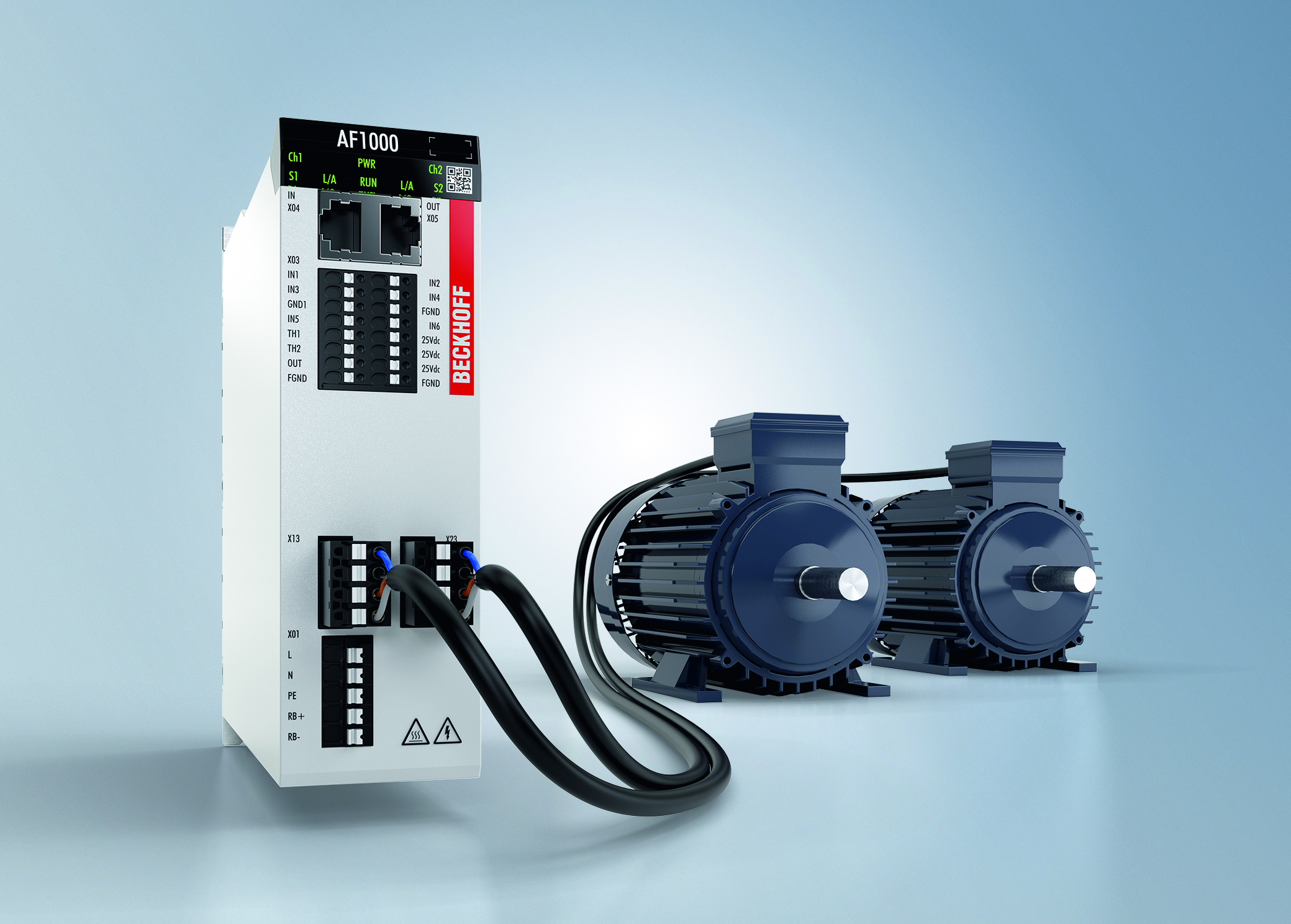
Beckhoff Automation, a global leader in PC-based control technology, has announced the release of its new AF1000 variable frequency drive (VFD), specifically engineered to address the demands of basic drive applications across a wide spectrum of industrial processes. This strategic introduction expands Beckhoff’s motion control portfolio, offering a cost-effective yet highly integrated solution for common tasks such as operating conveyor systems, pumps, and fans, while leveraging the established advantages of the TwinCAT automation system and EtherCAT communication protocol. The AF1000 is poised to bring advanced control capabilities and simplified commissioning to segments traditionally served by standalone or less integrated drive solutions, marking a significant step in democratizing high-performance automation.
The AF1000 represents a deliberate move by Beckhoff to extend its philosophy of unified, PC-based control into a broader range of industrial applications, particularly those requiring reliable yet straightforward motor speed and torque control. Variable Frequency Drives, also known as inverters, are critical components in modern industrial machinery, enabling precise control over alternating current (AC) motor speed and rotation. This control not only optimizes process efficiency but also significantly contributes to energy savings by allowing motors to operate at speeds dictated by the actual load, rather than constantly running at full capacity. Furthermore, VFDs facilitate soft starting and stopping of motors, reducing mechanical stress on equipment and extending its operational lifespan, while also mitigating electrical disturbances on the power grid.
Technical Specifications and Versatility
The AF1000 drive is introduced in two distinct versions, catering to different power supply configurations and application requirements. The first variant is designed for single-phase 240 V AC supply systems, offering a power range from 0.37 kW (approximately 0.5 horsepower) up to 1.5 kW (approximately 2 horsepower). This version is ideal for smaller machines, standalone units, and applications where three-phase power is not readily available or cost-effective. The second, more robust version, targets three-phase supply systems up to 480 V AC, providing a broader power range from 0.37 kW up to 5.5 kW (approximately 7.5 horsepower). This three-phase option is suitable for more demanding industrial environments and larger motor applications.
A notable design feature across both versions of the AF1000 is the inclusion of an integrated control power supply, DC link capacitors, and a ballast circuit. The integrated control power supply simplifies wiring and reduces the need for external components, streamlining installation and minimizing cabinet space. The DC link capacitors are crucial for smoothing the rectified DC voltage before it is converted back into a variable frequency AC signal for the motor, ensuring stable operation. The ballast circuit provides a mechanism to dissipate excess energy generated during motor deceleration, particularly with high-inertia loads, preventing overvoltage conditions and protecting the drive. Uniquely, the control voltage for the AF1000 is generated directly from the integrated power supply from the DC link, further enhancing its self-sufficiency and reducing complexity.
In terms of modularity, both single-phase and three-phase versions are available as either a single-axis module or a two-axis module. The two-axis module offers significant advantages for applications requiring synchronized control of two motors or for space-constrained designs, effectively halving the physical footprint compared to two separate single-axis drives. The AF1000 supports a diverse range of motor types, demonstrating its adaptability. It can operate synchronous servomotors, asynchronous motors (the most common industrial motor type), and reluctance motors. Crucially, it supports these motors without the need for external feedback devices, which simplifies wiring and reduces overall system cost for basic applications. Control modes include UF (Volts per Hertz) mode, which is a fundamental and widely used control method for asynchronous motors, and vector control, which offers more precise speed and torque regulation, even without encoder feedback, by estimating rotor flux.
Seamless Integration with TwinCAT and EtherCAT
A cornerstone of Beckhoff’s product strategy is the seamless integration of its hardware with its powerful software platform, TwinCAT. The AF1000 VFD is no exception, designed from the ground up for deep integration with the TwinCAT automation system through the EtherCAT real-time Ethernet fieldbus. TwinCAT transforms any compatible PC into a comprehensive control system, capable of handling PLC, motion control, robotics, safety, and HMI functions within a single software environment. This PC-based control paradigm offers unparalleled flexibility, scalability, and computational power, distinguishing Beckhoff from traditional PLC-centric approaches.
EtherCAT, Beckhoff’s high-performance communication protocol, plays a pivotal role in the AF1000’s integration. As a real-time Ethernet system, EtherCAT offers deterministic communication with incredibly short cycle times and high data throughput, making it ideal for motion control applications. Its unique "processing on the fly" principle allows telegrams to be processed as they pass through each device, virtually eliminating communication delays. This ensures that the AF1000 receives control commands and transmits diagnostic data with minimal latency, critical for precise motor control and rapid fault detection. The open nature of EtherCAT also promotes interoperability within an industrial network.
The integration via EtherCAT means that commissioning and diagnostic functions for the AF1000 are directly accessible within the TwinCAT environment. This is a significant advantage for users, as it allows them to leverage the same sophisticated tools and workflows that they utilize for Beckhoff’s high-performance servo drive products. Specifically, the AF1000 is commissioned using TwinCAT Drive Manager 2, the identical engineering tool employed for Beckhoff servo drives. This common engineering environment drastically reduces the learning curve for existing Beckhoff users, streamlines development processes, and minimizes potential errors associated with disparate software tools. Engineers can configure, parameterize, and diagnose the AF1000 alongside other Beckhoff components, creating a truly unified automation solution. The ability to manage both basic VFDs and advanced servo drives from a single platform underscores Beckhoff’s commitment to a holistic, integrated control architecture.
Target Applications and Market Needs
The AF1000 is meticulously designed for "basic drive applications," a term encompassing a vast array of industrial tasks where precise speed and torque control are beneficial but the complexity and cost of a full servo system are unwarranted. Key target applications include:
- Conveyor Systems: From simple belt conveyors in logistics and material handling to intricate assembly lines, the AF1000 can provide smooth acceleration and deceleration, preventing product damage and reducing wear on mechanical components. Its ability to integrate with the overall control system allows for dynamic speed adjustments based on production demands.
- Pumps: In water treatment, HVAC, chemical processing, and other fluid handling applications, VFDs are crucial for optimizing pump performance and conserving energy. The AF1000 can regulate pump speed to match flow requirements, avoiding inefficient throttling and reducing power consumption, especially in variable-load scenarios.
- Fans: Industrial fans in ventilation systems, dust collection, and cooling towers benefit immensely from variable speed control. The AF1000 enables precise airflow regulation, leading to significant energy savings, reduced noise levels, and improved environmental control, particularly in HVAC systems where demand fluctuates.
Beyond these primary examples, the AF1000 is also well-suited for applications such as agitators, mixers, centrifuges, and basic machine tool axes where open-loop speed control or simple positioning is sufficient. The focus on cost-effectiveness, ease of integration, and simplified commissioning directly addresses the pain points often encountered in these segments, where traditional solutions can be overly complex or lack the benefits of modern automation connectivity.
Beckhoff’s Strategic Vision and Background
Beckhoff Automation, headquartered in Verl, Germany, has built its reputation over four decades on the pioneering concept of PC-based control. Founded in 1980, the company has consistently pushed the boundaries of industrial automation, advocating for the use of standard industrial PCs as the central control platform for machines and processes. This philosophy allows for the consolidation of various control functions (PLC, motion, robotics, HMI, IoT communication) onto a single, high-performance platform, offering unparalleled flexibility, scalability, and cost efficiency compared to dedicated hardware solutions.
Historically, Beckhoff has been renowned for its high-performance motion control solutions, particularly its servo drives and motors, which are used in demanding applications requiring extreme precision, speed, and synchronization. The introduction of the AF1000 marks a strategic expansion, demonstrating Beckhoff’s intent to capture a larger share of the broader industrial drive market, including segments that may not require the ultimate performance of a full servo system but still benefit from integrated control and efficient operation. This move aligns with a broader industry trend towards providing scalable solutions that cater to a wider range of application complexities and budget constraints.
"This launch represents a pivotal moment for Beckhoff as we broaden the accessibility of our integrated automation platform," stated a hypothetical spokesperson for Beckhoff Automation. "With the AF1000, we are bringing the robust capabilities of our TwinCAT ecosystem and the real-time performance of EtherCAT to basic motion tasks, enabling our customers to achieve greater efficiency and control without compromise. Our goal is to empower a wider range of industries to harness the power of PC-based control, from the simplest conveyor to the most complex robotics system, all within a unified engineering environment."
The Broader VFD Market Landscape
The global market for Variable Frequency Drives is substantial and continues to grow at a healthy pace. According to various market research reports, the VFD market was valued at over $20 billion in 2022 and is projected to reach well over $30 billion by 2030, with a compound annual growth rate (CAGR) of around 5-7%. This growth is primarily driven by increasing awareness and stringent regulations concerning energy efficiency, the escalating adoption of industrial automation across manufacturing sectors, and the growing demand for optimized motor control in process industries.
Key drivers include:
- Energy Efficiency Mandates: Governments and regulatory bodies worldwide are imposing stricter energy efficiency standards for industrial motors and equipment. VFDs offer a direct path to compliance by allowing motors to consume only the power necessary for the current load, leading to significant energy savings—often 20-50% in variable torque applications.
- Industrial Automation and Industry 4.0: The ongoing Fourth Industrial Revolution (Industry 4.0) emphasizes interconnectedness, data exchange, and smart manufacturing. VFDs, especially those with integrated communication capabilities like EtherCAT, are foundational components for achieving these goals, enabling real-time monitoring, predictive maintenance, and adaptive control.
- Cost Savings and ROI: Beyond energy savings, VFDs contribute to reduced operational costs by minimizing mechanical wear and tear on machinery, decreasing maintenance requirements, and extending equipment lifespan. This translates into a compelling return on investment (ROI) for adopting VFD technology.
- Technological Advancements: Continuous innovation in power electronics, control algorithms, and communication protocols (like EtherCAT) is leading to more compact, efficient, and intelligent VFDs, further accelerating their adoption.
Within this competitive landscape, established players like Siemens, ABB, Rockwell Automation, Danfoss, and Schneider Electric have long dominated the VFD market. Beckhoff’s entry into the basic VFD segment with the AF1000 positions it as a challenger, leveraging its unique strength in integrated, PC-based control. While many VFDs offer network connectivity, Beckhoff’s offering stands out due to its inherent, deep integration with TwinCAT and EtherCAT, providing a level of coherence and ease of use that can be a significant differentiator for customers already invested in the Beckhoff ecosystem or those seeking a truly unified automation platform.
Implications for Industrial Automation
The introduction of the Beckhoff AF1000 drive has several important implications for the industrial automation landscape. Firstly, it democratizes access to advanced control capabilities. By offering a cost-effective VFD that integrates seamlessly into a high-performance PC-based control system, Beckhoff is making sophisticated motor control more accessible to small and medium-sized enterprises (SMEs) and for applications where budget constraints might have previously dictated less efficient or less integrated solutions. This could accelerate the adoption of VFDs in segments that have been slower to modernize.
Secondly, it reinforces the trend towards holistic automation solutions. The ability to manage basic VFDs alongside advanced servo drives, PLCs, HMIs, and IoT gateways within a single software environment (TwinCAT) simplifies system design, reduces engineering effort, and enhances overall system transparency. This "one-stop-shop" approach for control and motion components streamlines troubleshooting, updates, and maintenance, reducing total cost of ownership over the lifecycle of a machine or plant.
Thirdly, the AF1000 enhances Beckhoff’s competitive posture. While Beckhoff has been a formidable force in high-end motion control, the AF1000 allows the company to effectively compete in the higher-volume, basic drive market. This expansion provides existing customers with a broader range of Beckhoff solutions, simplifying procurement and support, and attracts new customers who are looking for integrated yet economical drive technology. The move also signals Beckhoff’s commitment to providing a complete spectrum of automation components, from I/O terminals and industrial PCs to motors and drives, all designed to work harmoniously within its unified architecture.
In conclusion, the Beckhoff AF1000 variable frequency drive is more than just a new product; it is a strategic extension of Beckhoff’s core philosophy into a wider segment of the industrial market. By combining robust technical specifications with deep integration into the TwinCAT and EtherCAT ecosystem, the AF1000 offers a compelling solution for basic drive applications, promising enhanced energy efficiency, simplified commissioning, and a streamlined approach to industrial automation. This development is poised to empower a broader range of industries to embrace advanced control technologies, contributing to more efficient, flexible, and sustainable manufacturing processes worldwide.