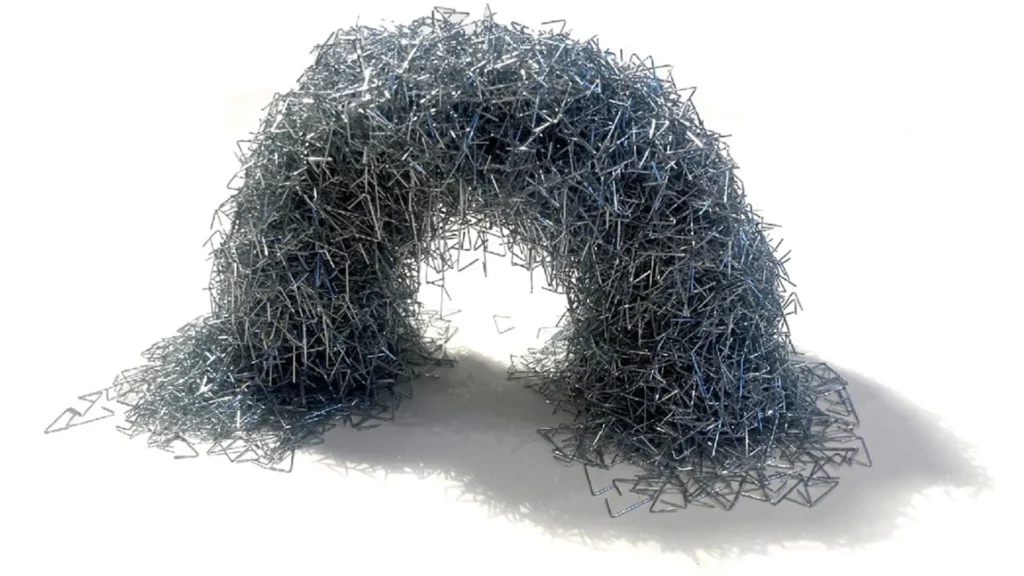
A tightly compressed bundle of office staples can behave in a surprising way, defying its constituent parts to act almost like a single, cohesive solid object, remarkably difficult to pull apart despite being an aggregation of many separate pieces. Yet, this very same bundle possesses an equally remarkable quality: it can quickly come undone. With the application of the right vibration or movement, the staples readily separate, reverting to a loose collection of individual pieces. This intriguing duality—an unusual combination of robust strength and effortless reversibility—has captivated researchers at the Paul M. Rady Department of Mechanical Engineering at CU Boulder, who believe it could inspire a new generation of engineered materials with profound implications for various industries. By designing particles that interlock in a manner akin to staples, the team envisions creating materials that are not only exceptionally strong but also highly adaptable and, crucially, inherently recyclable.
"We’ve been playing around with the idea of building blocks and geometry for many years, but we started looking at interlocking, entangled particles only recently," stated Professor Francois Barthelat, the visionary leader of the Laboratory for Advanced Materials & Bioinspiration. His enthusiasm for the breakthrough is palpable. "We are excited about the combination of properties we can get out of these systems and we believe this technology has the potential to go in many directions." The groundbreaking findings, which delve into the mechanics of entanglement and the surprising efficacy of staple-shaped particles, were recently published in the esteemed Journal of Applied Physics, marking a significant milestone in the pursuit of advanced materials.
The Foundational Principles of Entanglement in Materials Science
At the heart of this research lies the fundamental phenomenon of entanglement, a concept that describes how discrete particles become intertwined, forming complex connections that lend collective strength and integrity to an aggregate system. While seemingly a novel area for engineered materials, entanglement is ubiquitous in the natural world, serving as a cornerstone of structural integrity across countless biological forms. Consider, for instance, the intricate architecture of a bird’s nest, where a seemingly random assortment of twigs and fibers is meticulously interwoven to create a remarkably robust and stable dwelling, capable of withstanding environmental stresses. Similarly, the remarkable strength of bones is not solely due to their hard mineral components; it is significantly enhanced by the intricate interaction and entanglement with softer protein matrices, creating a composite material with superior mechanical properties.
The CU Boulder team embarked on their investigation with a clear objective: to discern how these natural principles of entanglement could be harnessed and translated into the realm of manufactured materials. Their meticulous work quickly converged on one critical, often overlooked, factor: the precise shape of the particles themselves. "Let’s take sand as an example. Sand is smooth and convex-shaped, meaning it cannot interlock from grain to grain," explained PhD student Youhan Sohn, elucidating the core challenge. "However, we found that if we change the shape of a grain of sand, we can drastically affect its behavior and mechanical properties, including the particle’s ability to link with other particles." This insight underscored the immense potential residing in particle geometry—a factor that could transform inert granular materials into dynamic, reconfigurable systems.
To systematically investigate this hypothesis, the researchers employed Monte Carlo simulations, a powerful computational technique widely used in physics and engineering. These simulations allowed them to model and analyze the interactions of myriad particle shapes under various conditions. By running thousands of probabilistic simulations, the team could efficiently explore a vast design space, identifying geometries that would optimally maximize entanglement without the need for extensive physical prototyping in the initial stages. This computational approach was instrumental in narrowing down the most promising candidates for real-world experimentation, accelerating the discovery process.
The Unrivaled Performance of Staple-Shaped Particles
Following the identification of several promising designs through their rigorous simulations, the team transitioned to the experimental phase, conducting a series of "pickup tests" to observe the real-world behavior of these novel particles. These tests were designed to quantitatively assess the degree of entanglement and the resulting macroscopic strength. The results were compelling and unequivocally pointed to a specific particle geometry: a "two-legged" design, strikingly resembling an everyday office staple, produced the highest degree of entanglement. This particular shape, it turned out, offered a suite of unexpected and highly beneficial mechanical properties.
One of the most notable advantages of the staple-like particle was its ability to combine tensile strength and toughness—two properties that are notoriously difficult to achieve simultaneously in conventional materials. Tensile strength refers to a material’s resistance to breaking when pulled apart, while toughness describes its ability to absorb energy and deform plastically without fracturing. Traditional materials often excel in one but fall short in the other; for instance, ceramics are strong but brittle, while many polymers are tough but lack ultimate strength. "Our entangled granular material using the staple-like particle demonstrates both high strength and toughness at the same time," affirmed PhD student Saeed Pezeshki, highlighting the significance of this dual achievement. This breakthrough suggests a pathway to creating materials that are not only robust under stress but also resilient against impact and deformation, expanding their potential applications dramatically.
Beyond this impressive mechanical synergy, the staple-like particles displayed another extraordinary characteristic: their capacity for rapid, reversible assembly and disassembly. They could quickly coalesce into a robust, load-bearing structure and then, just as swiftly, separate again. This dynamic behavior was found to be precisely controllable through the application of varying vibration patterns. Gentle, controlled vibrations encouraged the particles to interlock, strengthening the material by increasing the density and connectivity of the entangled network. Conversely, stronger, more disruptive vibrations caused the network to unravel, returning the material to its loose, granular state. This exquisite control over the material’s phase transition—from a "solid-like" entangled state to a "liquid-like" disentangled state—is what makes this research particularly revolutionary.
Professor Barthelat mused on the unusual nature of this new material: "It’s a strange material because it’s obviously not a liquid. However, it’s also not quite solid. This opens new and intriguing engineering possibilities." He added, "Handling a bundle of these entangled particles feels very remote and exotic," underscoring the novelty of the tactile experience and the conceptual leap involved in working with such a reconfigurable medium. This ability to dynamically alter mechanical properties on demand positions these entangled granular materials as a new class of "smart materials," capable of responding to external stimuli in a programmable manner.
Broader Impact and Transformative Applications
The implications of this research extend far beyond the laboratory, potentially revolutionizing multiple sectors, most notably construction and robotics. The researchers envision a future where this technology underpins more sustainable approaches to building and infrastructure. Imagine bridges, buildings, or other large structures constructed using these entangled materials. At the end of their service life, instead of costly and environmentally destructive demolition, these structures could simply be "deconstructed" by applying specific vibrations, causing the materials to separate into their individual components. These components could then be readily reused or fully recycled, fostering a true circular economy in construction and significantly reducing waste and environmental impact. This contrasts sharply with current practices, where concrete and steel structures often generate massive amounts of non-reusable waste, consuming vast energy resources in both their production and disposal. The ability to reclaim and re-purpose materials at this scale could lead to unprecedented efficiencies and environmental stewardship.
The concept also holds immense promise for advancements in robotics, particularly in the burgeoning field of swarm robotics and reconfigurable systems. PhD student Saeed Pezeshki elaborated on this exciting prospect: "I was talking with other students who believe this technology can be used in swarm robotics—where small robots can entangle, do a task and then disentangle when they are done." This vision aligns perfectly with the goal of creating modular, adaptable robotic systems that can dynamically change their form and function to suit diverse operational requirements.
Professor Barthelat, ever the visionary, drew a vivid parallel: "Yes, kind of like that liquid metal T-1000 in Terminator 2 who can change shape to slide under a door and then transform back to a human’s size on the other side." While acknowledging the vast chasm between current technology and science fiction, he conceded, "It’s expensive and scaling up is a challenge, but it’s something that’s on everybody’s mind." This analogy, while futuristic, perfectly captures the transformative potential: robots that can transition between rigid and fluid states, enabling unprecedented dexterity, maneuverability, and resilience. Such capabilities could revolutionize exploration in hazardous environments, search and rescue operations, and even micro-manufacturing. Beyond robotics, other potential applications include impact-absorbing materials that stiffen upon collision, smart textiles that can change their rigidity, or temporary medical implants designed for controlled degradation or removal.
The Path Forward: Testing Even Stronger Particle Designs
The CU Boulder team is not resting on its laurels; they are already pushing the boundaries of their discovery, moving into the next, more ambitious stage of their research. Their latest experiments are focused on developing and testing a new particle design that incorporates additional protruding "legs." The researchers describe this advanced shape as resembling the spiky burrs commonly found in nature—those tenacious plant seeds that cling stubbornly to shoes and clothing outdoors. This bio-inspired design principle is aimed at enhancing the degree and robustness of entanglement even further.
The hypothesis is that these added features will create even stronger interlocking effects, thereby increasing the material’s overall strength and resilience while maintaining its critical reversibility. This iterative design process, informed by both computational modeling and real-world experimentation, is key to unlocking the full spectrum of possibilities for these future materials. Each refinement in particle geometry brings them closer to a new class of intelligent, adaptable, and sustainable materials that could reshape our built environment and expand the capabilities of robotics and advanced manufacturing.
The development of these staple-inspired entangled materials represents a significant leap forward in materials science. It not only offers a compelling solution to the pressing need for sustainable construction methods and advanced robotic capabilities but also opens up entirely new avenues for scientific inquiry into the fundamental mechanics of granular matter and reconfigurable systems. As the research progresses, the world watches with anticipation, poised for the practical applications that could emerge from these "remote and exotic" materials, potentially ushering in an era of unprecedented material intelligence and adaptability.