In a groundbreaking study published in Physical Review Letters, a team of theoretical physicists at Brown University has introduced a novel framework that may resolve the "cosmological constant problem," a discrepancy often cited as the most significant mismatch between theory and observation in the history of science. By drawing an unexpected parallel between the vast scales of the universe and the microscopic behavior of electrons in condensed matter physics, researchers have suggested that the mathematical "shape" or topology of space-time itself may be the key to stabilizing the energy of the vacuum. This discovery offers a potential bridge between Albert Einstein’s general relativity and the complex world of quantum field theory, two pillars of modern physics that have remained in conflict for nearly a century.
The research, led by Stephon Alexander, a professor of physics at Brown, alongside colleagues Aaron Hui and Heliudson Bernardo, suggests that the cosmological constant—a value representing the energy density of empty space—is protected by topological constraints. These constraints prevent the constant from reaching the astronomical values predicted by quantum mechanics, which are approximately 120 orders of magnitude larger than what astronomers actually observe. This "topological protection" is analogous to the quantum Hall effect, a phenomenon observed in two-dimensional electron systems, providing a robust mathematical foundation for a problem that has long eluded the world’s most brilliant minds.
The Worst Prediction in the History of Physics
To understand the magnitude of the problem the Brown team is addressing, one must look at the sheer scale of the theoretical error. In the framework of quantum field theory (QFT), "empty" space is never truly empty. Instead, it is a sea of activity where virtual particles constantly pop into and out of existence. These quantum fluctuations carry energy, and according to standard calculations, the cumulative energy of these fluctuations should be immense.
If this vacuum energy is equated with the cosmological constant, the resulting value is so high that it would have caused the universe to expand with such violence that matter could never have clumped together. Galaxies, stars, and planets would have been impossible, as the fabric of space-time would have stretched faster than gravity could pull atoms together. However, astronomical observations of distant supernovae and the cosmic microwave background radiation reveal that the cosmological constant is actually a very small, positive value. The difference between the theoretical prediction of QFT and the observed reality is a factor of 10 to the 120th power—a discrepancy so large it is frequently referred to by physicists as the "worst prediction in the history of physics."
A Historical Chronology: From Einstein’s Blunder to Dark Energy
The history of the cosmological constant is a narrative of scientific revisionism. The term was first introduced by Albert Einstein in 1917 as an addition to his field equations for general relativity. At the time, the prevailing scientific consensus was that the universe was static—neither expanding nor contracting. However, Einstein’s original equations suggested that gravity would eventually cause a static universe to collapse under its own weight. To maintain a steady state, he added the cosmological constant ($Lambda$) as a "repulsive" force to balance gravity.
The timeline of the constant’s relevance shifted dramatically over the following decades:
- 1929: Edwin Hubble observed that distant galaxies were moving away from Earth, proving the universe was expanding. Einstein subsequently discarded the cosmological constant, famously calling it his "biggest blunder."
- Mid-20th Century: As quantum mechanics matured, physicists realized that the vacuum must have some inherent energy, reviving the constant as a theoretical necessity, though its value remained a mystery.
- 1998: Two independent teams of astronomers studying Type Ia supernovae discovered that the expansion of the universe was not slowing down, as expected due to gravity, but was actually accelerating. This acceleration required the reintroduction of the cosmological constant (now often associated with "dark energy") to explain the mysterious force pushing the cosmos apart.
- 2024: The Brown University team proposes that the stability of this revived constant is due to the topological properties of the Chern-Simons-Kodama (CSK) state.
The Quantum Hall Effect: A Terrestrial Map for Cosmic Mysteries
The core of the Brown researchers’ insight lies in a branch of physics that seemingly has nothing to do with the stars: condensed matter physics. Specifically, they looked at the quantum Hall effect, first discovered by Klaus von Klitzing in 1980 (for which he received the Nobel Prize).
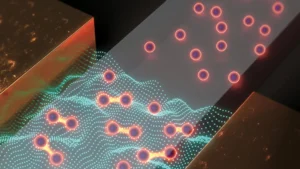
In the quantum Hall effect, electrons in a thin, two-dimensional layer are subjected to low temperatures and strong magnetic fields. Under these conditions, the Hall conductance (the ratio of current to voltage) does not change smoothly. Instead, it moves in discrete, highly precise steps or "plateaus." What is most remarkable about these plateaus is their stability; they remain constant even if the material has impurities or structural defects. This stability is "topologically protected," meaning it is a result of the global geometric properties of the electron system rather than local details.
"What we’ve shown is that if space-time has this non-trivial topology, then it resolves one of the deadliest problems of the cosmological constant," Stephon Alexander explained. The team discovered that the mathematics describing the ground state of quantum gravity—specifically the Chern-Simons-Kodama state—shares an identical structure with the mathematics of the quantum Hall effect. In this analogy, the cosmological constant is "quantized" or locked into place by the topology of space-time, much like the electrical conductance is locked in the Hall effect.
Topological Protection and the CSK State
The Chern-Simons-Kodama (CSK) state is a proposed solution to the equations of quantum gravity. While a unified "Theory of Everything" that merges gravity and quantum mechanics remains the "holy grail" of physics, the CSK state represents a "conservative" or "canonical" approach to the problem. It utilizes the principles of quantization established by pioneers like Paul Dirac and Erwin Schrödinger but applies them to the geometry of space-time.
By applying the logic of the quantum Hall effect to the CSK state, Alexander and his colleagues Aaron Hui and Heliudson Bernardo demonstrated that the quantum fluctuations which should "blow up" the cosmological constant are rendered "inert." In the quantum Hall effect, electrons are forced into specific orbits by a magnetic field, and their collective behavior becomes resistant to change. Similarly, in the CSK framework, the "magnetic" components of the gravitational field (related to the curvature of space-time) force the vacuum energy into a stable, topological configuration.
Aaron Hui, an assistant professor at Brown specializing in topological systems, noted the significance of this cross-disciplinary approach. "There turn out to be constraints in the theory that force the cosmological constant to take certain allowed quantized values," Hui stated. This quantization ensures that the energy density of the vacuum cannot spiral out of control, maintaining the delicate balance required for a life-sustaining universe.
Data Analysis and Implications for Modern Cosmology
The implications of this research extend far beyond theoretical mathematics. If the cosmological constant is indeed topologically protected, it suggests that our current understanding of dark energy may need to be refined. Dark energy, which accounts for approximately 68% of the total energy-matter content of the universe, is the leading candidate for the force driving the accelerated expansion.
Supporting data from the Planck satellite and the Dark Energy Survey have consistently measured a small value for the cosmological constant, but they have not been able to explain why it is that specific value. The Brown University study provides a mechanism for this "fine-tuning."
Key analytical takeaways from the study include:
- Robustness Against Perturbations: Just as the Hall effect is resistant to material impurities, the cosmological constant remains stable despite the chaotic nature of quantum fluctuations.
- A New Scale for Gravity: The theory suggests that gravity may have an inherent "minimum" or "quantized" scale that prevents the infinite values often encountered in black hole singularities or the early Big Bang.
- Validation of Canonical Quantization: The success of the CSK state in this context provides renewed support for traditional methods of quantizing gravity, which have recently been overshadowed by more exotic theories like String Theory or Loop Quantum Gravity.
Collaborative Innovation at the Brown Theoretical Physics Center
The breakthrough is also a testament to the collaborative environment at the Brown Theoretical Physics Center (BTPC). Stephon Alexander, a cosmologist, and Aaron Hui, a condensed matter theorist, combined their disparate expertise to identify a connection that specialists in either field might have missed.
"This is us practicing what we preach—a cosmologist working closely with a condensed matter theorist," Alexander said. This interdisciplinary "mixing of perspectives" is increasingly seen as the future of physics, as the most difficult problems in the field—such as the nature of black holes or the origin of the universe—often sit at the intersection of different physical regimes.
The team’s work also involved Heliudson Bernardo, a postdoctoral researcher, whose contributions were vital in mapping the complex mathematical transformations required to link the CSK state to the Hall effect. Their collective effort has been received with interest by the broader scientific community, sparking discussions on whether other "unsolvable" problems in physics might have topological solutions.
Future Directions and Final Analysis
While the proposed topological solution is a major step forward, the researchers acknowledge that the work is not yet complete. The CSK state is a specific ground state, and proving that it represents the actual state of our universe requires further observational evidence. Future experiments, such as those conducted by the James Webb Space Telescope or the upcoming Nancy Grace Roman Space Telescope, may provide more precise data on the nature of dark energy that could confirm or refute the topological model.
Furthermore, the team is now looking toward a "bigger picture" of how this phenomenon works across different epochs of the universe’s history. They aim to investigate whether this topological protection was present during the "inflationary" period—the fraction of a second after the Big Bang when the universe expanded exponentially.
In conclusion, the research by Alexander, Hui, and Bernardo offers a compelling and elegant answer to one of the most persistent questions in science. By viewing the universe not just as a collection of particles and forces, but as a topological structure with inherent stability, they have provided a potential roadmap for reconciling the microscopic and macroscopic worlds. If their theory holds, the "biggest blunder" in physics may finally be understood as a masterstroke of cosmic architecture, protected by the very shape of existence itself.