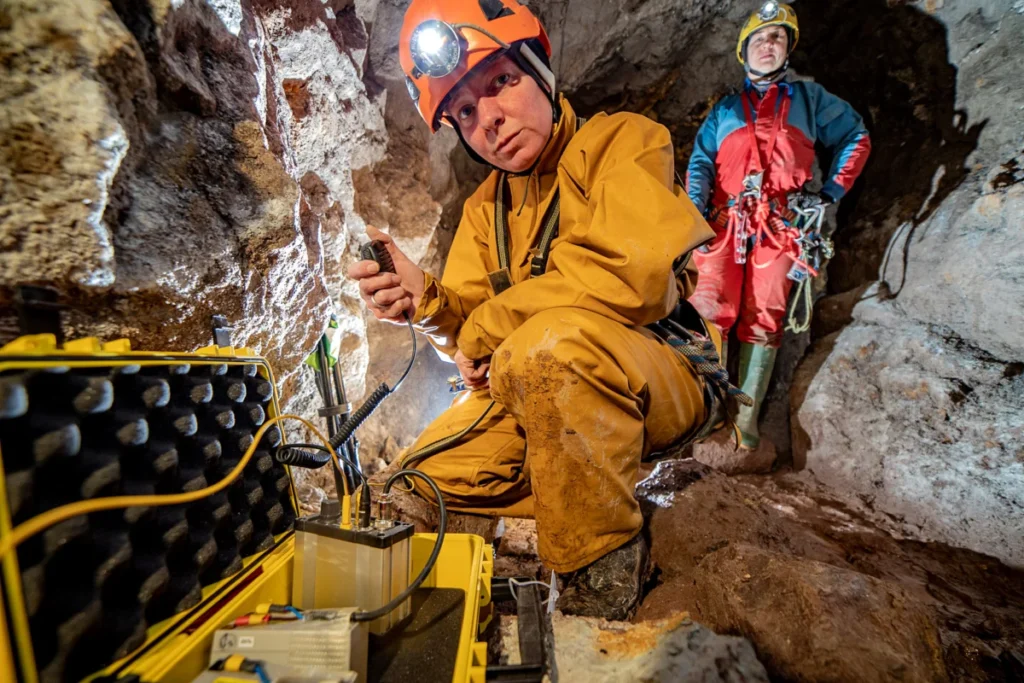
Unlike commercial radio systems that rely on the propagation of electromagnetic waves through the atmosphere, cave radio utilizes specialized techniques to transmit information directly through the strata of the Earth. While commercial equipment exists for the mining industry, it is often prohibitively expensive and lacks the portability required for the cramped, arduous conditions of natural cave systems. Consequently, the advancement of subterranean communication has largely been driven by a dedicated community of makers, radio amateurs, and rescue specialists who have engineered innovative solutions to talk through solid rock.

The Physics of Subterranean Signal Propagation
To understand how cave radio functions, one must first address the phenomenon of signal attenuation. When a radio wave encounters a conductive medium like the Earth, it induces currents that dissipate the wave’s energy as heat. This effect is frequency-dependent: the higher the frequency, the faster the signal is absorbed. This is why a standard FM radio station operating at 100 MHz is lost almost immediately upon entering a tunnel, whereas lower frequency signals can penetrate deeper.
In the context of cave exploration, which often occurs in limestone karst environments, frequencies in the Low Frequency (LF) band—specifically between 30 kHz and 300 kHz—have proven most effective. At these frequencies, the "skin depth," or the distance a signal can travel before its intensity drops significantly, is much greater than at the megahertz or gigahertz ranges used by modern consumer electronics. For many cave radio systems, 87 kHz has become a standard frequency, balancing the need for penetration with the practicalities of equipment design.

However, utilizing low frequencies introduces a significant engineering challenge: antenna size. A traditional, efficient dipole antenna needs to be approximately half the length of the signal’s wavelength. At 87 kHz, the wavelength is roughly 3.5 kilometers, implying an antenna length of 1.75 kilometers—a physical impossibility for a portable unit being carried through a narrow subterranean passage. To circumvent this, cave radio systems rely on two primary alternative antenna designs: the magnetic loop and the earth array.
The Evolution of Underground Communication Technology
The history of communicating through the Earth has evolved from primitive tethered systems to sophisticated digital networks. This chronology reflects both the advancements in electronic miniaturization and an increasing understanding of geophysics.

The Era of Single-Wire Telephones (SWT)
Before the advent of portable through-the-earth (TTE) radio, explorers relied on Single-Wire Telephones. This technology, which dates back to the early 20th century and saw significant use in military contexts, uses a single insulated wire to carry the signal, with the Earth itself serving as the second conductor (the "ground return"). While simple and reliable, SWTs require a physical cable to be laid from the surface to the underground location, a task that is labor-intensive and leaves the line vulnerable to breakage from rockfalls or passing explorers.
The Rise of Through-the-Earth (TTE) Magnetic Induction
In the mid-20th century, researchers began experimenting with magnetic induction. By using multi-turn loop antennas, typically around one meter in diameter, operators could generate a magnetic near-field. This field is not a "radio wave" in the traditional sense but rather a localized magnetic disturbance that can be detected by a similar loop at a distance. Because magnetic fields are less affected by the conductivity of the rock than electric fields, TTE systems allowed for wireless communication through hundreds of meters of solid material. The primary drawback is the "inverse cube law," where signal strength drops off extremely rapidly as distance increases, requiring significant power for long-range transmission.

The Development of Earth Arrays and Conduction
As electronics became more efficient, the "earth array" emerged as a superior alternative to the loop antenna. An earth array consists of two electrodes—often metal stakes on the surface or bare wires in a cave—driven into the ground at a distance of 50 to 100 meters apart. By injecting an electrical current directly into the ground, the system creates a conduction field that can be detected by a distant receiver. This method offers a greater range than loop antennas, sometimes reaching up to one kilometer through solid rock, providing much-needed flexibility for surface operators.
Critical Applications in Cave Rescue and Mining Safety
The most vital application of cave radio is in the realm of search and rescue. In a typical cave rescue scenario, an injured individual may be located several hours or even days away from the entrance. The logistics of transporting a stretcher through narrow, vertical, and often flooded passages are immense.

According to data from cave rescue organizations like the British Cave Rescue Council (BCRC), communication is the single most important factor in a successful outcome. Without cave radio, messages must be carried by "runners"—physically fit cavers who must traverse the distance between the rescue site and the surface to deliver updates. This creates a dangerous lag in information. With TTE radio, a rescue team can communicate directly with a surface controller, allowing them to:
- Request specific medical supplies or specialized doctors.
- Coordinate the arrival of helicopters or ambulances to coincide with the casualty’s extraction.
- Provide real-time updates on the casualty’s vital signs, which can be critical for hospital preparation.
The 2018 Tham Luang cave rescue in Thailand highlighted the global importance of specialized subterranean communication. While that specific rescue relied heavily on diverted water and diving logistics, the incident underscored the absolute necessity of being able to track and communicate with teams in environments where GPS and satellite phones are non-functional.

The Maker Movement and DIY Innovation
A unique aspect of cave radio is the role of the "maker" community. Because the market for these devices is too small for major telecommunications firms, the development of the hardware has fallen to enthusiasts and specialized non-profits. This has led to a surge in creative, low-cost solutions using off-the-shelf components.
One such innovation involves the use of audio-frequency TTE. By using a standard 10W megaphone amplifier and an impedance-matching transformer, makers have successfully transmitted voice signals through the Earth at frequencies between 300 Hz and 3 kHz. This "audio through the earth" approach eliminates the need for complex modulation and allows for the use of simple, robust hardware.

More recently, the integration of the LoRa (Long Range) protocol has revolutionized communication along cave passages. LoRa is a digital spread-spectrum modulation technique designed for low-power, wide-area networks. While it operates at high frequencies (typically 433 or 868/915 MHz) that cannot penetrate rock, its high sensitivity allows it to work effectively with "string-of-pearls" repeaters. By placing small, battery-powered LoRa nodes at every bend in a cave passage, explorers can create a data network that carries text messages over kilometers of winding tunnels without the need for a continuous wire.
Technical Specifications and Data Analysis
The performance of any cave radio system is governed by the electrical conductivity of the surrounding rock, measured in millisiemens per meter (mS/m).

| Material | Conductivity (mS/m) | Typical Penetration Depth (87 kHz) |
|---|---|---|
| Dry Limestone | 0.01 – 1 | 500 – 1000 meters |
| Wet Sandstone | 1 – 10 | 150 – 300 meters |
| Shales/Clays | 10 – 100 | 50 – 150 meters |
| Seawater | 4000 | < 5 meters |
Data indicates that while limestone provides an excellent medium for TTE communication, the presence of mineralized ore or high water tables can severely limit range. Furthermore, interference from the surface power grid—specifically 50Hz or 60Hz hum and its harmonics—remains the primary technical hurdle for receivers. Modern digital signal processing (DSP) is now being employed to filter out this "mains hum," significantly improving the signal-to-noise ratio of subterranean systems.
Safety Protocols and Regulatory Considerations
Given the hazardous nature of both caving and electrical experimentation, safety is a paramount concern for those developing cave radio. Organizations such as the National Speleological Society (NSS) in the United States and the British Cave Research Association (BCRA) emphasize that electronic equipment must be "ruggedized" to withstand 100% humidity, mud, and physical shock.

Furthermore, the legal landscape for low-frequency transmission varies by country. In many regions, the frequencies used for cave radio fall into "license-free" or "experimental" bands, but operators must ensure they do not interfere with maritime or military navigation beacons that also utilize the VLF and LF spectrums.
Broader Implications and Future Outlook
The techniques developed for cave radio have implications beyond hobbyist exploration. As urban environments become more complex, with deeper subway systems and sprawling underground utility networks, the ability to communicate through "solid" infrastructure becomes a matter of civil defense. In the event of a catastrophic building collapse or a tunnel fire, TTE technology could provide a lifeline for trapped individuals where all other systems have failed.

The future of the field likely lies in the fusion of TTE and mesh networking. Imagine a scenario where a single TTE link provides a "backhaul" from a deep cave to the surface, while a local LoRa or Wi-Fi mesh network provides connectivity to multiple teams within the cave system. As battery technology improves and low-power microcontrollers become more capable, the "silent world" of the subterranean realm is gradually becoming more connected, ensuring that those who venture into the dark are never truly alone.
Through the persistent efforts of makers and researchers, the barrier of solid rock is being eroded by the clever application of physics. Cave radio remains a testament to human ingenuity—a specialized, life-saving tool that proves even the most formidable physical obstacles can be overcome with the right frequency and a bit of innovative engineering.