The common experience of losing a cellular signal or a radio broadcast while driving through a tunnel serves as a daily reminder of the inherent difficulty of transmitting electromagnetic waves through solid matter. For decades, the prevailing assumption among the general public has been that radio signals simply cannot penetrate the dense rock of mountains, mines, and deep cave systems. However, this assumption is only partially correct. While high-frequency signals like those used by modern smartphones are easily absorbed by the earth, specialized low-frequency techniques have enabled a robust field of subterranean communication known as "cave radio." This technology, largely driven by the global maker and amateur radio communities, provides a vital link between the deep underground and the surface, proving indispensable for scientific exploration and life-saving rescue operations.

The Physics of Subsurface Signal Propagation
To understand why standard communication fails underground, one must examine the relationship between radio frequency and material attenuation. In the atmosphere, high-frequency (HF) and ultra-high-frequency (UHF) waves travel long distances with minimal interference. However, rock—particularly limestone, where most caves are found—acts as a massive attenuator. The higher the frequency, the faster the signal is absorbed by the medium.
To overcome this, engineers and hobbyists utilize the Low Frequency (LF) band, typically ranging from 30kHz to 300kHz. At these frequencies, signals can penetrate hundreds of meters of solid rock. In many cave radio applications, a frequency of approximately 87kHz is utilized. The trade-off for this penetration is the physical requirement for the antenna. An efficient antenna usually needs to be at least half the length of the signal’s wavelength. At 87kHz, the wavelength is roughly 3.5 kilometers, necessitating an antenna 1.75 kilometers long—a physical impossibility for a portable unit in a cramped subterranean passage.

To resolve this, through-the-earth (TTE) systems often rely on "magnetic near-field" induction rather than traditional radio wave propagation. By using multi-turn loop antennas, usually around one meter in diameter, a transmitter creates a magnetic field that can be detected by a matching receiver. The primary limitation of this method is the "inverse cube law," which dictates that signal strength decays rapidly as distance increases. Doubling the transmission range requires an eightfold increase in power, while a tenfold increase in range requires a thousandfold increase in power.
A Chronology of Subterranean Communication
The evolution of underground communication has moved from heavy, wired systems to sophisticated digital nodes. The timeline of this development reflects broader shifts in electronic engineering and the specific needs of the caving community.

- The Pre-Radio Era (Early 20th Century): Early mining and exploration relied on heavy twin-conductor cables. These were prone to breakage and were difficult to transport through narrow apertures.
- Single Wire Telephones (1960s-1970s): The development of Single Wire Telephones (SWTs) revolutionized cave communication. By using the ground itself as the second conductor, explorers halved the weight of the cable they needed to carry.
- The Induction Loop Breakthrough (1970s-1980s): The first true "cave radios" appeared, using large induction loops. These allowed for wireless communication but required the surface and underground parties to be precisely aligned vertically.
- The HeyPhone and the LF Standard (1990s-2000s): Developed by the late John Hey (G3XTT), the HeyPhone became the standard for British Cave Rescue. It utilized the Low Frequency band and "earth array" antennas, which involve driving metal stakes into the ground to inject current directly into the earth.
- The Digital Revolution (2010s-Present): Modern systems now incorporate digital modes, such as LoRa (Long Range) data transmission and Software Defined Radio (SDR). These allow for text-based communication and telemetry at ranges previously thought impossible without high power.
Critical Applications: The Vital Role in Cave Rescue
While cave radio is a fascinating hobby for electronics enthusiasts, its most critical application is in the realm of emergency services. Cave rescue is one of the most demanding forms of technical rescue, often involving hundreds of volunteers and lasting several days.
In a typical rescue scenario, an injured caver may be located several kilometers from the entrance and hundreds of meters below the surface. The "Golden Hour" of medical intervention is often impossible to meet in a subterranean environment. Moving a casualty on a stretcher through narrow, winding passages and up vertical shafts is a slow, grueling process.

Cave radio allows the underground team to provide real-time medical updates to the surface. This ensures that when the casualty finally reaches the entrance, a specialized medical team is ready with the correct equipment and supplies. In many documented cases, the ability to coordinate medical advice and logistics via cave radio has been the deciding factor in a patient’s survival. Beyond emergencies, these systems are used during long-term expeditions to coordinate supply drops and manage the safety of divers in flooded systems.
Comparative Methodologies: TTE vs. Guided Systems
There is no "one-size-fits-all" solution for talking through rock. Different environments require different technological approaches.

Through-the-Earth (TTE) Radio
TTE is the "holy grail" of cave communication because it requires no physical connection between the two parties. Using earth arrays—pairs of wires run along the ground for 50 meters and terminated with metal stakes—operators can achieve ranges of up to one kilometer. This method is highly effective for communicating between a deep base camp and a surface station located directly above.
Guidewire and Leaky Feeders
In long, horizontal cave systems, TTE may not be practical if the surface topography is inaccessible (such as a high mountain peak). In these cases, guidewire radio is used. This involves laying a single wire along the passage. Handheld radios, such as 27MHz CB units, can transmit to the wire via induction if held within a few meters of it. The wire then carries the signal along the passage. A more advanced version of this is the "leaky feeder," a specialized coaxial cable that "leaks" signal along its entire length, commonly used in subway systems like the London Underground.

High-Frequency Repeaters and LoRa
Recent innovations have seen the use of ultra-high-frequency (UHF) signals within cave passages. While these signals cannot pass through rock, they can bounce around corners in large passages. By dropping small, low-power LoRa repeaters at every bend, cavers can create a digital "breadcrumb" trail that allows for text-based communication over several hundred meters of complex passage.
The Maker Community and Hardware Innovation
Because the market for cave communication is too small for most major defense or telecommunications contractors, the bulk of innovation has come from the "maker" community—hobbyists, amateur radio operators, and cave explorers who build their own gear.

For example, a functional TTE transmitter can be constructed using a modified 10W megaphone. By removing the speaker and replacing it with a "back-to-front" audio line transformer, the megaphone’s amplifier can be used to inject audio signals into an earth array. The transformer is necessary to match the low impedance of the amplifier to the much higher impedance of the ground.
On the receiving end, a simple audio amplifier connected to a laptop or a USB sound card can serve as a receiver. However, these DIY systems face significant challenges, most notably "mains hum." The global electricity grid creates a constant background noise of 50Hz or 60Hz (and their harmonics) that can drown out weak signals. Makers often employ sophisticated digital filtering or notch filters to clear this interference and extract the voice or data from the noise.

Safety and Environmental Considerations
The pursuit of subterranean communication is not without risks. Experts emphasize that the underground environment is inherently hazardous, characterized by cold, dampness, and the risk of physical injury.
"The surface is the best laboratory for your first tests," suggests Mike Bedford, a veteran of the cave radio community. Testing equipment in a controlled environment, such as a "rail-to-trail" tunnel (an abandoned railway tunnel converted for public use), allows for subterranean testing without the dangers of a "wild" cave.

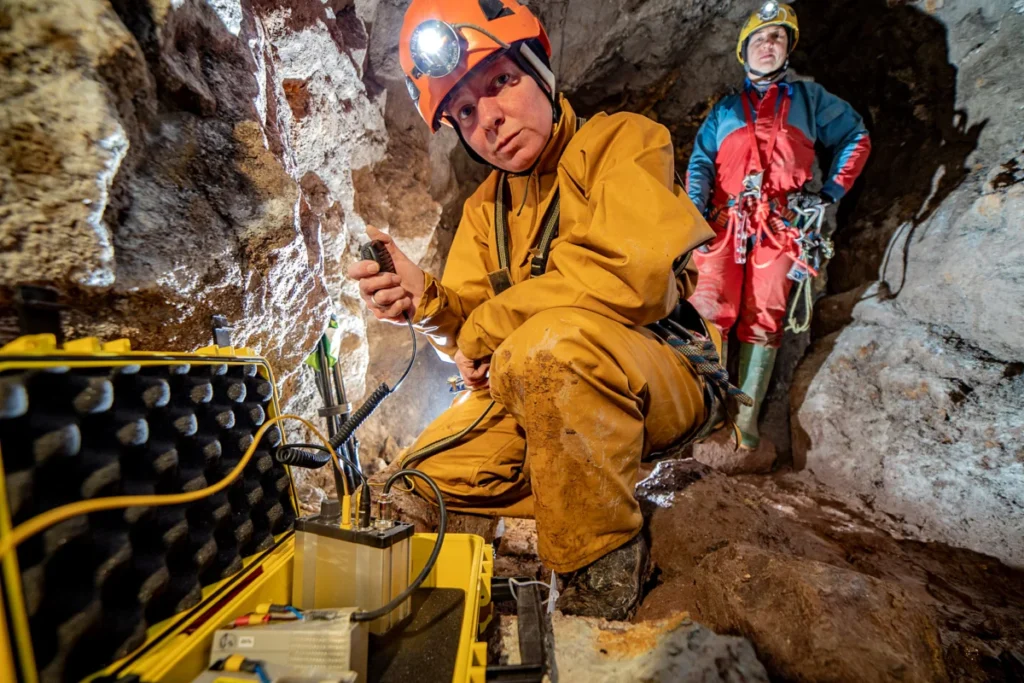
Furthermore, the electronic equipment itself must be "hardened" for the environment. Caves are often 100% humidity environments with mud and dripping water. Professional and high-end DIY cave radios are typically housed in rugged, waterproof cases (such as Pelican cases) and designed with oversized controls that can be operated while wearing thick, muddy gloves.
Broader Impact and Future Implications
The techniques developed for cave radio have implications far beyond recreational caving. The ability to communicate through solid media is of great interest to disaster relief organizations for locating survivors in collapsed buildings or rubble after earthquakes.

Additionally, as space agencies like NASA and the ESA look toward the exploration of lunar and Martian "lava tubes," through-the-earth communication becomes a critical component of future planetary exploration. The lessons learned by cavers in the limestone hills of Earth may one day provide the blueprints for the first communication networks on other worlds.
As technology continues to shrink and become more power-efficient, the barrier to entry for cave radio is lowering. Organizations like the British Cave Research Association (BCRA) and its Cave Radio & Electronics Group (CREG) continue to publish research and schematics, ensuring that this niche field of science remains open to anyone with a passion for electronics and a desire to explore the unknown. Through the persistent efforts of these makers, the "solid" rock is becoming increasingly transparent, allowing for a level of subterranean connectivity that was once the stuff of science fiction.