Researchers have achieved a significant breakthrough in biomimetic materials science, creating a sophisticated hollow CdS@polydopamine nanoreactor that meticulously imitates two fundamental features of living cells. This innovative design offers a novel and promising pathway to replicate some of the highly organized and efficient chemical functions inherent to biological systems within synthetic nanomaterials, opening new avenues for advanced chemical synthesis and energy conversion.
The groundbreaking findings, which detail the intricate design and impressive performance of this cell-inspired nanoreactor, were recently published in the prestigious Journal of the American Chemical Society. The pioneering research was spearheaded by Professor LI Can at the Dalian Institute of Chemical Physics (DICP) of the Chinese Academy of Sciences (CAS), in a crucial collaborative effort with Professor Jian Liu’s team at Inner Mongolia University. This collaboration underscores the interdisciplinary nature of modern scientific inquiry, bringing together expertise in catalysis, materials science, and biochemistry to tackle complex challenges.
Recreating Cellular Chemistry at the Nanoscale: A Paradigm Shift
The extraordinary efficiency and precision with which living cells orchestrate complex biochemical reactions have long captivated scientists. This unparalleled capability stems from a highly sophisticated internal organization, where various molecular components are strategically arranged within tightly controlled microenvironments. Within these confined spaces, molecules can move, interact, and react under meticulously regulated conditions, often involving precise spatiotemporal control over chemical gradients and reaction pathways. This intricate cellular machinery allows for minimal energy waste and maximum product yield, a benchmark largely unmatched by conventional synthetic chemical processes.
For decades, scientists have strived to understand and, subsequently, to mimic these cellular principles in engineered systems. This ambition has given rise to a burgeoning field known as nanocell engineering, a cutting-edge discipline that seeks to construct synthetic, cell-like structures endowed with specialized surfaces, internal pores, or intricate cavities. These synthetic systems, frequently referred to as nanoreactors, represent a potent convergence of insights gleaned from cell biology and advanced nanotechnology. The ultimate goal is to create artificial constructs that can perform complex chemical transformations with the same level of control, selectivity, and efficiency observed in living organisms, but without the inherent limitations or complexities of biological systems themselves.
The Evolution of Biomimicry in Catalysis
The concept of biomimicry in catalysis is not entirely new, tracing its roots back to early attempts to understand enzyme function. However, the ability to engineer materials at the nanoscale with such precise control over their architecture and functionality is a more recent development, driven by advancements in synthetic chemistry, materials characterization, and nanotechnology.
Historically, traditional heterogeneous catalysts have focused primarily on optimizing active site chemistry and surface area. While effective, these catalysts often lack the intricate spatiotemporal control and compartmentalization that characterize biological systems. The realization that cellular organization plays as crucial a role as the specific catalytic enzymes themselves has spurred a shift in research focus. Early efforts in nanoreactor design often involved encapsulating enzymes or catalysts within simple vesicles or porous frameworks. However, these early designs frequently faced challenges related to stability, precise control over reactant flux, and the ability to mimic dynamic cellular processes.
The current work by Prof. Li and Prof. Liu’s teams represents a significant leap forward, moving beyond simple encapsulation to incorporate dynamic, functional elements that actively participate in reaction regulation, drawing direct inspiration from sophisticated cellular mechanisms like proton gradients and compartmentalized organelles. This research stands on the shoulders of decades of foundational work in colloidal chemistry, polymer science, and photocatalysis, integrating these disparate fields into a coherent, highly functional design.
Two Cell-Inspired Features: The Core of the Nanoreactor’s Innovation
The newly developed CdS@polydopamine nanoreactor distinguishes itself through the incorporation of two principal biomimetic elements, each playing a critical role in enhancing its catalytic performance.
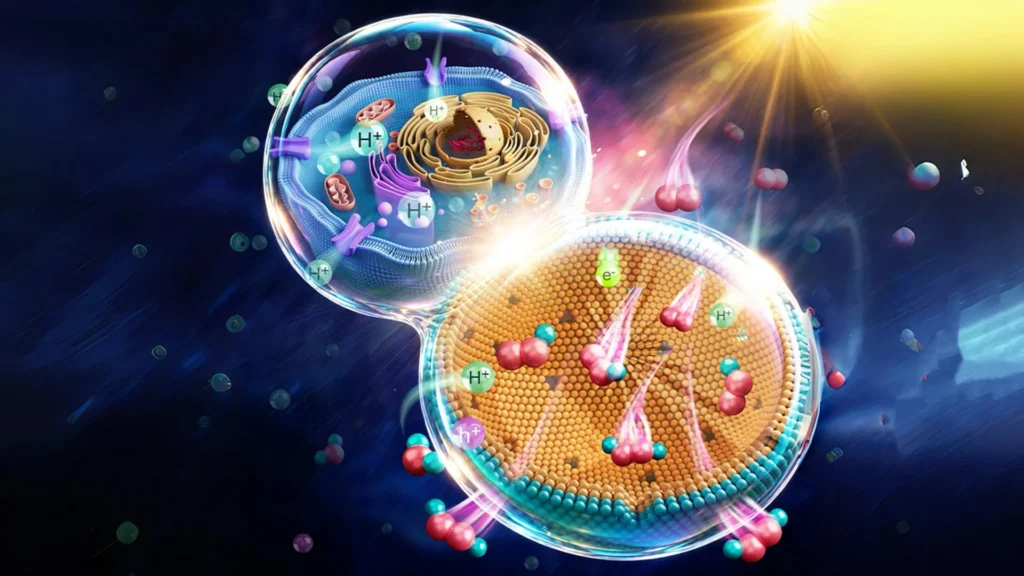
The first, and arguably most innovative, feature is the dynamic catechol/o-benzoquinone redox pair strategically embedded within the polydopamine shell of the nanoreactor. Unlike the more commonly studied active proton pumps found in cellular membranes (such as ATP synthase, which actively translocates protons across a membrane to generate an electrochemical gradient), this chemical pair operates as a sophisticated proton relay system. Its function involves the repeated acceptance and subsequent release of protons, effectively facilitating and accelerating proton-coupled electron transfer (PCET) processes. PCET is a fundamental reaction mechanism in many biological and chemical systems, where the movement of a proton and an electron are intimately coupled. In many catalytic cycles, particularly those involving multi-electron and multi-proton transformations, PCET steps can often be the rate-limiting factors. By providing an efficient pathway for proton transfer, this biomimetic relay mechanism significantly speeds up the overall reaction kinetics, allowing for more rapid and efficient energy conversion. The polydopamine, a synthetic melanin-like polymer, is an ideal scaffold for this due to its facile synthesis, excellent biocompatibility, and, crucially, the presence of redox-active catechol groups that can be reversibly oxidized to o-benzoquinones.
The second pivotal feature is the nanoreactor’s meticulously engineered compartmentalized structure. At its heart lies a nanoscale hollow cavity, precisely engineered to serve as a confined reaction environment. This central cavity is enveloped by a porous shell, which acts as a selective barrier and a means of controlled interaction with the external environment. This unique architecture confers several critical advantages. Firstly, the confined environment within the hollow cavity promotes the accumulation and increased local concentration of reactants, effectively increasing their collision frequency and thus reaction rates, much like how specific organelles concentrate substrates. Secondly, the porous shell enables controlled molecular diffusion, allowing reactants to enter and products to exit efficiently while potentially hindering undesirable side reactions or the diffusion of inhibitory species. Thirdly, and particularly vital for light-driven reactions, this compartmentalized design is highly effective at trapping incoming photons. The multiple scattering events within the porous shell and hollow core increase the path length of light, thereby enhancing light harvesting efficiency and ensuring that the photocatalytic reactions proceed more effectively. This mimics the light-harvesting complexes in natural photosynthesis, which are also highly organized to capture and transfer light energy.
Improving Hydrogen Peroxide Photosynthesis: A Green Chemical Imperative
The synergistic interplay of these two biomimetic features — the dynamic proton relay and the compartmentalized structure — is instrumental in achieving a delicate balance between the disparate reaction speeds of oxygen reduction and water oxidation. These two half-reactions are fundamental and must proceed in concert to efficiently produce hydrogen peroxide (H2O2). Imbalance can lead to the accumulation of reactive intermediates, reduced selectivity, and lower overall efficiency.
Hydrogen peroxide is a critically important industrial chemical, widely utilized as a powerful oxidant, bleaching agent, disinfectant, and a key reagent in numerous chemical syntheses. Its applications span diverse sectors, from pulp and paper bleaching to wastewater treatment and even rocket propulsion. Traditionally, H2O2 is produced predominantly through the anthraquinone process, a multi-step, energy-intensive method that relies on fossil fuels and generates significant waste. The pursuit of sustainable, environmentally benign methods for H2O2 production is therefore a major goal in green chemistry and renewable energy research.
The nanoreactor developed by Prof. Li’s team offers a compelling solution through artificial photosynthesis. Under visible-light illumination in an aqueous solution, the nanoreactor demonstrated an impressive H2O2 photosynthesis rate of 3.24 mmol gcat.-1 h-1. Furthermore, it achieved a solar-to-chemical conversion efficiency of 1.2%. While seemingly modest compared to biological photosynthesis, this efficiency is highly competitive for artificial systems aimed at producing value-added chemicals directly from sunlight and water, particularly given the complexity of multi-electron redox reactions involved. This rate and efficiency represent a significant advancement in the field, showcasing the potential of biomimetic design to overcome long-standing challenges in photocatalysis.
To thoroughly unravel the intricate working mechanism of this sophisticated system, the researchers employed a comprehensive suite of advanced analytical techniques. This multi-pronged approach included in situ spectroscopy, which allowed for real-time observation of reaction intermediates and changes in electronic structure; photochemical analysis, to quantify quantum yields and reaction kinetics; finite element simulations, to model diffusion pathways and photon distribution within the nanoreactor; and rigorous theoretical calculations, to provide atomic-level insights into the electronic structure, charge transfer dynamics, and catalytic pathways. These combined methods were crucial in allowing the team to observe the cell-inspired processes directly and to definitively clarify the Z-scheme heterojunction-based photocatalytic mechanism responsible for the efficient H2O2 production. The Z-scheme, drawing its name from the "Z" shape of its electron transfer pathway, effectively mimics the two photosystems in natural photosynthesis, allowing for enhanced charge separation and the generation of sufficiently high redox potentials to drive both oxygen reduction and water oxidation simultaneously and efficiently.
A Recyclable System Powered by Sunlight: Towards Practical Applications
Beyond its impressive catalytic performance, the research also addressed a critical aspect for practical application: recyclability and stability. The researchers ingeniously embedded the nanoreactors within an environmentally benign sodium alginate hydrogel matrix. Sodium alginate, a natural polysaccharide derived from seaweed, is biodegradable, biocompatible, and forms stable hydrogels, making it an excellent choice for green chemistry applications.
This embedding strategy resulted in the production of solid, easily separable, and recyclable photocatalysts. Crucially, these hydrogel-encapsulated nanoreactors demonstrated the capacity to continuously synthesize H2O2 under natural sunlight while maintaining stable performance over extended periods. The ability to recycle the catalyst without significant loss of activity is paramount for economic viability and environmental sustainability in industrial processes. The use of natural sunlight as the sole energy input further underscores the "green" credentials of this technology, moving away from energy-intensive conventional methods.
Expert Reactions and Broader Implications
Prof. Li Can, reflecting on the significance of their achievement, stated, "Our study provides a new strategy for engineering biomimetic nanoreactors that increasingly replicate the sophisticated functions of living cells, opening new opportunities in artificial photosynthesis, energy catalysis, and synthetic chemistry." This statement highlights the profound impact this research is expected to have across multiple scientific and industrial domains.
The implications of this breakthrough extend far beyond hydrogen peroxide production. The successful implementation of a proton relay system and sophisticated compartmentalization within a synthetic nanoreactor represents a significant conceptual advance in materials design. Experts in the field of artificial photosynthesis and catalysis are likely to view this work as a critical step towards designing next-generation catalysts with unprecedented control over reaction pathways and selectivity.
Potential Applications and Future Outlook:
- Artificial Photosynthesis: The core principles demonstrated here could be applied to other challenging reactions in artificial photosynthesis, such as carbon dioxide reduction to fuels (e.g., methane, methanol) or the direct production of solar fuels like hydrogen. Replicating the efficiency of natural photosynthesis remains a grand challenge, and this work provides new tools.
- Energy Catalysis: Beyond H2O2, the ability to precisely control PCET could revolutionize other energy-intensive chemical processes, such as ammonia synthesis (currently dominated by the Haber-Bosch process), methane conversion, or the production of other platform chemicals.
- Synthetic Chemistry: The creation of highly organized reaction environments with controlled diffusion and active proton management could enable the synthesis of complex molecules with high enantioselectivity or regioselectivity, mimicking enzyme-catalyzed reactions. This could lead to greener and more efficient routes for pharmaceutical synthesis and fine chemical production.
- Environmental Remediation: Nanoreactors with enhanced photocatalytic activity could be deployed for the degradation of persistent organic pollutants in water and air, utilizing sunlight as a clean energy source.
- Biomedical Applications: While the current focus is on catalysis, the principles of compartmentalization and controlled transport at the nanoscale have potential applications in drug delivery, biosensing, and even synthetic biology, where precise control over molecular interactions within confined spaces is crucial.
Challenges and the Road Ahead:
Despite the remarkable progress, significant challenges remain on the path to commercialization and widespread adoption.
- Efficiency Enhancement: While 1.2% solar-to-chemical conversion is good for this specific reaction, further improvements in efficiency will be necessary to compete with established industrial processes, especially for high-volume commodity chemicals.
- Scalability: Translating laboratory-scale synthesis of these intricate nanoreactors to industrial production levels will require innovative engineering and cost-effective manufacturing techniques.
- Long-term Stability: Although the hydrogel matrix provides good stability, ensuring decades-long operational stability under harsh industrial conditions is paramount for economic viability.
- Cost-Effectiveness: The materials and synthesis methods must be economically viable to replace existing technologies. Cadmium sulfide (CdS), while an effective photocatalyst, contains cadmium, a heavy metal, which could pose environmental concerns and regulatory hurdles for large-scale deployment. Research into equally effective but more environmentally benign photocatalysts will be crucial.
- Fundamental Understanding: Continued in-depth studies using advanced spectroscopy and computational modeling will be essential to further optimize the design and unlock even greater catalytic potential.
This research by Prof. Li Can and Prof. Jian Liu’s teams marks a pivotal moment in the quest to harness the power of biomimicry for sustainable chemistry. By meticulously deconstructing and re-engineering fundamental cellular functions into synthetic nanomaterials, they have not only demonstrated a powerful new strategy for artificial photosynthesis but have also laid a robust foundation for the development of a new generation of highly efficient and environmentally friendly catalysts that could redefine how we produce essential chemicals and generate clean energy. The journey from lab to widespread application is often long, but this breakthrough undoubtedly shines a bright light on the immense potential of nanocell engineering.