Imagine a future where the aesthetic of your belongings is as fluid and adaptable as a digital display. This vision is rapidly moving from the realm of science fiction to tangible reality, thanks to groundbreaking work by researchers at the Massachusetts Institute of Technology (MIT). A team at MIT’s Computer Science and Artificial Intelligence Laboratory (CSAIL), led by PhD student Yunyi Zhu, has developed a novel device called ChromoLCD, capable of dynamically altering the visual designs on everyday objects, from clothing and accessories to furniture and whiteboards. This innovation promises to usher in an era of personalized, adaptable aesthetics, transforming how we interact with our physical environments.
The core of this transformative technology lies in the intelligent application of photochromic dyes, materials that change color when exposed to specific light frequencies. While previous MIT projects like "PhotoChromeleon" demonstrated the potential of this technology, they were often tethered to stationary projectors, limiting their portability and practical application. Zhu’s latest innovation, ChromoLCD, addresses these limitations by integrating the precision of liquid-crystal displays (LCDs) with the targeted illumination of light-emitting diodes (LEDs) into a portable, handheld device. This fusion of technologies allows for the high-resolution "printing" of dynamic imagery onto surfaces coated with photochromic ink, offering unprecedented flexibility in personalizing physical objects.
The Genesis of Reprogrammable Surfaces
The journey towards ChromoLCD began with the fundamental challenge of making dynamic visual changes accessible and practical for everyday use. Early research at CSAIL focused on harnessing the light-sensitive properties of photochromic dyes. The initial "PhotoChromeleon" system, developed by Zhu’s colleagues, utilized a projector to selectively expose these dyes to different light wavelengths, thereby altering their color and creating patterns. While a significant step forward, the projector-based approach was bulky and required a stable setup, hindering its adoption for on-the-go customization.
Recognizing the need for greater mobility, Zhu subsequently developed "PortaChrome," an LED-based tool designed to reprogram lower-resolution imagery onto objects. This portable device marked a crucial advancement in making the technology more accessible. However, PortaChrome’s resolution limitations meant that intricate details and sharp graphics were not fully achievable. The development of ChromoLCD represents the culmination of these efforts, combining the portability of PortaChrome with a significant leap in image fidelity, effectively bridging the gap between concept and widespread usability.
ChromoLCD: A Deeper Dive into the Technology
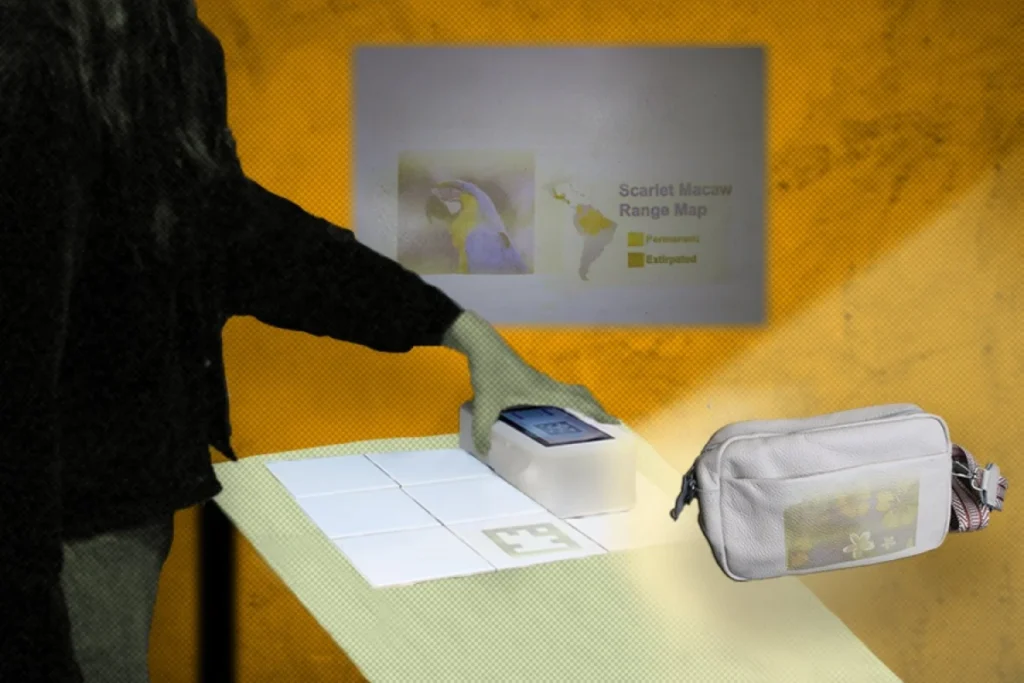
ChromoLCD operates much like a sophisticated printer, but instead of depositing ink, it precisely manipulates the color of existing photochromic dyes on a surface. The device’s external appearance is unassuming, resembling a compact printer. Internally, however, it houses a sophisticated system that orchestrates a "light show" to achieve its remarkable results. At its heart lies a powerful combination of an LCD panel and an array of UV and RGB (red, green, blue) LEDs.
The process begins when a user selects a desired image – be it a digital rose for a hoodie, a colorful fish for a handbag, or even an augmented reality (AR) tag for a kitchen counter. This image is uploaded to ChromoLCD via a Bluetooth or USB connection. The device then generates a black-and-white representation of the image, mapping the precise brightness of each pixel. This grayscale blueprint dictates where light will be applied.
Following this, a UV light is emitted, which saturates or darkens the photochromic dye in the designated areas. Subsequently, the RGB LEDs are activated with pinpoint accuracy, guided by the LCD panel. These LEDs then "color in" each pixel, bringing the digital design to life on the physical surface. The precision of these lights, emitted at specific frequencies, ensures that the color changes are controlled and vibrant, creating high-resolution graphics that can be easily reapplied or changed.
The entire process, from uploading an image to seeing the final design appear, takes approximately 15 minutes. This relatively short timeframe makes spontaneous customization a practical reality. The ability to reprogram an object’s appearance means that a single item can serve multiple aesthetic purposes, reducing the need for numerous specialized items and promoting a more sustainable approach to consumption.
Expanding the Canvas: Applications and Implications
The potential applications of ChromoLCD are vast and extend far beyond mere fashion customization. Zhu envisions it as a bridge connecting consumers with the transformative power of photochromic dyes. "It’s basically a stamp, and it’s very easy to use," Zhu explains. "There are no alignment requirements, no 3D object texture creation. You just upload the image you’d like to put on your bag, place it on there, and then you’d have a personalized accessory."
The research team has already demonstrated ChromoLCD’s versatility by personalizing handbags with vibrant drawings, embedding AR tags on kitchen counters that link to cooking tutorials, and even transforming whiteboards into dynamic displays capable of showing high-resolution reference images. This latter application hints at the potential for interactive learning environments and collaborative workspaces, where information can be visually presented and updated in real-time.
One particularly exciting implication is the potential to turn any whiteboard into an interactive canvas. Imagine a classroom where lessons can be augmented with dynamic visuals, or a design studio where concepts can be sketched and immediately animated. Furthermore, the technology could revolutionize how we interact with shared spaces. A doormat could display a personalized greeting for each guest, or a wall in an office could cycle through family photos when an employee feels nostalgic. As Zhu aptly puts it, "It’s sort of like turning the world into your canvas."
Towards a More Interactive Future
The development of ChromoLCD is part of a broader effort by CSAIL researchers to integrate digital capabilities into our physical surroundings. Building upon the foundational work of PhotoChromeleon and PortaChrome, the team is now looking towards the next frontier: simplifying the creative process itself. Currently, users must upload or create their own images. However, with the rapid advancements in Artificial Intelligence, particularly in generative AI for texture creation, the future could see users simply making verbal requests. For instance, pointing a smartphone camera or wearing an AR helmet at a plain cup and asking, "Turn this cup into a medieval-style tankard," could result in the desired transformation.
Beyond handheld devices, the research is expanding to larger scales. The team is developing a wall-roller-shaped reprogrammer, akin to a paint roller, which will enable the application of larger designs onto walls. They are also exploring other motion-based reprogramming techniques, such as swiping and ironing, and are investigating the integration of this technology into robotics. For example, a robotic vacuum cleaner could use its surface to display messages, such as "Area X cleaned," to communicate its operational status to other machines or human observers.
Narges Pourjafarian, a postdoctoral researcher at Northeastern University who was not involved in the study, praised ChromoLCD’s innovation. "It reframes monochromatic LCD panels as wavelength-selective fabrication tools, rather than merely display endpoints," Pourjafarian stated. "This approach expands how we think about reprogrammable surface appearance, enabling high-resolution, reconfigurable graphics to be embedded directly into physical environments without the need for stationary projection enclosures. It opens a path toward compact, portable augmentation of garments, countertops, and shared surfaces."
The Team Behind the Innovation
The paper detailing the ChromoLCD technology was co-authored by a dedicated team of researchers from MIT and Harvard University. Yunyi Zhu, an electrical engineering and computer science PhD student at MIT, served as a co-lead author. She was joined by MIT undergraduates Qingyuan Li (also a co-lead author), Katherine Yan, Alex Luchianov, and Eden Hen. Emily Guan, a graduate student at Harvard University and a former visiting researcher at MIT, also contributed significantly. The research was overseen by MIT Associate Professor Stefanie Mueller, a CSAIL principal investigator and senior author on the paper. The team is set to present their findings at the prestigious ACM International Conference on Tangible, Embedded, and Embodied Interaction, further solidifying the impact of their work on the field of human-computer interaction.
The development of ChromoLCD represents a significant stride towards a more dynamic and personalized material world. By democratizing the ability to alter the appearance of objects, MIT researchers are not just creating a new technology; they are paving the way for a future where our physical environment can adapt to our needs, moods, and creative impulses with unprecedented ease. The implications for design, manufacturing, and everyday life are profound, promising a future where surfaces are not static backdrops but active participants in our visual and interactive experiences.