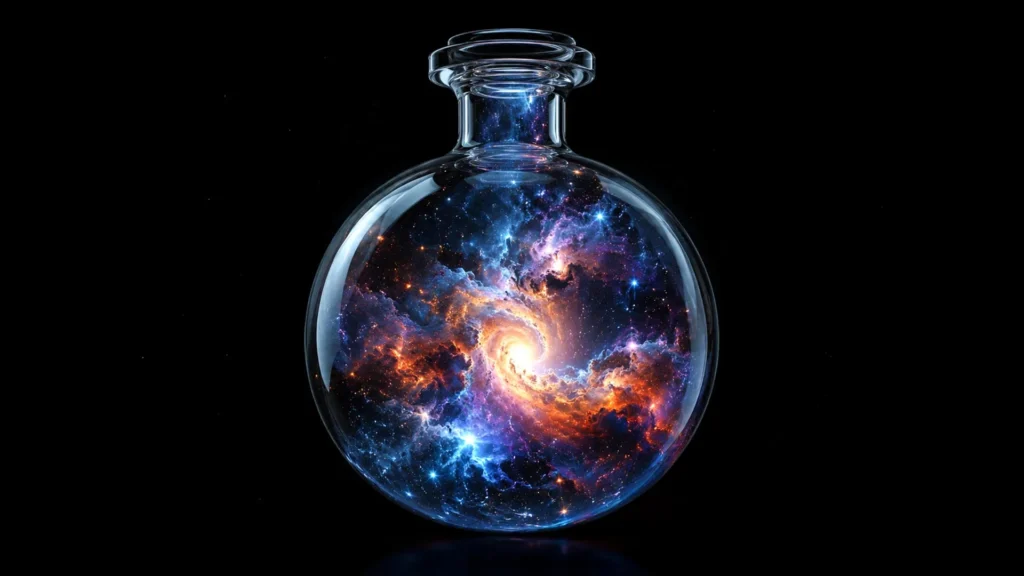
In a significant advancement for the field of astrochemistry, a doctoral researcher at the University of Sydney has successfully synthesized cosmic dust within a controlled laboratory environment, effectively recreating the conditions of the early universe inside a glass bottle. This breakthrough, led by Linda Losurdo, a PhD candidate in materials and plasma physics at the School of Physics, provides a new framework for understanding how the chemical precursors to life may have formed in the vacuum of space long before the Earth itself was coalesced from the solar nebula. By simulating the high-energy environments surrounding aging stars and supernova remnants, the research team has demonstrated that the complex organic molecules essential for biological life can emerge from simple gaseous precursors under specific plasma conditions.
The experiment involved the use of a custom-built plasma reactor where Losurdo combined nitrogen, carbon dioxide, and acetylene—gases known to be prevalent in various stellar environments. By subjecting this mixture to a high-voltage electrical discharge, the researchers were able to trigger chemical reactions that mirror those occurring in interstellar space. The resulting material was a carbon-rich dust that bears a striking resemblance to the "stardust" found in the tails of comets, the interiors of asteroids, and the fragments of meteorites that occasionally strike the Earth’s surface. The findings, which have significant implications for our understanding of the distribution of organic matter throughout the galaxy, were recently published in The Astrophysical Journal, a peer-reviewed publication of the American Astronomical Society.
The Chemistry of Life: The Role of CHON Molecules
At the heart of this research is the production of CHON molecules—complex combinations of carbon (C), hydrogen (H), oxygen (O), and nitrogen (N). These four elements constitute the fundamental building blocks of all known life, forming the basis of amino acids, DNA, and cellular structures. In the laboratory setting, Losurdo was able to observe these elements bonding into intricate organic structures that have long been observed by astronomers through telescopes but have been difficult to study in a physical, tangible form.
Historically, scientists have relied on the serendipitous arrival of extraterrestrial material, such as the Murchison meteorite or samples returned by missions like Japan’s Hayabusa2, to study cosmic organic chemistry. However, the ability to "reverse engineer" this dust in a laboratory allows for a more proactive approach. As Losurdo noted, the experiment enables researchers to build analogue environments that simulate different stages of a star’s life cycle. By analyzing the "infrared fingerprints" of the laboratory-grown dust, scientists can match their samples with data collected from deep-space observations, providing a bridge between theoretical astrophysics and practical material science.
The laboratory-produced dust settles as a thin, often sparkling film on silicon chips. Under microscopic examination, these particles reveal a complex internal structure that records the energetic history of their formation. This "carbonaceous cosmic dust" is believed to be distributed across the universe by the "plasma puffs" of red giant stars or within the turbulent nurseries where new stars are born. The realization that these life-giving molecules can form in such hostile, high-energy environments suggests that the ingredients for life may be a universal byproduct of stellar evolution rather than a rare fluke of Earth’s specific history.
Technical Methodology: Simulating the Vacuum of Space
The experimental setup designed by Losurdo and her supervisor, Professor David McKenzie, required a meticulous replication of the near-vacuum conditions of interstellar space. The process began with the use of high-performance vacuum pumps to evacuate air from glass tubes, reducing the internal pressure to levels that approximate the emptiness found between stars. Once the vacuum was established, the specific gas mixture—acetylene as the primary carbon source, alongside nitrogen and carbon dioxide—was introduced.
The catalyst for the chemical transformation was a "glow discharge" plasma, created by applying an electrical potential of approximately 10,000 volts across the gas mixture. For roughly one hour, the intense energy of the plasma ripped the molecular bonds of the input gases apart, creating a sea of highly reactive ions and electrons. In this chaotic state, the atoms began to recombine into increasingly large and complex arrangements. This process mimics the "ion bombardment" that occurs in space, where cosmic rays and stellar winds provide the kinetic energy necessary for complex chemistry to occur in temperatures that would otherwise be too cold for traditional chemical reactions.
Professor McKenzie emphasized that this laboratory-based approach allows for the manipulation of variables that are impossible to control in deep space. By adjusting the intensity of ion impacts and the temperature of the reaction, the team can pinpoint the exact conditions required to produce specific chemical signatures. This level of control is essential for interpreting the history of meteorites. A meteorite’s chemical composition is essentially a geological "flight recorder," and the Sydney team’s work provides the manual needed to decode that record, revealing the radiation levels and thermal shifts the object experienced during its multi-billion-year journey through the cosmos.
Chronology of Earth’s Organic Enrichment
To understand the impact of this research, one must look back at the timeline of the Solar System’s formation. Approximately 4.6 billion years ago, the sun and its planets began to form from a rotating disk of gas and dust. During the period known as the Late Heavy Bombardment, which occurred between 4.1 and 3.8 billion years ago, the young Earth was relentlessly struck by asteroids and comets.
It is during this epoch that scientists believe the vast majority of Earth’s water and organic material was delivered. While the Earth’s own volcanic and atmospheric processes likely contributed to early chemistry, the sheer volume of organic matter found in carbonaceous chondrite meteorites suggests an extraterrestrial origin for many of the precursors to life. Losurdo’s research helps clarify the "pre-Earth" stage of this chronology—explaining how those organic materials were synthesized in the envelopes of distant stars and preserved in the cold vacuum of space before eventually being swept up by the forming Earth.
By proving that these CHON structures can form rapidly in plasma, the study supports the theory that organic complexity is a fundamental feature of the universe. This timeline suggests that by the time the Earth was cool enough to support liquid water, it was already being seeded with a sophisticated "chemical kit" ready to undergo the transition from organic chemistry to biology.
Establishing a Database for Future Astronomy
Beyond the immediate findings, the University of Sydney team is working toward a broader goal: the creation of a comprehensive database of infrared signatures. In astronomy, light is the primary source of data. When cosmic dust absorbs and re-emits stellar radiation, it does so at specific infrared wavelengths that correspond to the vibration of its chemical bonds. These signals are as unique as a human fingerprint.
By producing a wide variety of cosmic dust analogues in the lab—varying the ratios of carbon, nitrogen, and oxygen—the researchers can create a library of reference spectra. When future telescopes, such as the James Webb Space Telescope (JWST), observe distant nebulae or the debris disks around young stars, astronomers can compare the observed light patterns against the Sydney database. A match would allow scientists to identify not just the presence of dust, but its specific chemical makeup and the physical conditions of the region where it was formed.
This database will be particularly useful for studying "cosmic nurseries"—dense clouds of gas and dust where gravity is pulling material together to form new suns. Understanding the chemistry of these regions is vital for determining whether the planets forming around those stars will also be endowed with the necessary ingredients for life.
Implications for the Search for Extraterrestrial Life
The implications of Losurdo’s work extend into the realm of astrobiology and the search for life beyond our solar system. If the building blocks of life are being manufactured continuously in the plasma of dying stars and distributed throughout the galaxy, then the probability of life emerging elsewhere increases significantly. The research suggests that the "CHON" chemistry is not unique to our corner of the Milky Way but is a standard feature of galactic evolution.
While the experiment does not create "life" itself, it identifies the specific chemical pathways that lead to the "non-living" organic complexity that life requires. The study has already gained international recognition, with Losurdo receiving the award for best presentation at the Annual Meeting of the Meteoritical Society. This accolade highlights the importance of the work to the global scientific community, which is increasingly focused on the "systems chemistry" of the early universe.
The project received support from the University of Sydney node of Microscopy Australia and was funded by the Australian Research Council. As the team continues to refine their "Universe in a bottle," they hope to explore even more extreme conditions, such as those found near the event horizons of black holes or in the intense radiation fields of pulsars, to see how far organic chemistry can be pushed.
In conclusion, the work of Linda Losurdo and Professor David McKenzie represents a vital step in solving the puzzle of our origins. By bringing the stars down to Earth, they have provided a new lens through which we can view the ancient history of the cosmos. Their research confirms that the dust floating between the stars is not merely debris, but a sophisticated chemical reservoir that may hold the secrets to how life began on our planet and where it might be found elsewhere in the vastness of space.