The future of personal expression and smart environments is rapidly unfolding at the Massachusetts Institute of Technology (MIT), where researchers at the Computer Science and Artificial Intelligence Laboratory (CSAIL) have developed a groundbreaking technology capable of transforming static objects into dynamic, customizable canvases. Led by Yunyi Zhu, an MIT electrical engineering and computer science PhD student, the team has created "ChromoLCD," a portable device that allows users to "reprogram" the visual appearance of everyday items, from clothing and accessories to furniture and whiteboards, using photochromic dyes and precision lighting. This innovation promises to usher in an era of highly personalized fashion, adaptive home decor, and interactive workspaces, blurring the lines between the digital and physical realms.
The Genesis of Reprogrammable Surfaces
The concept of dynamically altering the appearance of physical objects has long been a staple of science fiction, but its realization has remained elusive until recent advancements in material science and display technology. Zhu’s work builds upon previous research at CSAIL, notably the development of a device called "PhotoChromeleon." PhotoChromeleon utilized a projector to activate photochromic dyes, which change color when exposed to specific wavelengths of light. While this early system demonstrated the potential of reprogrammable surfaces, its lack of portability limited its practical application.
Recognizing this limitation, Zhu and her colleagues previously developed "PortaChrome," a portable, LED-based tool designed to reprogram lower-resolution imagery on the go. This served as a crucial stepping stone, proving that dynamic visual customization could be achieved outside of a laboratory setting. The culmination of this research journey is ChromoLCD, a device that merges the portability of PortaChrome with a significant leap in visual fidelity and ease of use.
ChromoLCD: A Fusion of Display and Illumination Technology
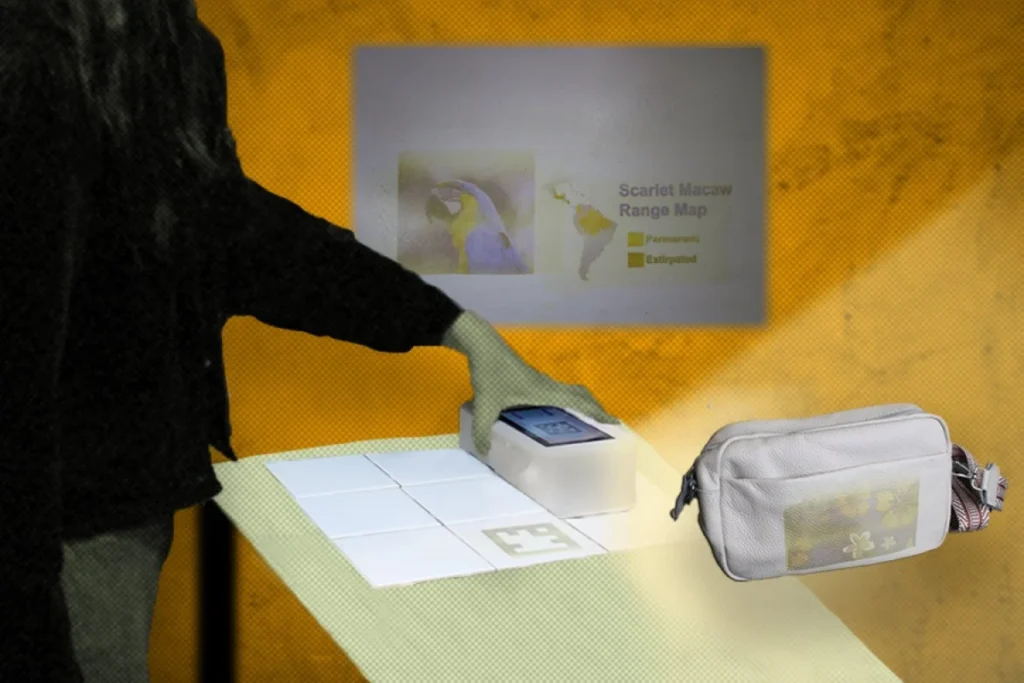
At its core, ChromoLCD functions as a sophisticated printing mechanism, but one that operates on light and specialized inks rather than traditional pigments. The device, externally resembling a compact printer, ingeniously integrates the precision of liquid-crystal displays (LCDs) with the targeted illumination of light-emitting diodes (LEDs). This synergistic combination empowers users to imprint high-resolution, clear images onto a variety of flat and soft surfaces that have been pre-treated with photochromic dye.
The process begins with the user applying an invisible photochromic ink to the desired object. This ink, when exposed to specific light frequencies, undergoes a chemical reaction that alters its color and opacity. Following this, the user connects their chosen image to the ChromoLCD device via Bluetooth or a USB port. The device then displays a menu of available designs, allowing for a preview before the actual imprinting process. Once a design is selected, the user stamps the ChromoLCD onto the treated surface. The entire transformation, from a blank canvas to a personalized visual, typically takes approximately 15 minutes. Crucially, the design is not permanent; users can later reprogram the surface with a new image, offering unparalleled flexibility.
"We see ChromoLCD as a bridge between consumers and photochromic dyes," explained Zhu, who also co-authored the paper presenting this research. "It’s basically a stamp, and it’s very easy to use. There are no alignment requirements, no 3D object texture creation. You just upload the image you’d like to put on your bag, place it on there, and then you’d have a personalized accessory."
Unlocking a World of Dynamic Customization
The practical applications of ChromoLCD are vast and varied. In demonstrations, the device successfully adorned a handbag with vibrant, custom-drawn fish and flowers, transforming a standard accessory into a unique piece of wearable art. Beyond personal accessories, ChromoLCD has shown its potential in enhancing functional objects. For instance, it was used to embed an augmented reality (AR) tag onto a kitchen countertop. This tag, akin to a QR code, could link to a digital cooking tutorial, allowing users to follow instructions while preparing meals, thus blending digital information with their physical environment.
Furthermore, ChromoLCD has proven capable of upgrading everyday tools like whiteboards. By reprogramming a standard whiteboard to display high-resolution reference images, the technology hints at the possibility of turning any whiteboard into an interactive canvas where digital visuals seamlessly integrate with physical sketching and brainstorming. This could revolutionize collaborative work and educational settings, offering dynamic visual aids that can be updated in real-time.
The "Light Show" Behind the Scenes: How ChromoLCD Works
The inner workings of ChromoLCD reveal a sophisticated interplay of optical and electronic components. Housed within a white shell, the device comprises a central computer chip, a powerful backlight assembly, and an LCD panel. The backlight is a carefully orchestrated combination of ultraviolet (UV) and red, green, and blue (RGB) LEDs, designed to precisely control the photochromic dye’s response.
The process begins with the ChromoLCD generating a black-and-white video representation of the selected image. This video outlines the precise brightness levels of each pixel, dictating where the dye will be activated and to what extent. For example, areas intended to be darker in the final image will correspond to pixels requiring more intense light.
Subsequently, the UV LEDs are employed to darken or saturate the photochromic dye across the targeted area of the object. This initial step primes the dye for coloration. Following the UV activation, the RGB LEDs precisely illuminate each pixel, injecting color and bringing the chosen design to life. The system achieves this by emitting light at specific frequencies, meticulously mapped onto the object by the LCD panel. This intricate dance of light and dye effectively "paints" the digital image onto the physical surface, much like opening blinds in the morning reveals a gradually coloring world.
Accessibility and DIY Potential
A significant aspect of the ChromoLCD research is its emphasis on accessibility. The components used in the device are reportedly readily available, suggesting the potential for individuals to replicate or adapt the technology for their own projects. This democratizes the creation of dynamic surfaces, empowering a wider community to experiment with reprogrammable aesthetics.
"A wall in your office can show your family’s pictures when you miss them, or perhaps a doormat can show a customized greeting for each of your guests," Zhu envisioned. "It’s sort of like turning the world into your canvas." This sentiment underscores the transformative potential of the technology, moving beyond mere novelty to become an integral part of how we interact with our surroundings.
Future Trajectories: From Personal Expression to Machine Communication
The development of ChromoLCD, alongside its predecessors PhotoChromeleon and PortaChrome, represents a significant stride in enabling the digitization of our physical environments. However, the CSAIL team is not resting on its laurels. Their immediate future research aims to address the creative aspect of this technology, focusing on simplifying the process of design generation.
With the rapid advancements in Artificial Intelligence (AI), particularly in generative AI for texture and image creation, the researchers envision a future where users can generate designs through natural language prompts. Imagine pointing your smartphone camera at a plain mug and requesting, "Turn this cup into a medieval-style tankard." An AI system, integrated with the reprogrammable surface technology, could then generate and apply the appropriate visual, turning a simple beverage container into a thematic artifact.
Beyond personal use, the researchers are exploring scalability. They are developing a wall-roller-shaped reprogrammer to apply larger designs onto architectural surfaces, effectively turning entire walls into dynamic displays. Furthermore, the team is investigating the integration of this technology into robotics. Imagine a Roomba vacuum cleaner using its surface-printing capability to leave a visual trail on the floor, indicating the areas it has cleaned to other automated devices or human observers. This could revolutionize how robots communicate their status and actions in shared spaces, enhancing efficiency and transparency in automated systems.
Expert Reactions and Broader Implications
Narges Pourjafarian, a postdoctoral researcher at Northeastern University not involved in the study, lauded ChromoLCD for its innovative approach. "ChromoLCD is more than a resolution upgrade over prior MIT projects," she commented. "It reframes monochromatic LCD panels as wavelength-selective fabrication tools, rather than merely display endpoints. This approach expands how we think about reprogrammable surface appearance, enabling high-resolution, reconfigurable graphics to be embedded directly into physical environments without the need for stationary projection enclosures. It opens a path toward compact, portable augmentation of garments, countertops, and shared surfaces."
This sentiment highlights the fundamental shift ChromoLCD represents: moving away from external displays and projectors towards embedding dynamic visual capabilities directly into the fabric of our everyday objects and environments. The implications for industries ranging from retail and advertising to education and entertainment are profound. Pop-up shops could feature constantly changing storefront displays, museum exhibits could offer interactive informational overlays on artifacts, and even home appliances could display personalized messages or useful information dynamically.
The research paper detailing the ChromoLCD technology was co-authored by Yunyi Zhu and a team of MIT and Harvard affiliates, including MIT undergraduates Qingyuan Li (co-lead author), Katherine Yan, Alex Luchianov, and Eden Hen, as well as Harvard graduate student Emily Guan. The work is under the guidance of MIT Associate Professor Stefanie Mueller, a CSAIL principal investigator and senior author on the project. The findings are set to be presented at the prestigious ACM International Conference on Tangible, Embedded, and Embodied Interaction, underscoring the significance of this advancement in the field of human-computer interaction and interactive design.
As ChromoLCD and its future iterations continue to develop, the concept of a static world is being challenged, replaced by an increasingly dynamic and personalized reality where our surroundings can adapt and communicate visually, offering a glimpse into a future where our environment is as expressive and changeable as we are.