Petoi, a prominent innovator in the field of accessible robotics, has significantly advanced the landscape of educational and hobbyist robotics with its latest offerings: the Nybble Q and Bittle X V2 programmable robot pets. These quadrupedal robots, priced at $435 for the Nybble Q and $469 for the Bittle X V2 + Arm, represent a sophisticated yet approachable entry point into the complex world of robotics, combining engaging interactivity with deep programming potential. Manufactured by Petoi, these models underscore a commitment to democratizing advanced robotic concepts for enthusiasts, educators, and students alike.
The Evolution of Accessible Robotics: Petoi’s Vision
The development of the Nybble Q and Bittle X V2 builds upon a growing global interest in quadrupedal robotics, a field previously dominated by high-cost, industrial-grade machines like Boston Dynamics’ Spot. Petoi’s strategy has been to scale down this advanced technology into affordable, open-source platforms, making complex robotics accessible to a broader audience. This aligns with a broader trend in STEM education, where hands-on learning experiences are increasingly recognized as crucial for developing critical thinking, problem-solving, and computational skills. Petoi’s robots serve as tangible examples of engineering principles, artificial intelligence, and software development, bridging the gap between theoretical knowledge and practical application.
The company’s philosophy centers on an open-source model, fostering a vibrant community of users who contribute to the development, modification, and troubleshooting of their robots. This collaborative environment is invaluable, providing peer-to-peer support, shared projects, and extensions that enrich the user experience beyond the manufacturer’s initial scope. The progression from earlier wooden Nybble and basic Bittle models to these advanced ‘Q’ and ‘X V2’ iterations showcases Petoi’s continuous refinement, incorporating user feedback and technological advancements to enhance both functionality and user-friendliness.

Nybble Q: The Graceful, Voice-Controlled Feline
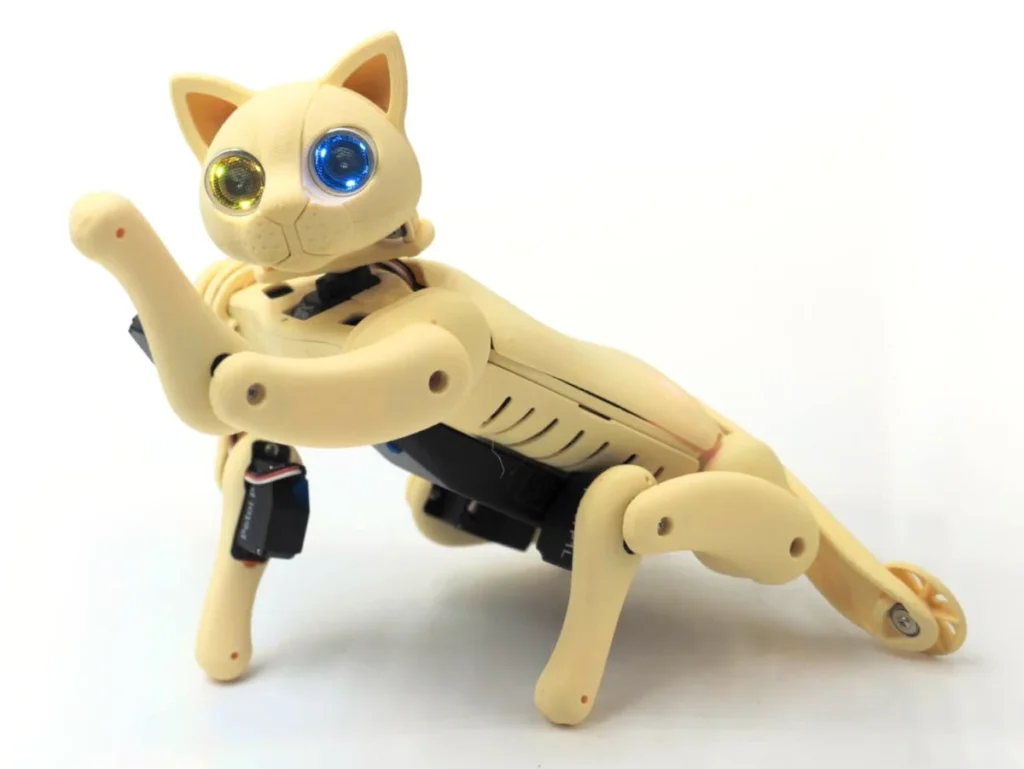
The Petoi Nybble Q, affectionately designed as a robotic cat, stands out as a sophisticated demonstration piece and an exceptional educational tool. Its aesthetic appeal, characterized by a slick 3D-printed body, immediately captures attention, making it an engaging focal point for demonstrations and an attractive platform for learning. This 3D-printed construction not only gives the robot a modern, polished look but also highlights the advantages of additive manufacturing in rapid prototyping and customization within robotics. The material choice balances durability with the flexibility required for agile movement.
At its core, the Nybble Q is packed with an array of features that make it both immediately fun and profoundly programmable. Out of the box, it responds to a variety of voice commands, allowing users to interact with it much like a living pet. This built-in voice recognition, while occasionally subject to "amusing misunderstandings" (such as "coffee table" being interpreted as "be table"), proves remarkably accurate and reliable, significantly reducing the reliance on a physical remote control like the micro:bit-powered unit. This voice interface not only enhances the user experience but also introduces users to the complexities of natural language processing and voice AI.
Beyond its impressive default behaviors, the Nybble Q truly shines in its programmability. It supports multiple coding environments, catering to a wide spectrum of skill levels. Beginners can dive into Mind+ block coding, a visual programming language that simplifies complex logic into drag-and-drop blocks, making it ideal for introducing fundamental programming concepts. Intermediate users can leverage Arduino, a popular platform for microcontroller programming, to gain deeper control over the robot’s hardware. Advanced users can utilize Python, a versatile and widely used language in robotics and AI, to develop sophisticated algorithms, integrate with external systems, and implement complex behaviors. Petoi complements these options with accompanying lessons, forming a structured curriculum that guides users through various aspects of robotics and programming.
The sensory suite of the Nybble Q is particularly robust. It features ultrasonic distance sensors, cleverly integrated as "eyes," which enable the robot to perceive its environment, detect obstacles, and navigate autonomously. This capability is fundamental for developing applications like obstacle avoidance, path planning, and rudimentary mapping. The color-changing eyes further enhance its interactive persona, providing visual cues for status, mood, or specific command acknowledgments. An onboard Inertial Measurement Unit (IMU) is crucial for maintaining balance and orientation. When the robot tumbles, the IMU detects its orientation, allowing the Nybble Q to intelligently attempt to flip itself back upright—a testament to its advanced control algorithms, even if smooth surfaces might present a momentary challenge to regaining balance.

Technological advancements in the Nybble Q include an upgraded BiBoard V1.0, an ESP32-based control board developed by Petoi, which offers enhanced processing power and connectivity (Wi-Fi and Bluetooth). Paired with improved servos, the robot achieves greater precision and smoother movements. A notable addition is servo feedback control, allowing users to manually manipulate the robot’s limbs to design custom actions and save them as executable sequences. For users seeking even greater computational prowess, the Nybble Q is designed to integrate with a Raspberry Pi, allowing for the distribution of "cognitive load" and enabling more complex AI applications, such as computer vision, advanced navigation, or machine learning tasks. The availability of structured curriculum and an active online community for troubleshooting and project sharing further solidifies Nybble Q’s position as a premium educational robotics platform.
Bittle X V2: The Versatile, Modular Canine
The Bittle X V2, Petoi’s canine-inspired robot, represents a robust and highly expandable platform, designed for users who might prioritize ruggedness and modularity. This latest iteration significantly upgrades the basic Bittle model, primarily through the inclusion of built-in voice control and an advanced ESP32-based board, aligning its core capabilities with the Nybble Q. The ESP32 microcontroller, known for its powerful processing capabilities and integrated Wi-Fi and Bluetooth, provides a solid foundation for complex robotic behaviors and connectivity.
While the Bittle X V2 lacks the ultrasonic "eyes" of the Nybble Q, its design emphasizes modularity, particularly around its head and mouth area. This allows for the integration of various sensors, including light, motion, and gesture sensors, which can be strategically placed within its mouth. This adaptability makes the Bittle X V2 highly versatile for different experimental setups and learning objectives, from simple environmental interaction to more complex human-robot interaction studies. A particularly significant optional add-on is the AI camera module, which unlocks capabilities such as object recognition, tracking, and potentially even basic facial recognition, propelling the Bittle X V2 into advanced AI and computer vision applications.
A distinctive feature of the Bittle X V2 is the option to replace its traditional head with a sophisticated robot arm. This variant transforms the quadruped from a purely locomotion-focused robot into a manipulator, capable of interacting with its physical environment through grasping and carrying. The article highlights the surprising strength of this arm, capable of picking up and tossing small toys. This capability is facilitated by "unlockable macros," pre-programmed sequences of movements that allow the arm to perform specific tasks. This feature introduces users to the principles of robotic manipulation, kinematics, and task automation. However, the trade-off between the arm’s utility and the robot’s overall nimbleness and expandability with a head is a key consideration for prospective users, as the arm configuration might be more specialized for specific tasks rather than general exploration.

The Bittle X V2 is positioned as a more durable option compared to the Nybble Q, potentially due to differences in chassis design or material choices that prioritize resilience, making it suitable for environments where it might experience more physical interaction or rougher handling. This durability factor is important for educational settings or for younger users who might subject the robot to more wear and tear.
Shared Foundations and the Maker Ethos
Both the Nybble Q and Bittle X V2 share a fundamental design philosophy that caters to the "maker" community. They are not "foolproof consumer products" in the traditional sense but rather "intermediate projects" where Petoi has handled the most challenging aspects of development—such as circuit board design and firmware—allowing users to "skip to the fun part" of programming and customization. This approach is highly empowering. While the robots arrive largely preassembled (or as kits for self-assembly), they are designed with modularity in mind. Users are not locked out of the internal hardware; components can be accessed and modified. For instance, fixing a non-wagging tail on the Nybble Q involved a simple, tool-free adjustment of a servo plug, albeit exposing a delicate ribbon cable. This accessibility to internal components allows for the addition of third-party sensors (e.g., Grove sensors), further expanding the robots’ capabilities and encouraging deeper exploration into hardware integration.
The balance between ease of use and expandability is a hallmark of Petoi’s design. The systems are robust enough to work out of the box but open enough to invite modification and advanced projects. This makes them exceptional tools for teaching not just coding, but also electronics, mechanical design, and systems integration. The structured curriculum provided by Petoi, coupled with the vast resources of an active online community, ensures that users have ample support and inspiration for their projects. The community often fills gaps in hardware documentation, offering practical solutions and innovative ideas.
Implications and Broader Impact

The Petoi Nybble Q and Bittle X V2 stand as significant contributions to the democratization of robotics. Their relatively accessible price points, combined with their advanced features and open-source nature, make high-level robotics education available to a much wider audience than ever before. For educators, these robots provide an unparalleled platform for hands-on STEM learning, transforming abstract computational concepts into engaging, interactive experiences. A teacher’s immediate interest in the Nybble Q for classroom use underscores its potential to captivate students and make learning robotics tangible and exciting.
For hobbyists and makers, these robots offer a sophisticated base for personal projects, enabling them to experiment with AI, machine learning, computer vision, and complex control systems without needing to build a quadrupedal robot from scratch. This fosters innovation and allows individuals to push the boundaries of what is possible with accessible robotics. The ability to integrate with powerful single-board computers like the Raspberry Pi further enhances their utility for research and development at an academic level.
From a market perspective, Petoi occupies a crucial niche, bridging the gap between toy robots and industrial-grade machines. They are advanced enough to offer substantial learning and project potential but remain within reach for educational budgets and dedicated hobbyists. The continuous evolution of these platforms, driven by community feedback and technological innovation, suggests a promising future for accessible robotics, where complex technologies become increasingly intuitive and customizable.
Conclusion
Whether one prefers the sleek, voice-controlled agility of the Nybble Q or the modular, potentially manipulative capabilities of the Bittle X V2, both Petoi quadrupedal robots offer an exceptional gateway into the captivating world of robotics and programming. They represent not just advanced toys, but powerful educational instruments and versatile platforms for innovation. By lowering the barrier to entry for complex robotics, Petoi empowers a new generation of engineers, programmers, and makers, proving that advanced robotics is no longer confined to specialized labs but is increasingly a hands-on experience for anyone eager to explore. As the field of robotics continues its rapid expansion, tools like the Nybble Q and Bittle X V2 will be instrumental in fostering the skills and creativity needed to shape our automated future.