The landscape of personal expression and smart environments is poised for a radical transformation with the unveiling of ChromoLCD, a groundbreaking technology developed by researchers at the Massachusetts Institute of Technology (MIT) Computer Science and Artificial Intelligence Laboratory (CSAIL). This innovative system empowers users to dynamically alter the visual appearance of everyday objects, from clothing and accessories to furniture and walls, effectively turning the physical world into a programmable canvas.
At the forefront of this pioneering work is Yunyi Zhu, a PhD student in electrical engineering and computer science at MIT, who envisions a future where static designs are replaced by fluid, on-demand aesthetics. "Imagine a world where you could change the designs you see on bags, shirts, and walls whenever you want," Zhu articulated. "Typical clothes would become customizable fashion pieces, while your humble abode could turn into a smart home." This vision is being brought to life through clever hardware that can add, modify, and later swap out imagery on personal items and decor.
The foundation of ChromoLCD lies in the application of photochromic dyes. These remarkable materials, when coated onto surfaces, can undergo dramatic color changes when exposed to specific wavelengths of intense light. Previously, CSAIL researchers had developed a device named PhotoChromeleon, which utilized a projector to activate these photochromic dyes. While PhotoChromeleon demonstrated the potential for programmable surfaces, its lack of portability limited its practical application. In response, Zhu and her team developed PortaChrome, an LED-based tool designed for reprogramming lower-resolution imagery on the go.
ChromoLCD represents a significant leap forward, merging the portability of PortaChrome with enhanced resolution and precision. This compact, printer-like device ingeniously combines the clarity of liquid-crystal displays (LCDs) with the targeted illumination capabilities of light-emitting diodes (LEDs). This synergy of technologies allows users to imprint sharp, detailed designs onto both flexible materials like textiles and rigid flat surfaces such as tables and whiteboards, provided they have been pre-treated with the photochromic dye.
The Mechanics of Dynamic Design
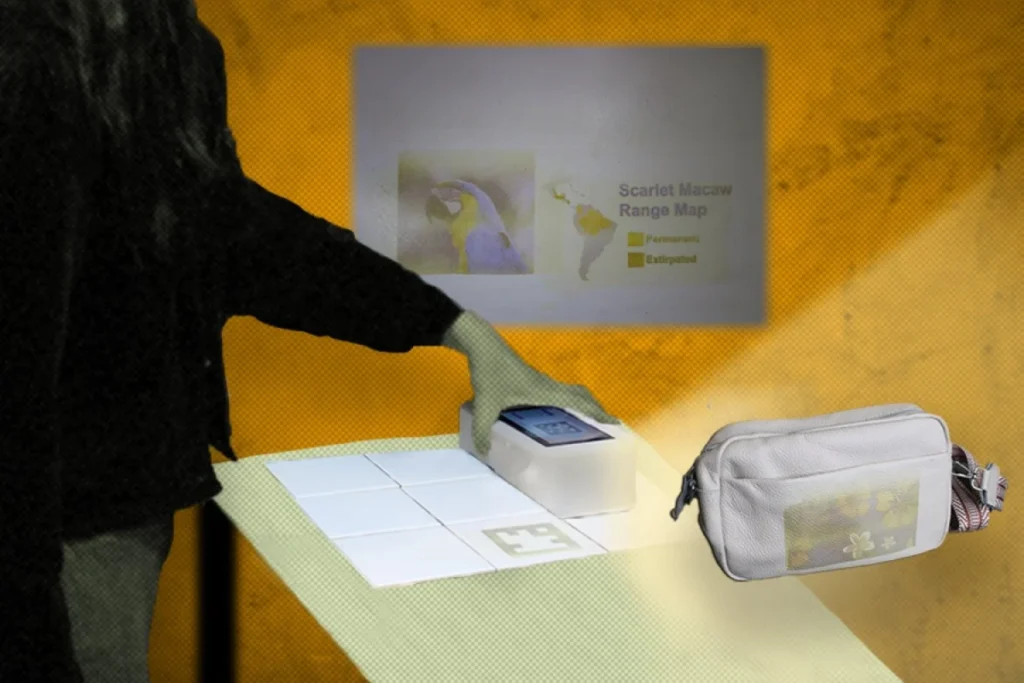
The process of transforming an object’s appearance with ChromoLCD is remarkably intuitive. After an item has been coated with the photochromic ink, a user can upload their desired image—whether a digital rose for a hoodie or a playful fish for a handbag—to the ChromoLCD device. This can be achieved through a standard Bluetooth or USB connection. The device features an integrated display menu, allowing users to preview and select their chosen design before proceeding. The user then simply stamps the ChromoLCD onto the coated surface. Within approximately 15 minutes, the programmed image materializes, offering a personalized aesthetic. The beauty of this system lies in its reversibility; if a user wishes to update the design, they can simply program a new image onto the same object.
"We see ChromoLCD as a bridge between consumers and photochromic dyes," stated Zhu, who also co-led the research paper presenting this innovation. "It’s basically a stamp, and it’s very easy to use. There are no alignment requirements, no 3D object texture creation. You just upload the image you’d like to put on your bag, place it on there, and then you’d have a personalized accessory."
The practical applications demonstrated by the ChromoLCD system are diverse and compelling. Beyond embellishing accessories with vibrant artwork, the technology has been used to embed augmented reality (AR) tags onto surfaces. For instance, an AR tag programmed onto a kitchen counter could link to a cooking tutorial, offering real-time guidance during meal preparation. Furthermore, ChromoLCD has shown its capacity to transform whiteboards into dynamic interactive displays. By programming high-resolution reference images or even interactive elements, whiteboards can evolve from static writing surfaces into blended digital and physical canvases, ideal for educational settings, collaborative workspaces, or creative brainstorming sessions.
Under the Hood: A Sophisticated Light Show
At its core, the ChromoLCD is a marvel of engineering, meticulously orchestrating a light show to achieve its programmable surface capabilities. The device’s exterior, characterized by a sleek white shell, conceals a powerful internal architecture. This includes a central computer chip, a sophisticated backlight unit comprising ultraviolet (UV) and red, green, and blue (RGB) LEDs, and a high-resolution LCD panel.
The programming process begins with the generation of a black-and-white video that precisely maps the intensity of each pixel in the selected image. This video dictates where the photochromic dye will be darkened or lightened. Following this, the UV LEDs play a crucial role in saturating the photochromic dye, initiating the color-changing process. Subsequently, the RGB LEDs are employed to precisely colorize each pixel, bringing the digital image to life on the physical surface. This intricate interplay of light, akin to adjusting the natural light in a room to reveal colors, operates at specific frequencies precisely controlled by the LCD panel to ensure accurate and high-resolution image transfer onto the target object.
Accessibility and Future Potential
A significant aspect of the ChromoLCD technology is its accessibility. The researchers highlight that the components required to build a ChromoLCD device are readily available, suggesting the potential for individuals to replicate the technology at home. This democratization of programmable surface technology could lead to an explosion of creative applications. Zhu elaborated on this potential: "A wall in your office can show your family’s pictures when you miss them, or perhaps a doormat can show a customized greeting for each of your guests. It’s sort of like turning the world into your canvas."
The development of ChromoLCD, alongside its predecessors PortaChrome and PhotoChromeleon, marks a significant milestone in CSAIL’s ongoing efforts to enable the digitization of our physical surroundings. The next frontier for these researchers involves enhancing the creative process itself, moving beyond simple image uploads. Leveraging recent advancements in artificial intelligence for texture generation, the team envisions a future where users can make simple verbal requests, such as "turn a cup into a medieval-style tankard," and have the AI system generate the appropriate design. This could be facilitated through smartphone cameras or augmented reality interfaces, seamlessly integrating AI-powered design into the physical world.
Scaling Up and Broader Implications
Beyond personal items, CSAIL researchers are actively exploring methods to apply photochromic technology to larger surfaces. A prototype of a wall-roller reprogrammer is currently under development, designed to apply extensive designs to walls in a manner akin to painting. Furthermore, the team is investigating dynamic application methods, including swiping and ironing motions, and the integration of this technology into robotics.
The potential for robots to communicate visually through reprogrammable surfaces is particularly intriguing. Imagine a robotic vacuum cleaner, like a Roomba, leaving a clearly displayed, high-resolution message on the floor indicating which areas it has cleaned. This visual communication could significantly enhance inter-robot coordination and human-robot interaction in complex environments.
Narges Pourjafarian, a postdoctoral researcher at Northeastern University who was not involved in the study, offered her perspective on the significance of ChromoLCD. She emphasized that the technology represents more than just an incremental improvement in resolution. "It reframes monochromatic LCD panels as wavelength-selective fabrication tools, rather than merely display endpoints," Pourjafarian noted. "This approach expands how we think about reprogrammable surface appearance, enabling high-resolution, reconfigurable graphics to be embedded directly into physical environments without the need for stationary projection enclosures. It opens a path toward compact, portable augmentation of garments, countertops, and shared surfaces."
The research paper detailing the ChromoLCD system was authored by six CSAIL affiliates: MIT undergraduates Qingyuan Li (co-lead author), Katherine Yan, Alex Luchianov, and Eden Hen; Harvard University graduate student and former visiting researcher Emily Guan; and MIT Associate Professor Stefanie Mueller, a principal investigator at CSAIL and senior author on the work. The findings are slated for presentation at the prestigious ACM International Conference on Tangible, Embedded, and Embodied Interaction, underscoring the academic and technological significance of this groundbreaking development. The successful integration of dynamic visual customization into everyday objects promises to reshape how we interact with our environments, fostering a more personalized, adaptable, and visually engaging world.