For the past three years, Citizen has been an integral partner in "Windup in a Lake," an annual diving event held on Lake Michigan that serendipitously coincides with the Windup Watch Fair in Chicago. This tradition has seen celebrations of Promaster milestones, legendary performances, and aquatic-themed parties. However, the 2026 iteration of this event held a particularly significant milestone: the 50th anniversary of Citizen’s groundbreaking Eco-Drive technology. This year’s expedition focused on the very essence of this innovation – light – by taking Citizen’s light-powered watches into the dark depths of Lake Michigan.

The Genesis of Eco-Drive: A Half-Century of Light-Powered Horology
Citizen’s Eco-Drive technology, a sophisticated movement capable of harnessing power from any light source, has quietly revolutionized the watch industry. Its origins trace back to the energy crisis of the 1970s, a period that spurred a search for sustainable and innovative solutions. Citizen’s ambition was to create a timepiece that did not rely on disposable batteries, a vision that materialized in 1976 with the world’s first analog watch powered by light. This pioneering achievement laid the foundation for the Eco-Drive technology that now underpins approximately 80% of Citizen’s watch production. Beyond its technological prowess, Eco-Drive boasts an impressive environmental credential, having diverted over 100 million batteries from landfills globally.
"Born in the wake of the 1970s energy crisis, our vision was remarkably simple, yet ambitious. Rather than relying on disposable batteries, we set out to build a movement powered by any light. That vision became reality in 1976 with the world’s first light-powered analog watch, laying the foundation for what would eventually become Eco-Drive," stated Neall Brick, Director of Merchandising at Citizen. "Five decades later, the technology is the backbone of Citizen’s collection, powering roughly 80% of the watches we produce. Along the way, Eco-Drive has helped keep more than 100 million batteries out of landfills, a result we’re deeply proud of."

The Mission: Illuminating the Depths
The theme for this year’s "Windup in a Lake" was distilled to its core: light. To execute this concept, participants were equipped with OrcaTorch’s powerful dive lights and Ombraz armless sunglasses, designed to mitigate surface glare. The objective was clear: to submerge Citizen’s light-powered watches into the dark waters of Lake Michigan, demonstrating their ability to function and even thrive in low-light environments.
An Unforeseen Voyage: Challenges and Determination
The expedition, despite its straightforward thematic premise, unfolded with the palpable tension of a covert operation. A delayed departure and an eleventh-hour change of captain injected an element of urgency into the proceedings. As the team prepared to set sail aboard the SeaQuest II, the docks buzzed with a concentrated, "go-time" energy. Observers likened the scene to a special forces deployment, with scuba cylinders, fins, masks, and regulators being meticulously secured. The setting sun added another layer of pressure, necessitating swift action.

The journey across Lake Michigan proved to be more arduous than anticipated. Upon clearing the harbor, the SeaQuest II was met with a formidable headwind and unusually rough waters. The destination was the Wells Burt, a 19th-century bulk carrier resting over an hour up the Chicago coastline. The relentless chop significantly affected many aboard, demanding a focused and resilient mindset simply to endure the transit. The turbulent conditions underscored the importance of secure gear, a test that the Ombraz sunglasses, with their integrated cord system, passed with flying colors.
The Wells Burt: A Submerged Time Capsule
Upon anchoring above the wreck of the Wells Burt, the team quickly distributed the dive lights and the array of Citizen watches. The collection featured a diverse range of Promaster models, including the new 42mm Promaster WaveTracker, which offers tide data for 203 cities worldwide, and the 39mm Promaster Land GMT, rated for 200-meter water resistance. Also showcased were various Promaster Dive models, such as the new olive green 40.6mm Promaster Dive with a skin diver-inspired rubber strap, the ISO-rated 46mm Promaster Dive E365 with a year-long power reserve, and the 37mm Promaster Dive on a stainless steel bracelet with a striking sunray-textured red dial.

The common thread among these diverse timepieces was their shared Eco-Drive technology, capable of drawing power from any ambient light – even the concentrated beam of a dive torch piercing the murky depths.
A Vintage Aqualand’s Unexpected Journey
Among the participants was James Stacey of The Grey NATO podcast, who opted to dive with a vintage mid-1990s Aqualand Duplex C506-Q00711TA. His dive was made even more poignant by the fact that U.S. Coast Guard and commercial diving veteran Ben Lowry had gifted him the original bracelet for the watch the previous evening. Stacey proudly wore it, the dive extension fitted over his thick exposure suit.

The plan was to convene on the surface for a group photograph before descending. As the divers bobbed in the choppy water, awaiting the stragglers, a sudden exclamation cut through the air. "It’s gone!" Stacey cried out. The aging dive extension had failed, and his beloved Aqualand had slipped from his wrist, vanishing into the depths. He managed to glimpse it as it sank like a torpedo, just in time to see it disappear. A collective sigh of dismay rippled across the surface. The group photo was taken, the mood subdued but not entirely defeated, and the divers proceeded to descend.
Exploring the Wells Burt: Light in the Darkness
Beneath the surface, the conditions were surprisingly manageable. The Wells Burt, resting at a maximum depth of approximately 40 feet, offered visibility of around 25 feet. Despite the characteristic turbidity of Lake Michigan, sufficient ambient green light filtered down to power the Citizen Eco-Drive watches. This filtered light, combined with the sweeping beams of the OrcaTorches, vividly illuminated the 19th-century timbers of the shipwreck.

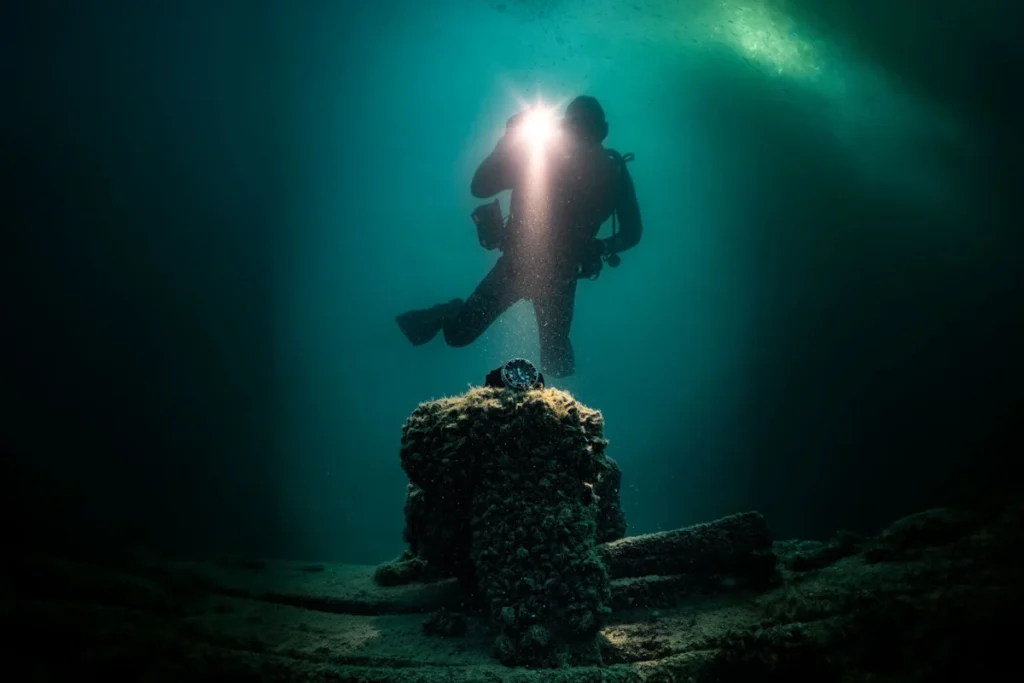
Several team members had specific photographic and videographic assignments. Chris "Scotty" Scott was documenting the dive with video, while Navy diver Brock Stevens and photographer Geoff Gerritts focused on capturing compelling imagery. Stevens, in particular, found a timber protruding from the wreck like a pillar. He artfully placed his Citizen Promaster Dive 300m atop it and signaled another diver to illuminate it with a torch. The resulting photograph perfectly encapsulated the confluence of light, advanced horology, and the deep.
As the divers’ heart rates stabilized, they navigated the gloom with their dive lights, entering a scene seemingly frozen in time. The Wells Burt, a grand three-masted schooner that once plied the Great Lakes maritime trade routes, lay fractured but majestic on the lakebed. Narrow beams of artificial light played across massive oak frames, thick hull planking, and a stout iron capstan still standing near the bow. Rows of deadeyes stared out, remnants of a bygone era. The divers could almost visualize the ship’s lines, strewn about the deck from her bow to the shattered remnants of her steering gear, as if the fierce gale that claimed her in 1883 had only just subsided. Hovering in the quiet, emerald drift above the cavernous cargo hold, the team glided alongside this beautiful, tragic monument to the golden age of sail.

An Unforeseen Discovery: A Glimmer of Hope
As the dive neared its conclusion, Geoff Gerritts, with a comfortable 1000 psi remaining in his cylinder, decided to take a final, leisurely lap around the wreck, free from the constraints of his camera lens. While navigating along the port side of the wreckage, a glint of metal caught his eye. Approximately a third of the way back from the bow, half-buried in the fine silt, lay a watch.
Gerritts paused. He had understood that Stacey had dropped a dive torch on the surface, making the discovery of a watch perplexing. For a fleeting, surreal moment, he considered Great Lakes maritime law, which strictly prohibits the removal of historical artifacts from shipwrecks. His logical mind quickly asserted itself: 19th-century sailors would not have been wearing Aqualands. He carefully scooped the watch from the silt, secured it in his drysuit pocket, and began his ascent.

The Improbable Recovery: A Moment of Disbelief
Back on the boat, a relaxed camaraderie settled over the team after a successful dive. However, some divers were already discussing the possibility of re-gearing for a blind search-and-recovery mission to locate Stacey’s lost watch. Geoff Gerritts was among the last to board. As he disembarked and began shedding his gear, he overheard the recovery plans with a sense of confusion.
"Wasn’t this supposed to be one dive?" Geoff inquired.

"James lost his watch!" several voices explained over the wind.
Geoff stopped, a realization dawning. "You lost your watch!?"

"Yeah," James replied, still visibly disappointed. "It just popped off my wrist."
Geoff paused, then reached into his pocket and produced the gleaming Aqualand. "Was it this one??"

The boat erupted in cheers. The sheer improbability of a watch falling from the turbulent surface, landing precisely within the port side of the wreckage, and then being discovered by a diver taking a casual final lap, was astounding. Miraculously, the Aqualand was not only ticking normally but its dive computer had faithfully logged the entire dive profile, having "explored" the bottom for a duration significantly longer than its owner.
A Celebration of Light, Both Natural and Artificial
As the SeaQuest II returned to the dock, the setting sun cast a spectacular array of colors across the Chicago skyline. Just as darkness began to envelop the lake, fireworks erupted along the shoreline, illuminating the night as if perfectly timed. Citizen’s Eco-Drive celebration of light had reached its crescendo, leaving the boat filled with divers sharing grins of satisfaction and disbelief over the extraordinary recovery.

Ultimately, Windup in a Lake 2026 served as a profound metaphor for Eco-Drive itself. The expedition plunged into the cold, turbid darkness of Lake Michigan, bringing five decades of light-powered innovation into the gloom. From modern Promaster watches illuminated by dive torches against the backdrop of a 19th-century shipwreck, to a miraculously recovered Aqualand meticulously logging its own solitary journey through the depths, the day underscored the enduring resilience of Citizen’s vision. Even in the deepest, darkest conditions, fifty years of Eco-Drive legacy consistently finds the light.